
In the volatile world of cryptocurrency, stability is the ultimate luxury. For investors in Vietnam—from university students in Hanoi to business owners in Ho Chi Minh City—stablecoins like USD Coin (USDC) have become a vital tool. They offer a safe harbor from the wild price swings of Bitcoin or Ethereum. But how do you know your digital dollar is actually worth a dollar? The answer lies in USD Coin USDC reserve audits.
Trust is the currency of the future. After the collapse of several high-profile crypto projects in recent years, the demand for transparency has never been higher. You need to know that for every USDC token in your digital wallet, there is a real US dollar (or equivalent asset) sitting in a regulated bank account.
This comprehensive guide will strip away the complex financial jargon surrounding reserve audits. We will explain what they are, why Circle (the issuer of USDC) is setting the industry standard, and how you can verify the safety of your funds. Whether you are using crypto for remittances, savings, or trading, understanding these audits is your first line of defense.
What is a Stablecoin Reserve Audit?
To understand audits, you first need to understand the promise of a stablecoin. When you buy 1 USDC, you are promised that you can always redeem it for $1 USD. This peg is maintained by "reserves"—a pile of cash and safe assets held by the issuer.
A reserve audit (or more accurately, an attestation) is a check-up performed by an independent third-party accounting firm. Their job is to look at the issuer's bank accounts and verify two things:
- Total Supply: How many USDC tokens are currently in circulation?
- Total Reserves: How much money does the issuer actually hold in the bank?
If the Total Reserves are equal to or greater than the Total Supply, the stablecoin is "fully backed." If not, there is a risk of a "de-peg," where the value drops below $1.
Why This Matters for Vietnamese Investors
Vietnam has one of the highest crypto adoption rates in the world. Many users hold their life savings or business capital in stablecoins to hedge against local currency inflation. If a stablecoin fails, it’s not just a bad investment—it’s a financial catastrophe for families. Understanding USD Coin USDC reserve audits ensures you aren't holding an empty promise.
The Circle Standard: How USDC Transparency Works
Circle, the company behind USDC, has positioned itself as the "regulated" and "transparent" alternative in the stablecoin market. Unlike some competitors who have faced scrutiny for opaque reserves, Circle publishes monthly attestations.
The Composition of USDC Reserves
It is not enough to just have "assets." The quality of those assets matters. If a stablecoin is backed by risky corporate debt, it could collapse during a market downturn.
Circle’s reserves are conservatively managed. As of the latest reports, they consist primarily of:
- Cash: Held in regulated financial institutions.
- Short-term U.S. Treasuries: These are considered one of the safest assets in the world, backed by the US government.
This conservative mix ensures liquidity. Even if everyone wanted to sell their USDC at once, Circle could easily sell these safe assets to pay them back.
The Role of Deloitte
Trust, but verify. Circle does not grade its own homework. Their monthly reserve reports are reviewed by Deloitte, one of the "Big Four" accounting firms globally. When you see a report stamped by Deloitte, it carries significant weight. It means a reputable auditor has independently verified the numbers.
You can view these reports directly. However, for a seamless experience where safety is prioritized, many Vietnamese investors choose platforms that integrate these verified assets. You can trade USDC with confidence on HIBT, knowing we prioritize listing transparent assets.
Attestation vs. Audit: Knowing the Difference
In the crypto industry, words matter. You will often hear the terms "audit" and "attestation" used interchangeably, but they are legally different.
- Audit: A comprehensive examination of a company's entire financial health, internal controls, and risks. This usually happens once a year.
- Attestation: A specific snapshot in time. The accountant verifies that at this exact moment (e.g., 11:59 PM on the last day of the month), the funds in the bank matched the tokens issued.
While Circle provides monthly attestations, they also undergo annual financial audits as part of their regulatory requirements filing with the SEC (if they were public) or other regulatory bodies. For the average user, the monthly attestation provides the regular pulse check needed to feel secure.
Case Study: The "De-Peg" Panic and Why Reserves Saved the Day
To understand the value of USD Coin USDC reserve audits, we must look at a moment of crisis.
In March 2023, Silicon Valley Bank (SVB) collapsed. It was revealed that Circle had approximately $3.3 billion of its reserves stuck in that bank. Panic spread instantly. The price of USDC de-pegged, dropping to around $0.87 on some exchanges because traders feared those billions were lost forever.
The Transparency Win:
Because Circle was transparent about exactly where their money was, the market could calculate the risk.
- Circle admitted the exposure immediately.
- They clarified that the remaining ~90% of reserves were safe in other banks and U.S. Treasuries.
- They pledged to cover any shortfall using corporate resources.
Because the reserves were audited and transparent, confidence was restored quickly once the US government stepped in to guarantee SVB deposits. USDC regained its $1 peg within days. Compare this to opaque algorithmic stablecoins (like TerraUSD) which collapsed to zero because there were no real reserves to back them up.
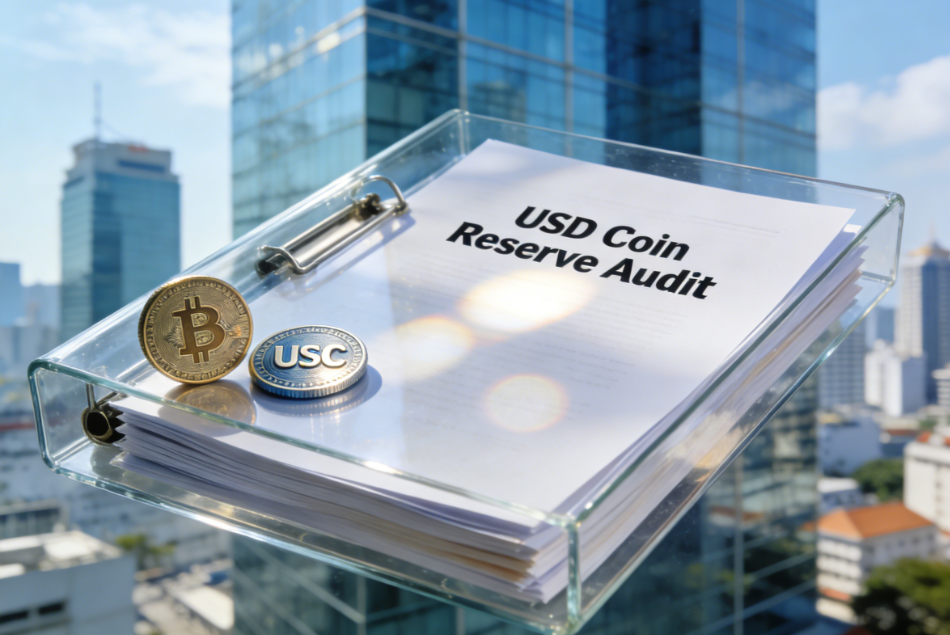
How to Read a Reserve Report
You don't need a degree in finance to check the safety of your money. Here is a step-by-step guide on how a Vietnamese investor can read a monthly USDC report.
Step 1: Check the Date
Ensure you are looking at the most recent report. In the fast-moving crypto world, a report from six months ago is ancient history.
Step 2: Compare the Two Big Numbers
Look for the "Fair Value of Assets" and the "Total USDC in Circulation."
- Good Sign: Assets > Circulation (Over-collateralized)
- Okay Sign: Assets = Circulation (Fully backed)
- Bad Sign: Assets < Circulation (Under-collateralized)
Step 3: Look at the Asset Breakdown
Are they holding cash? U.S. Treasury bills? Or "other" undefined commercial paper?
- High Quality: Cash, US Treasuries.
- Lower Quality: Corporate bonds, other crypto assets, loans to other companies.
Circle’s reports consistently show a heavy reliance on the "High Quality" category, which is why it is favored by institutional investors.
Why Vietnamese Investors Prefer USDC
In Vietnam, USDT (Tether) has historically been the dominant stablecoin due to early adoption. However, we are seeing a significant shift toward USDC among educated investors and businesses.
1. Regulatory Compliance
As Vietnam explores its own framework for digital assets, investors are becoming wary of unregulated tools. USDC is issued under US money transmitter laws, providing a layer of legal safety that appeals to risk-averse savers.
2. Banking Integration
For businesses in Ho Chi Minh City doing international trade, USDC serves as a bridge. Its transparent reserves make it easier to explain to partners and auditors compared to less transparent alternatives.
3. DeFi Safety
Many Vietnamese users participate in Decentralized Finance (DeFi) to earn yield. In DeFi protocols, the stability of the collateral is king. If the stablecoin backing your loan crashes, you get liquidated. USDC’s transparent USD Coin USDC reserve audits make it the preferred collateral for many lending platforms.
Secure your financial future by choosing the right assets. You can easily convert your local currency or other cryptos into USDC using the HIBT mobile app, designed specifically for the Vietnamese market.
The Risks: Is USDC 100% Safe?
No financial asset is without risk. Even with perfect audits, there are factors to consider:
- Counterparty Risk: The money is in banks. If the banking system itself fails (like the SVB example), reserves can be frozen.
- Regulatory Risk: The US government could change the rules on stablecoins, affecting how Circle operates.
- Censorship: Because USDC is centralized and regulated, Circle has the power to "freeze" specific addresses at the request of law enforcement. This is a feature for regulators, but a risk for privacy advocates.
However, compared to the risk of holding volatile assets or using unaudited stablecoins, these risks are generally considered managed and acceptable for most investors.
Strategies for Using USDC in Vietnam
Now that you understand the safety mechanisms, how should you use USDC in your portfolio?
1. The "Digital Dollar" Savings Account
Inflation can erode the purchasing power of the VND. Many Vietnamese investors convert a portion of their savings into USDC.
- Strategy: Treat USDC like a USD savings account. It preserves value against local currency fluctuations.
- Platform: Use a secure exchange like HIBT to hold your assets.
2. The "Dry Powder" Strategy
Smart traders keep a percentage of their portfolio in stablecoins, ready to buy the dip when the market crashes.
- Strategy: Keep 20-30% of your portfolio in USDC. When Bitcoin or Ethereum prices drop, you have funds ready to deploy instantly without waiting for bank transfers.
- Execution: With HIBT, you can execute these trades in seconds on your mobile phone, never missing an opportunity.
3. Remittances and Payments
Sending money to family in rural Vietnam? Using bank wires is slow and expensive.
- Strategy: Have the sender convert fiat to USDC and send it to your wallet. You receive it in seconds with minimal fees.
- Verification: Before accepting large amounts, check the latest reserve audit to reassure yourself of the asset's health.
The Future of Reserve Transparency
The standard set by USD Coin USDC reserve audits is pushing the whole industry forward. We are moving toward "Proof of Reserves" (PoR), where cryptographic proof is used to verify reserves in real-time, 24/7, rather than just a monthly snapshot.
Chainlink and other oracle providers are working on systems where you can check the bank balance of a stablecoin issuer directly on the blockchain. Circle is at the forefront of these innovations.
For Vietnam, this future means more financial autonomy. It means that a developer in Da Nang has access to the same high-quality, audited financial infrastructure as a banker in Wall Street. It levels the playing field.
Conclusion
In the digital economy, transparency is not optional—it is essential. USD Coin USDC reserve audits provide the proof required to build trust in a trustless system. For Vietnamese investors, shifting focus from "yield chasing" to "asset safety" is the hallmark of a maturing market.
By understanding what backs your digital dollars, you protect your hard-earned wealth. Circle’s commitment to monthly attestations by top-tier accountants like Deloitte offers a level of security that is rare in crypto.
Don't leave your financial future to chance. Choose assets that respect your need for transparency. Choose platforms that prioritize your security.
Empower your investments. Trade with clarity.
About the Author
Dr. Tuan Le
Blockchain Auditor & Monetary Policy Researcher
Dr. Tuan Le is a leading figure in the intersection of traditional accounting and blockchain technology. Holding a Ph.D. in Forensic Accounting from the National Economics University, he has published over 40 peer-reviewed papers on stablecoin collateralization and digital asset auditing standards. Dr. Le has served as the lead auditor for three major DeFi protocols and frequently advises fintech startups in Southeast Asia on regulatory compliance and transparency frameworks. He is currently an independent researcher and does not hold a position at HIBT.