
Introduction: Why is CFX Worth Your Technical Research and Time?
In the cryptocurrency market, most public chain tokens tell a remarkably similar story: blazing fast speeds, near-zero transaction fees, an expanding ecosystem, and a revolutionary future. However, CFX stands apart. The network behind it, Conflux Network, didn't capture the spotlight purely off a standard "performance narrative." Instead, it simultaneously commands three highly distinct labels: a regulatory-compliant Chinese public chain, a high-performance Layer 1, and an essential piece of Asian Web3 infrastructure.
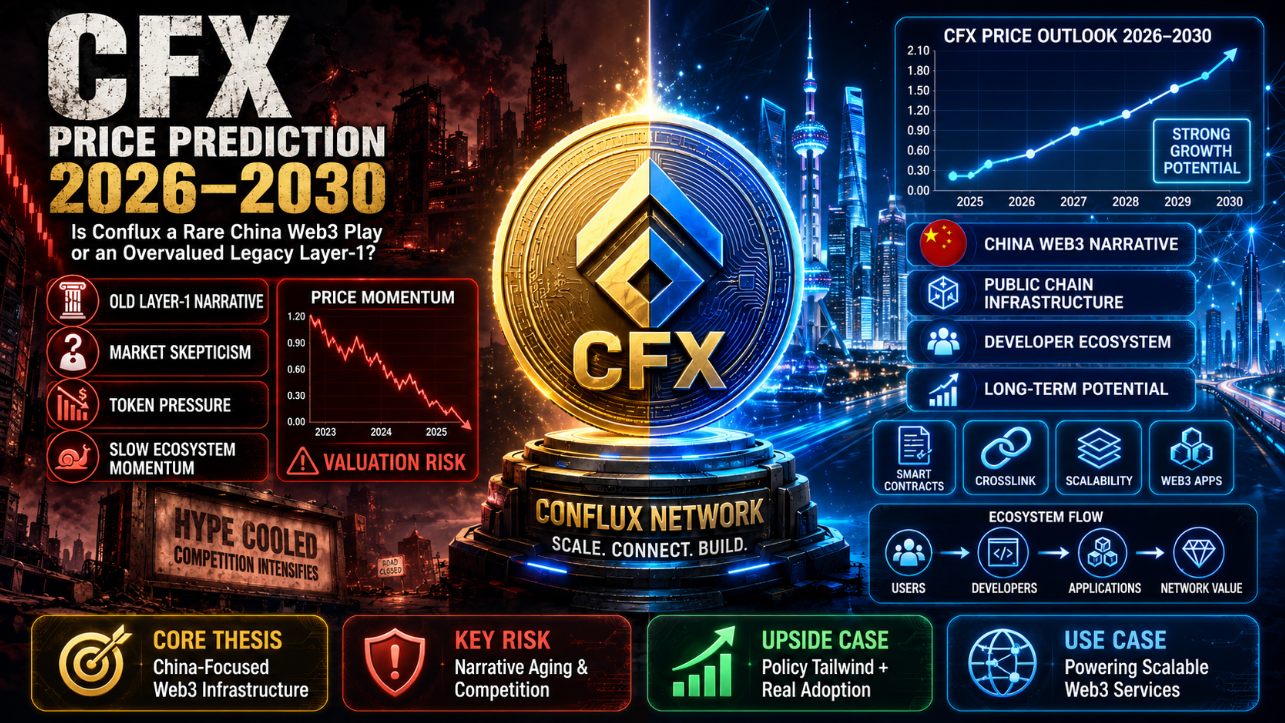
This is exactly why predicting the price of CFX requires looking far beyond simple technical chart setups. Its valuation is tightly bound to the macro Bitcoin liquidity cycle, but it is equally sensitive to localized, high-impact variables like mainland China regulatory shifts, Hong Kong's web3 compliance frameworks, real-world asset (RWA) tokenization, cross-border digital financial settlements, and organic on-chain dApp velocity.
Conflux officially frames its ecosystem as a multi-chain network capable of seamlessly bridging creators, communities, and markets, emphasizing its unique "cross-border, cross-protocol" connectivity. Crucially, the protocol positions itself as one of China's premier "compliant, public, and permissionless" blockchains. This alone pushes its strategic and narrative trajectory in a completely different direction than global alternative Layer 1s like Sui, Aptos, TON, or Avalanche.
By May 2026, the price of CFX has been hovering around the $0.05 mark. CoinMarketCap data shows a circulating supply of approximately 5.2 billion CFX, establishing its market capitalization in the $280 million tier. This market standing confirms that CFX is no longer a hidden, low-liquidity micro-cap, yet it reveals that the asset is trading at a steep discount relative to its major 2023 cyclical highs.
The goal of this article is not to distribute a hollow, speculative target price. Instead, it constructs a comprehensive analytical framework: identifying what logically drives CFX upward, what forces weigh it down, mapping out a year-by-year cyclical projection for 2026–2030, and detailing strict risk mitigation guidelines for retail allocators.
Chapter 1: Demystifying Conflux to Forecast the Token's Economic Bounds
1.1 What Class of Public Chain is Conflux? How Does Tree-Graph Outpace Traditional Architectures?
Conflux operates fundamentally as a high-throughput Layer 1 public blockchain, featuring a unique technical foundation known as the Tree-Graph consensus structure. Traditional proof-of-work or proof-of-stake blockchains typically execute under a "longest-chain rule." In those legacy structures, when multiple blocks are mined or validated concurrently, only a single chain is recognized as the valid state; competing parallel blocks are forcefully discarded as orphaned blocks, leading to massive wasted computational resource and throughput bottlenecks.
Conversely, Conflux's Tree-Graph architecture is explicitly designed to safely incorporate multiple concurrently generated parallel blocks directly into a single, unified ledger, drastically amplifying the network's processing throughput.
Conflux’s official technical documentation notes that its Tree-Graph consensus replaces legacy longest-chain paradigms with a proprietary framework called the GHAST rule. Under this structure, block selection does not blindly evaluate a singular linear chain; instead, it analyzes the cumulative compute weight embedded within sub-trees. This design pivot enables the system to run at an exceptionally high block-generation frequency while maintaining robust security parameters against liveness-based network attacks. Official technical outlines confirm that Conflux natively supports a block generation frequency of up to 2 blocks per second.
Put simply, Conflux is tackling a classic distributed ledger bottleneck: How to scale transaction processing capabilities without completely sacrificing decentralization or protocol security.
This technical architecture forms the primary floor of CFX's long-term valuation: if Conflux's core scalability engineering translates into deep, sustainable commercial applications, the CFX token captures an independent fundamental valuation floor. If the underlying technology remains confined to research papers and promotional marketing campaigns, the asset price will inevitably decay back into standard speculative volatility.
1.2 Unpacking the Utility Sinks of the CFX Token
As the native cryptographic utility asset of the Conflux Network, CFX serves several essential functions across the protocol economy:
- On-Chain Transaction Settlements: Users interacting with the network, executing transfers, or invoking smart contracts are mandated to pay execution fees settled directly via CFX Gas.
- Consensus Staking & Security: Conflux incorporates native, built-in staking mechanisms to secure decentralized consensus. Token holders can stake their CFX directly or delegate capital to validators to help secure the distributed network while capturing predictable annualized emissions.
- Governance & Ecosystem Grants: CFX serves as the voting asset driving protocol governance, developer subsidy distributions, resource allocation parameters, and localized ecosystem incentives.
- Storage Collateralization (Storage-Collateral Model): Distinct from traditional public networks that evaluate fees solely off computational execution (Gas), Conflux’s economic model incorporates a structural storage-collateral framework. Users or smart contracts occupying permanent on-chain state storage must programmatically lock up CFX as collateral. Third-party analyses track how this storage model directly links real-world dApp deployment velocity to systemic token lockups, creating a dynamic sink for the asset.
Consequently, CFX cannot be categorized as a pure, utility-less governance token, nor does it operate as a speculative meme coin. Its market pricing model tracks the economic profile of a "public chain resource utility asset." Elevated on-chain network velocity drives a direct expansion in structural demand for CFX; conversely, a stagnant or empty ecosystem allows the market to aggressively compress the asset's valuation multiples.
1.3 The "Compliant Chinese Public Chain" Narrative: Generational Moat or Systemic Risk?
This singular label represents Conflux’s most powerful point of market differentiation, yet it introduces its most intense structural uncertainty.
- The Moat: Should mainland China, Hong Kong, or the broader Asian digital financial settlement sectors demand an open, permissionless public blockchain infrastructure capable of aligning with localized regulatory boundaries, Conflux is uniquely positioned to capture that institutional market share. Historic milestones, such as its partnership with China Telecom to manufacture blockchain-backed BSIM cards, showcase its ability to interface with state-backed enterprise entities.
- The Risk: Digital asset trading, speculatory capital routing, and secondary exchange operations remain subject to incredibly strict oversight within mainland China. Regulatory tolerance for institutional blockchain development does not guarantee that secondary market spot token prices will benefit. Conflux can establish a highly compliant operating space across enterprise digital IDs, cross-border financial data infrastructure, and state-backed RWA tokenization rails, but the tradeable CFX token will always remain subject to global exchange liquidity shifts, regulatory compliance barriers, and shifting market emotion.
Therefore, CFX’s "China Narrative" is far too complex to be categorized as a simple net-positive or a net-negative indicator. The accurate framing is clear: The long-term valuation ceiling of CFX is dictated by the market's imagination of a compliant, Asian Web3 infrastructure hub; its absolute valuation floor is strictly constrained by shifting regulatory boundaries and verified on-chain application demands.
1. supply Curve and Inflationary Dynamics
CFX does not incorporate an unalterable, fixed supply cap like Bitcoin's 21 million limit. CoinMarketCap data reveals a circulating supply fluctuating around 5.2 billion tokens, with its maximum supply parameters left uncapped to accommodate ongoing network staking emissions and developer ecosystem incentives.
This structural reality dictates that allocators cannot evaluate the token solely on a low unit price. You must closely track circulating market capitalizations, fully diluted valuations (FDV), future token unlocking clips, staking emission curves, and the net rate of on-chain programmatic token burning.
For CFX to sustain a multi-year structural uptrend, its token economy must consistently satisfy a strict equilibrium: the velocity of newly distributed token supply and ecosystem grant emissions must be continuously outpaced by structural on-chain sinks—such as deep validator staking pools, storage-collateral lockups, and transactional gas fee burns. If demand metrics expand slower than supply distribution velocity, CFX will face the classic infrastructure drag: the underlying project remains functional, while the token price undergoes long-term structural markdown.
Chapter 2: Five Core Variables Dictating CFX’s Price Ceilings and Floors
2.1 Macro Liquidity: The Transmission Architecture from Bitcoin to CFX
As an altcoin-tier public chain asset, CFX is structurally incapable of decoupling from the overarching macro Bitcoin liquidity cycle.
When global crypto liquidity expands and market risk appetites rise, capital trends sequentially: first into BTC and ETH, then cascading downward into major alternative Layer 1 and Layer 2 infrastructure assets, before ultimately rotating into specialized themes like AI, RWAs, GameFi, and high-beta meme networks. CFX sits directly within this rotational path. The macro liquidity transmission architecture maps out as follows:
[BTC Expands] ➔ Market Risk Appetite Scales ➔ Altcoin Liquidity Surges ➔ Asian / RWA Narratives Re-Price ➔ Capital Targets CFX
Conversely, the moment Bitcoin enters a macro correction or markdown phase, the transmission flips violently: global liquidity contracts -> investors aggressively liquidate high-beta, volatile assets in favor of capital preservation -> mid-cap public chain tokens suffer outsized sell-offs -> CFX, despite its unique compliance narrative, faced synchronized programmatic liquidations. Therefore, forecasting CFX requires auditing the structural position of the macro Bitcoin cycle ahead of protocol-specific updates.
2.2 Ecosystem Adoption: Evaluating On-Chain DeFi, GameFi, and RWA Density
The ultimate valuation trap for any public blockchain infrastructure is engineering an advanced network that hosts no organic ecosystem activity.
According to data compiled by DeFiLlama, Conflux's current native on-chain DeFi density remains relatively small. Metrics reveal that Conflux hosts a native stablecoin market capitalization of approximately $5.69 million, accompanied by modest 24-hour decentralized exchange (DEX) turnover tracking near $31,000, and nominal 24-hour protocol fee generation of around $79. These real-time figures confirm that Conflux's internal financial velocity is currently limited, sitting far below the dominant liquid economic loops found on networks like Ethereum, Solana, BSC, Arbitrum, or Base.
This reality places clear upward pressure on the CFX token price: For the asset to move past short-term speculatory pumps and establish a sustained, structural bull trend, the Conflux Network must prove it can onboard sticky enterprise users, locked capital value, and consistent transactional velocity.
The absolute key ecosystem growth sectors to track over the 2026–2030 cycle include:
- Real-world asset (RWA) tokenization and compliant regional financial settlement rails.
- The deployment scale of Hong Kong's Web3 regulatory sandbox pilots.
- Asian cross-border payment routing and B2B asset ledger clearing.
- Consumer-facing mobile wallet activations, infrastructure-level BSIM card scaling, and decentralized identity (DID) frameworks.
- Foundational DeFi infrastructure depth, specifically highly liquid DEX architectures, compliant yield primitives, decentralized lending markets, and scalable native stablecoin issuers.
2.3 Regulatory Policy: Shifting Asian Compliance Mandates
Because CFX is deeply intertwined with the "China Web3" narrative, regional regulatory policy shifts function as a significantly more volatile variable for this token than for standard global public chains.
Should Hong Kong aggressively accelerate its legislative rollouts for compliant stablecoins, offshore RWA tokenization frameworks, and licensed digital asset exchange structures, Conflux stands to capture a massive re-pricing wave as a premier Asian compliant infrastructure player. Conflux’s official communications frequently track its developmental exploration across offshore RWA pilots and regional digital finance sandboxes. However, long-term allocators must continuously audit the translation of these narrative headlines into hard, verifiable on-chain metrics.
Conversely, if regional regulatory mandates tighten unexpectedly, or if the market concludes that the compliant narrative cannot translate into direct utility-based buying pressure for the tradeable CFX token, speculative capital will rapidly exit the position. Policy shifts do not directly assign a numerical price to CFX; they dictate the macro valuation multiple the market is willing to assign to Conflux's future addressable market.
2.4 Competitive Landscape: Identifying Conflux's Moat Against Sui, Aptos, and TON
Conflux operates within a hyper-competitive Layer 1 infrastructure market. Sui and Aptos aggressively capture market share as premier high-performance networks utilizing the Move language architecture; TON commands an immense retail user-onboarding funnel via its structural integration with Telegram; Solana has engineered an exceptional ecosystem spanning high-velocity memes, DeFi primitives, DePIN dApps, and retail payment rails; while Avalanche builds deep institutional moats via custom subnets and compliant corporate RWA frameworks.
To understand the contrasting valuation logic of a global institution-focused network over the 2026–2030 cycle, analyzing an AVAX Price Prediction 2026–2030 is highly instructive. While Avalanche centers its economic model on cross-border enterprise deployments and global institutional subnets, Conflux tethers its primary growth thesis to regional compliance, state-backed enterprise dApps, and Asian cross-border settlement narratives.
Conflux's market moat does not rely on claiming the absolute fastest raw TPS metrics. Its defensive perimeter is constructed around:
- Its highly unique regulatory-friendly positioning within the Asian and Chinese digital asset narrative.
- Its proven, multi-year track record of interfacing with state-regulated entities like China Telecom and regional municipal infrastructures.
- Its structural technical foundation via the Tree-Graph consensus model.
- Its explicit architectural alignment to serve as a compliant clearing network for regional tokenized financial assets.
However, a defensive moat is only viable if the protocol executes its roadmap ahead of schedule. If Conflux enters the late stages of the 2026–2030 cycle without registering massive, viral consumer dApp adoption or deep institutional asset expansion on-chain, CFX will struggle to defend its market valuation against dominant global alternatives.
2.5 Market Structure: CEX Liquidity Depth and Whale Wallet Dynamics
As a mid-to-low-cap infrastructure token, CFX remains highly sensitive to market structure and exchange liquidity depth. Sophisticated allocators must continuously monitor:
- Sustained, outsized expansions in trading volume across tier-one centralized exchanges (CEXs).
- The depth of spot order books and bid-ask spread stability during macro market flushes.
- Persistent accumulation or distribution patterns across major whale wallets and foundation addresses.
- Systemic enhancements in derivatives liquidity, specifically open interest scaling and funding rate patterns.
- Direct investment injections or liquidity provisioning from specialized crypto market-making firms.
CFX’s massive historical breakout in 2023 was not an isolated technical event; it was driven by a concentrated wave of global market capital aggressively squeezing an under-allocated "China Narrative" asset class. Consequently, structural market liquidity and capital routing dictates the near-term explosive velocity of CFX.
Chapter 3: Historical Price Review: What the Cyclical Anatomy of CFX Teaches Us
The macro price history of CFX does not reflect a smooth, linear growth curve. Instead, it serves as a textbook study of a narrative-driven public chain asset undergoing violent expansion and contraction cycles that perfectly align with global liquidity shifts.
Historical Timeline and Cyclical Anatomy
- Phase 1: The 2020–2021 Early Genesis Launch: This opening phase was defined by mainnet activation milestones, early centralized exchange listings, and the classic premium valuation assigned to brand-new, high-performance Layer 1 projects. Operating within a highly exuberant global bull market, speculative capital willingly granted immense valuation multiples to Conflux's academic papers, Tree-Graph architecture, and long-dated market roadmap.
- Phase 2: The 2022 Cyclical Capitulation Winter: As global macro liquidity contracted under rising interest rates, the altcoin market suffered a massive, synchronized liquidity drain. CFX entered a deep, multi-month accumulation trough. This cyclical phase serves as a stark reminder: regardless of internal engineering progress, when macro risk appetites collapse, mid-cap alternative infrastructure assets will undergo extreme valuation compression.
- Phase 3: The Early 2023 "China Narrative" Explosion: This run stands as the most critical market event in CFX’s chart history. A rapid succession of major headlines—including localized NFT integrations with major digital platforms like Xiaohongshu (RED) and the official engineering announcement of the BSIM card partnership with China Telecom—triggered an immense wave of speculative capital rotation. The explosive price velocity was not driven solely by the protocol milestones themselves, but by global capital pools aggressively coordinating a momentum squeeze around the themes of the "Hong Kong Web3 Expansion," "Asian Capital Re-Entry," and the "Chinese Narrative Token."
- Phase 4: The 2023–2024 Retracement and Mean Reversion: Once the initial speculative mania peaked and hot capital rotated away, the market initiated a sober re-evaluation of Conflux’s hard on-chain fundamentals. When an asset's narrative valuation runs completely ahead of its underlying TVL growth, unique active user addresses, and physical fee generation, a deep market correction is mathematically inevitable. This phase represented a standard, structural mean reversion.
- Phase 5: The 2025–2026 Re-Evaluation Phase: Moving through this window, the market outgrew old speculative metrics. Allocators stopped evaluating CFX based on past historical pumps, choosing instead to rigorously audit its concrete delivery across tokenized RWAs, Hong Kong compliant digital finance rails, and its true positioning within the modern multi-chain landscape.
[2021 Launch Hype Peak] ──► [2022 Bear Market Trough] ──► [2023 China Narrative Explosion] ──► [2024-2026 Valuation Mean Reversion]
Deconstructing the 2023 Liquidity Inflow
The explosive multi-fold appreciation of CFX from its early 2023 lows was driven by a powerful confluence of three distinct catalysts:
- Consumer App Integration: Public reports in January 2023 tracking the integration of Conflux network architecture to power digital collectible configurations within the massive social application Xiaohongshu sparked an immediate ~60% single-day spot breakout, alerting global momentum algorithms.
- State-Backed Enterprise Validation: The formalized partnership with China Telecom to manufacture and deploy Web3-enabled BSIM cards provided tangible validation. The physical hardware was engineered to execute on-chain data storage, decentralized identity encryption, and secure digital asset management directly from a SIM card interface, heavily anchoring the "compliant infrastructure" narrative.
- Macro Capital Alignment: Global trading Desks were actively hunting for localized, regional narratives to trade against global macro stagnation, choosing to aggressively concentrate volume within the thematic buckets of "Asian Capital Inflows" and "Hong Kong Crypto Frameworks."
The Anatomy of the Subsequent Correction
The profound multi-month retracement from its historical peaks was driven by four clear structural realities:
- Pre-Funded Speculative Expectations: The market had aggressively front-ran years of growth assumptions within a multi-week window. When asset prices achieve an over-extended valuation peak, they demand immediate, exponential scaling across active unique users, protocol fee flows, and ecosystem cash flows to sustain the chart. When those fundamental metrics materialize linearly rather than exponentially, the valuation contracts.
- On-Chain Velocity Deficit: Real-time data engines confirmed that Conflux's native DeFi velocity and locked capital metrics remained minor, proving that the immense 2023 speculative volume had failed to instantly convert into sticky, automated on-chain economic activity.
- Ecosystem Mindshare Dilution: Between 2023 and 2026, alternative infrastructure environments—specifically Solana's retail resurgence, Base network's consumer onboarding success, and high-performance Move-based networks—captured a massive share of global developer attention and risk capital, diluting Conflux's mindshare.
- Altcoin Liquidity Contraction: During broader market consolidations, systematic capital pools consistently liquidate lower-cap alternative layer-1s to de-risk, favoring ultra-liquid large-caps like Bitcoin and Ethereum.
Chapter 4: CFX Price Prediction — 2026
The year 2026 represents a defining re-pricing window for Conflux Network. The core question defining this period is whether the protocol can successfully transition away from an asset that moves purely off episodic narrative hype, into an infrastructure layer whose valuation is backed by concrete operational milestones.
2026 Macro Environment Context
The year 2026 operates deep within the historical post-halving window following Bitcoin's 2024 halving. While this phase of the crypto market cycle has historically triggered systemic liquidity expansions and altcoin rotation waves, near-term performance remains heavily dictated by broader global macro interest rates, institution-led ETF inflows, global regulatory compliance shifts, and the baseline risk-on appetite of global capital allocators.
Vital Fundamentals to Monitor
The paramount developments to track across the Conflux Network in 2026 span real-world asset (RWA) tokenization, cross-border digital financial clearing frameworks, modular infrastructure optimizations, and localized ecosystem footprints within the Asian financial hubs. Conflux's operational reports highlight ongoing community and developer focus directly targeting the build-out of structural RWA integrations and core protocol infrastructure optimizations.
Furthermore, ecosystem conferences hosted directly within economic zones like Hong Kong—focusing heavily on the convergence of decentralized blockchain ledgers, automated artificial intelligence models, and compliant digital finance layers—confirm that the foundation is actively attempting to position the network as a dominant clearing engine for compliant Asian financial data.
2026 Price Targets & Probability Projections
[2026 Spot Valuation Playbooks]
  ├── Bullish Target  ($0.25 - $0.60): Synchronized Market Rotation / RWA Scale / Asian Compliance Pump
  ├── Base-Case Range ($0.08 - $0.18): Linear Metric Scaling / Standard Altcoin Beta Rotation
  └── Bearish Floor   ($0.03 - $0.07): Stagnant Local Ecosystem / General Macro Liquidity Drain
- Bearish Scenario ($0.03 – $0.07): This scenario plays out if Bitcoin displays macro structural weakness, aggregate altcoin liquidity thins out across major venues, and Conflux’s localized on-chain ecosystem metrics remain stagnant. In this environment, global capital desks will refuse to accord any narrative premium to the asset, treating CFX strictly as a standard, lower-liquidity alternative layer-1, causing the chart to languish in a depressed horizontal chop.
- Base-Case Scenario ($0.08 – $0.18): This target represents a realistic, highly balanced baseline projection. Assuming the broader digital asset market enters a phase of moderate, steady recovery, CFX possesses the structural parameters to track standard altcoin beta rotation. However, lacking a major, independent fundamental catalyst—such as an explosive scaling of localized RWA issuance or major regulatory policy breakthroughs within the Hong Kong digital finance layer—its upward bounds will remain constrained by standard technical resistance zones.
- Bullish Scenario ($0.25 – $0.60): For CFX to mount a powerful trend extension toward the $0.25–$0.60 range, three critical forces must align simultaneously: Bitcoin maintains a powerful structural uptrend, global altcoin liquidity cascades heavily into alternative infrastructure layer-1s, and regional compliance narratives (Hong Kong stablecoin frameworks, cross-border asset clearing, Asian enterprise Web3 adoptions) experience an explosive revival. This combination would attract high-volume algorithmic and retail capital to squeeze the asset back toward past local resistance zones.
Chapter 5: CFX Price Prediction — 2027
The overarching analytical parameter defining the 2027 cycle centers on a simple thesis: If CFX executes a structural narrative breakout during the 2026 expansion window, can it successfully defend that newly acquired valuation tier?
Alternative public chain assets with lower market caps frequently capture over-extended valuations during moments of maximum market sentiment, but they are historically vulnerable to massive valuation compression during macro market transitions. This occurs because the market rapidly shifts from trading abstract, future-dated assumptions to demanding hard financial performance data: What is your net protocol revenue? What is the verified scaling rate of your on-chain TVL? How sticky is your unique active developer pool? If a network cannot supply data-backed answers to these questions, its valuation multiple will face immediate compression.
2027 Price Targets
- Cyclical Downtrend Scenario ($0.02 – $0.06): Should the broader digital asset landscape transition into a macro bear cycle or enter a sharp correction phase in 2027, CFX will likely retrace back toward the $0.02–$0.06 accumulation band. Lacking a massive, self-sustaining internal on-chain economy, individual protocol milestones cannot decouple an asset from a systemic contraction in global liquidity, causing the token to undergo a sharp valuation markdown.
- Consolidation / Sideways Scenario ($0.06 – $0.15): Under a balanced market consolidation framework, CFX is projected to sustain a trading range between $0.06 and $0.15. The core network operates smoothly, code commits remain steady, and the foundation maintains regional corporate collaborations, but the growth rate of native on-chain financial metrics scales linearly rather than exponentially. This range can trigger significant opportunity costs for non-disciplined holders, as the project functions perfectly while the token price remains range-bound.
- Extended Bullish Trend Scenario ($0.18 – $0.45): For CFX to successfully defend or attack the $0.18–$0.45 parameters, the macro market must preserve its risk-on liquidity profile, complemented by concrete, large-scale structural adoptions across Conflux’s RWA tokenization models and compliant cross-border asset settlements. If the network conclusively demonstrates that it is capturing a dominant share of the state-regulated Asian institutional Web3 pipeline, the market will willingly preserve an elevated valuation premium.
Chapter 6: MINA Price Prediction — 2028
The year 2028 will likely operate as a decisive survival and stress-test year for the Conflux token economy. During this phase of the macro market cycle, capital allocators will refuse to trade loose marketing slogans. The market will rigorously audit hard data points: Does this network host a real-world, retaining user base? What is the precise dollar volume of tokenized financial assets operating natively on the chain? Are regional enterprise networks actively utilizing the Tree-Graph ledger for B2B settlements? Does the protocol's internal fee generation comfortably absorb the ongoing token emission structure?
Because Conflux possesses an established operating history, a proven track record of interfacing with regulated state enterprises, and deep regional alignment, its systemic risk of winding down to absolute failure is lower than newer, unvetted micro-cap protocols. However, avoiding outright project death does not mean an asset will deliver market-beating returns. The blockchain sector is populated by dozens of legacy public chains that remain technically functional for years while their native tokens permanently underperform core large-caps.
2028 Price Targets & Structural Outcomes
- Capitulation / Marginalization Scenario ($0.01 and below): This outcome occurs if Conflux's localized ecosystem adoption stalls permanently over a multi-month window, unique developers migrate to dominant alternative global layer-1s, mainnet spot volume dries up significantly, and the tradeable CFX token is completely marginalized by regional capital Desks, driving the price below $0.01 despite the underlying technical network remaining functional.
- Depressed Bear Market Trough ($0.01 – $0.04): In a standard, un-subsidized bear market cycle, CFX is projected to carve out a local bottom between $0.01 and $0.04. The network stays alive and node infrastructure remains operational, but the market strips away all narrative and growth premiums, leaving the token to trade purely off basic baseline liquidity.
- Base-Case Structural Bottom ($0.04 – $0.12): Under normal macro market consolidation parameters, CFX is projected to navigate a low-range floor between $0.04 and $0.12. This level reflects that the network has successfully preserved its developer core, maintained major centralized exchange liquidity, and grinds out steady technical optimizations, awaiting the arrival of the next macro liquidity expansion cycle.
- Early Cyclical Valuation Repair ($0.15 – $0.35): This optimistic target unlocks if concrete, large-scale compliance applications (such as regional asset-backed token clearings or institutional stablecoin rails) achieve deep commercial integration on Conflux during the late stages of the bear market, prompting forward-looking capital pools to begin front-running the projected 2029 halving cycle.
The absolute key to evaluating CFX in 2028 is auditing its survival quality. A public chain token that preserves major spot depth, sticky validator concentrations, and ongoing developer code commits during a severe cyclical winter is an asset positioning itself for the next macro expansion.
Chapter 7: Long-Term Outlook — CFX Price Prediction 2029–2030
Between 2029 and 2030, the Conflux token economy will face its ultimate macro challenge: Can the protocol successfully build enough real-world economic velocity to challenge and surpass its past historical valuation peaks?
If Bitcoin executes its next historical halving cycle around 2028, the 2029–2030 window will logically map to a fresh macro expansion phase for global digital assets. However, the future altcoin landscape will display extreme polarization; the days of unvetted, across-the-board altcoin pumps are ending. Capital allocators will rigorously judge infrastructure networks against a strict set of parameters: verifiable protocol fee revenues, the absolute scale of on-chain asset tokenization, net user retention metrics, active unique developer density, structural regulatory alignment, and the physical capacity to interface with legacy, real-world financial architectures.
By 2030, the public chain market will likely consolidate around five distinct operational roles:
- Global Layer-1 Settlement Layers: Monopolized by dominant mega-caps like Bitcoin and Ethereum.
- High-Performance Consumer Execution Chains: Led by high-velocity networks like Solana, TON, or Sui.
- Institutional Corporate & RWA Ledgers: Customized corporate clearing frameworks.
- Regional Compliant Infrastructure Layers: Architectures tailored explicitly to operate within specific regulatory jurisdictions.
- Marginalized Legacy Blockchains: Networks that failed to achieve commercial adoptions.
Conflux’s optimal long-term objective is securing a dominant position within the third and fourth categories: emerging as the definitive compliant digital asset clearing network and RWA tokenization engine for the Asian financial markets. If it successfully locks down this operational niche, its long-term valuation ceiling expands exponentially; if it fails to scale past an abstract marketing narrative, it risks being permanently marginalized into the fifth category.
2029–2030 Long-Term Price Projections
- Marginalized Scenario ($0.005 – $0.03): This outcome unfolds if Conflux is completely bypassed by mainstream Asian enterprise developers, on-chain dApp adoptions flatline permanently, exchange order book depth degrades significantly, and ongoing token emissions systematically dilute passive spot holders, leaving the token to languish at minimal valuations.
- Weak Cyclical Recovery ($0.03 – $0.15): Under this scenario, the network remains technically functional but fails to achieve commercial breakout velocity. Price action simply tracks the baseline volatility of the aggregate altcoin market index, occasionally printing short-lived spikes on local news catalysts before mean-reverting back into a low-liquidity range.
- Base-Case Framework ($0.20 – $0.80): This target represents a balanced, rational baseline-to-optimistic projection. It assumes that the Asian Web3 compliance narrative, tokenized RWA frameworks, and regional cross-border payment settlements achieve real commercial traction. Under this model, Conflux logs a substantial expansion in its underlying on-chain data metrics, allowing CFX to undergo a major structural re-pricing.
- Optimistic Market Expansion ($1.00 – $3.00): Achieving the $1.00 to $3.00 bracket requires Conflux to successfully cement its position as a primary, state-sanctioned infrastructure engine powering compliant Asian digital finance clearings. Under this framework, the network registers massive growth across native stablecoin issuance, verified institutional RWA tokenizations, and active developer retention—prompting global capital pools to assign a major strategic valuation premium to the CFX token.
- Extreme Bull Market Target ($5.00 – $10.00): Mounting a vertical challenge toward the $5.00–$10.00 zone demands a flawless alignment of extreme conditions: a massive global crypto super-cycle, structural regulatory breakthroughs allowing deep institutional capital pools to interface directly with Conflux-backed digital assets, explosive on-chain transaction metrics, and a tokenomic model where utility-based token locks completely overwhelm circulating emissions. Treat this upper bound as a statistical outlier rather than a standard investment base-case.
When measured against premier large-caps like BTC and ETH, a long-term allocation to CFX represents a high-beta, highly localized regional narrative play rather than a foundational store-of-value position. While Bitcoin provides paramount global monetary certainty and Ethereum commands the dominant share of global smart contract liquidity, CFX delivers outsized speculative elasticity. If your localized compliance thesis proves correct, the token can deliver substantial upward multipliers; if the regional execution fails, it faces structural underperformance against mainstream large-caps over a multi-year horizon.
To analyze this regional compliance infrastructure play against a global multi-chain deployment model, contrasting it directly against an AVAX Price Prediction 2026–2030 is highly analytical. While Avalanche structures its economic token value around scalable subnet customizability, institutional corporate deployments, and global network expansion, Conflux binds its primary token velocity to regional Asian compliance, state-backed enterprise dApps, and localized asset clearing narratives.
Chapter 8: Practical Portfolio Action Plan for Retail Investors
Long-duration alternative asset forecasting is a tool engineered to establish disciplined, probability-based exposure frameworks rather than mapping out rigid, absolute price outcomes. The true utility of a market forecast is setting up a rigorous execution model to navigate changing market conditions without psychological bias.
Portfolio Allocation Parameter Guidelines
Because CFX displays high volatility and is deeply tied to a shifting regulatory narrative, it should be restricted to your high-risk satellite portfolio tranche—historically managed under strict caps:

Execution Methodology: Systematic Scaling vs. Unhedged Entry
Given CFX’s high historical volatility profile, executing a single, large-volume unhedged market buy exposes an investor to massive near-term drawdown risks. A significantly more professional execution framework requires utilizing a Systematic Scaling Methodology:
- Temporal Bracketing: Allocating minor capital blocks over fixed multi-month intervals to systematically smooth out near-term price entry, avoiding attempting to predict an exact market bottom.
- Technical Support Bracketing: Setting disciplined limit orders strictly within major historical macro support bands.
- Fundamental Metric Confirmation: Restricting large capital additions until the underlying protocol data engines—specifically mainnet TVL expansion, active native stablecoin velocity, and verified enterprise dApp onboarding—confirm a structural upward inflection.
Shifting On-Chain Health Signals to Monitor
To audit the structural status of your position, consistently track these core network variables via open blockchain data engines:
- Mainnet TVL Velocity: Audits whether capital allocators are actively locking value inside Conflux smart contracts or pulling liquidity out of the network.
- Native Stablecoin Capitalization Scale: Tracks the absolute volume of liquid fiat-backed tokens operating on-chain, functioning as a direct health indicator of network economic velocity.
- Programmatic Staking Ratios & Storage Locks: Verifies what percentage of circulating CFX is safely locked inside validation nodes and storage collateral smart contracts, effectively reducing active secondary market selling pressure.
- Organic Fee Generation (Gas Burn): Confirms whether network activity is driven by real users executing transactions or temporary, un-monetized marketing campaigns.
Structural Red Flag Checklist
Immediately re-evaluate your long-term position sizing and investment thesis if any of the following events occur:
- [ ] Net mainnet TVL enters a structural, multi-month downward trend.
- [ ] Shifting regulatory frameworks in Hong Kong or broader Asian financial hubs enact explicit bans or major restrictions on permissionless public blockchain integrations.
- [ ] Core developers, key cryptographic engineers, or foundation leadership exit the project.
- [ ] Major centralized exchange venues show a continuous contraction in spot order book depth and trading volume.
- [ ] Shifting token emissions completely overwhelm on-chain gas fee burns and storage locks without a normalization path.
- [ ] Regional enterprise partners systematically migrate their Web3 applications to dominant competing public networks.
If your risk profile heavily favors pure community coordination networks, viral meme distribution loops, and extreme short-term retail emotion over localized regulatory policy frameworks and infrastructure code, comparing this analysis against a SHIB Price Prediction 2026–2030 offers an excellent tactical contrast. While Shiba Inu's valuation cycles are heavily driven by retail attention networks, viral cultural distribution, and decentralized community scaling, CFX's price path is structurally tethered to shifting regional compliance frameworks, hard on-chain network utility, verified corporate integrations, and institutional financial clearing adopptions. Both choices occupy the high-risk spectrum, yet their core drivers of structural risk are completely decoupled.
Conclusion: CFX represents a Regional Infrastructure Option on Asian Digital Finance
The long-term value capture of the CFX token economy relies on a concentrated wager that three distinct structural conditions will prove true simultaneously over the 2026–2030 macro horizon:
- The Asian and Chinese digital financial ecosystems will continuously demand and deploy a regulatory-friendly, permissionless public blockchain infrastructure.
- Conflux successfully locks down its competitive perimeter as the dominant, state-trusted clearing engine across this regional institutional pipeline.
- The underlying CFX token architecture effectively extracts economic value from that network velocity via deep storage-collateral locks and consistent gas burns, rather than functioning merely as an unabsorbed emission asset.
The Strategic Bottom Line: CFX should never be treated as an asset for blind, unhedged over-allocation. It operates fundamentally as a high-beta "regional infrastructure option" on the future realization of compliant Asian Web3 ecosystems. If regional RWA tokenization models, state-backed digital financial clearing frameworks, and institutional stablecoin rails successfully transition into mass commercial deployment phases, Conflux is positioned to capture an outsized re-pricing wave from global capital desks. If that macro inflection window faces multi-year structural delays or policy roadblocks, the token will continue to grind through horizontal accumulation bands to digest its circulating emissions. Focus on raw signal verification: track mainnet TVL charts, monitor native stablecoin scaling, audit regulatory policy boundaries, and align your position sizing with strict risk management discipline.
FAQ: Frequently Asked Questions Regarding CFX (2026–2030)
1. What precise utility does the CFX token provide?
CFX functions as the native cryptographic utility asset powering the Conflux Network. It is structurally required to settle on-chain transaction gas fees, secure distributed consensus via validation staking, execute governance parameters, distribute developer ecosystem grants, and act as mandatory collateral within the protocol's unique storage-collateral model.
2. Can CFX execute a major bull trend in 2026?
The technical and fundamental parameters exist, but a sustained rally remains dependent on the convergence of macro liquidity cycles and localized catalysts. If Bitcoin preserves a powerful bull trend, capital flows directly down into alternative layer-1 networks, and Conflux logs expanding mainnet data metrics alongside positive regulatory updates within the Hong Kong digital asset sandbox, CFX possesses the necessary elasticity to execute a strong upward move. However, short-term momentum lacking fee-generation growth will struggle to hold structural support.
3. Is a $1 target price realistic for CFX by 2030?
Challenging the $1 boundary by 2030 is technically possible, but it requires several major conditions to align: the digital asset space enters a mature macro bull cycle, Conflux successfully transforms into a dominant infrastructure engine for compliant Asian Web3 frameworks, and native metrics—specifically mainnet TVL, stablecoin issuance, unique active addresses, and storage locks—register consistent, compounding growth.
4. What represents the single largest risk vector threatening the CFX token?
The primary threats to CFX span four distinct vectors: first, ecosystem stagnation where on-chain utility fails to expand to support the token valuation; second, shifting regulatory policies within mainland China and Hong Kong that contract its addressable market; third, intense competition from faster, more liquid global alternative layer-1s; and fourth, tokenomic emission pressure where newly distributed supply overwhelms on-chain burn rates.
5. How does CFX compare directly against networks like AVAX, Sui, or TON?
CFX’s competitive advantage does not rely on claiming the absolute largest global ecosystem size or the highest raw retail mindshare. Its moat is structured around its highly unique regulatory-friendly positioning and multi-year history of interfacing with state-regulated corporate enterprises within the Asian markets. While Avalanche optimizes for global corporate subnets, Sui prioritizes high-performance Move-based architectures, and TON leverages Telegram's retail onboarding funnel, Conflux operates as a specialized regional compliance play.
⚠️ Professional Risk Disclaimer
The technical, tokenomic, macro-political, and financial evaluations compiled within this document are structured exclusively for educational, academic, and research purposes and under no circumstances constitute formal financial, legal, tax, or professional investment advice. The digital asset markets are defined by extreme price volatility. CFX, as a mid-cap infrastructure asset, is capable of printing aggressive vertical runs during narrative expansions and undergoing deep, severe capital drawdowns during market contractions.
Prior to committing capital to the Conflux Network, you must establish clear answers to three risk parameters: Do you fundamentally understand the structural mechanics of the distributed ledger infrastructure sector? Do you fully accept the ongoing emission realities embedded within its uncapped tokenomics framework? Are you financially insulated enough to comfortably withstand a deep correction or total loss of your principal capital?
Never assume an asset is guaranteed to return to past historical peaks simply because it traded at those levels during prior market cycles. An all-time high reflects what the market was irrationally willing to pay during a peak global liquidity event; it does not represent an asset's permanent fair value. Similarly, a low nominal unit price does not mean an asset is cheap. To determine structural valuation, you must calculate circulating market caps, fully diluted valuations, vesting emission schedules, active network node concentrations, on-chain fee generations, and net consumer query demands—never make investment decisions based on a standalone price chart.
The only professional method for navigating alternative assets is initializing micro tracking positions and continuously auditing network health via platforms like DeFiLlama, Token Terminal, Dune Analytics, CoinMarketCap, and official protocol updates. Short-term price action is noise; organic network adoption and structural token value capture represent the definitive signal.
About the Author
Author: Lucas | Web3 SEO & Crypto Research
Lucas is a veteran digital asset analyst specializing in blockchain economics, exchange market structures, Web3 growth engineering, and technical Google SEO traffic optimization. His ongoing research initiatives track quantitative crypto asset price modeling, exchange scaling architectures, deep on-chain transaction forensics, Layer-1/Layer-2 network dynamics, public chain competitive matrices, tokenized RWA frameworks, DeFi cash flow structures, and institutional-grade ZK/AI integrations.
When publishing research, Lucas rejects superficial price forecasting in favor of constructing rigorous, multi-variable logical frameworks. He specializes in breaking down the long-term economic value of cryptographic assets by cross-referencing core network fundamentals, macro liquidity cycles, developer retention metrics, geopolitical regulatory developments, and market participant psychology. His structural analysis of Conflux Network and price projections for 2026–2030 are built exclusively to assist readers in engineering clear, independent analytical frameworks, rather than relying on automated target figures to execute market trades.