
I. Introduction: What is T? A "Low-Key Blue Chip" Born from the Merger of Three Projects
In the crypto market, T is a token with low visibility but a background that is far from simple.
Many newcomers, upon seeing T for the first time, instinctively think it is just a "low-priced small coin." But upon deeper research, you will find that the Threshold Network behind T is not a project that appeared out of nowhere. It was formed from the merger of NuCypher and Keep Network. Threshold Network officially launched in early 2022 as the product of merging two decentralized protocols – such an "on-chain network merger" was uncommon at the time.
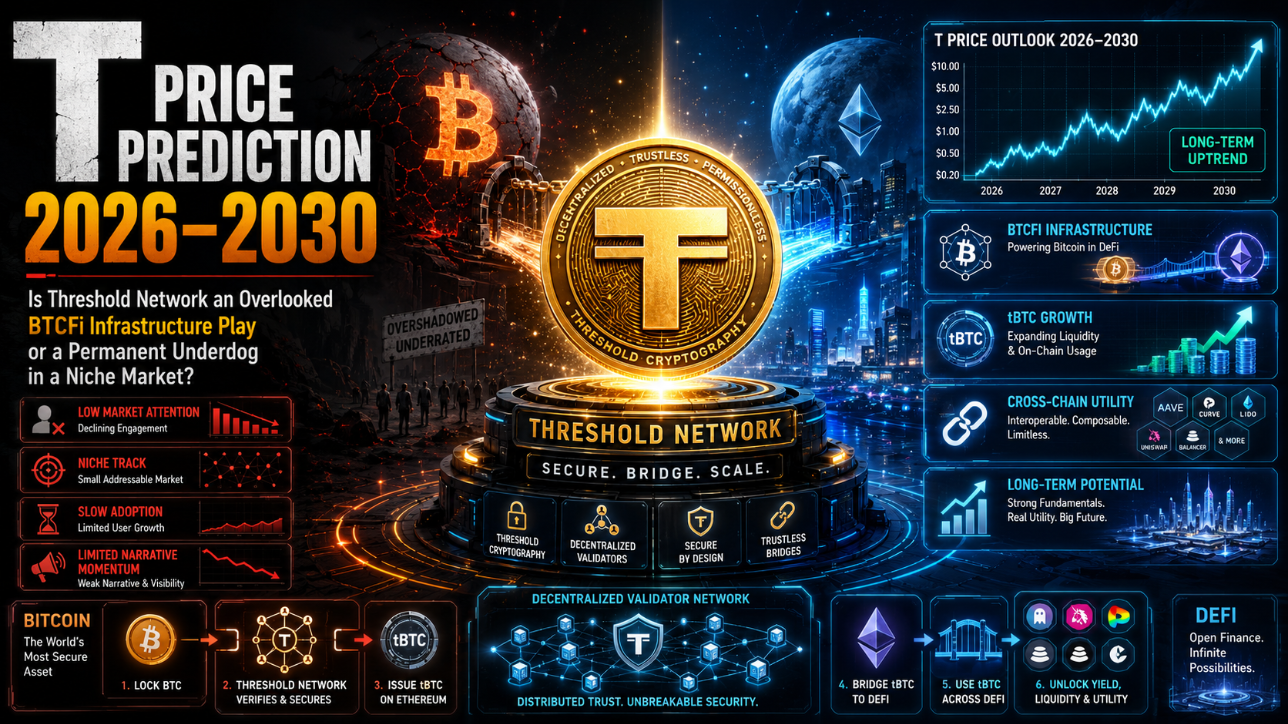
Threshold Network's core positioning is to use threshold cryptography and a decentralized node network to provide more secure infrastructure for on-chain assets and data. Its most important product today is tBTC.
Simply put, tBTC's goal is: To bring Bitcoin into Ethereum and other DeFi ecosystems while minimizing reliance on centralized custodians.
This is very important because Bitcoin itself is the largest asset by market capitalization in crypto, but the native BTC chain makes it difficult to directly participate in Ethereum DeFi. For a long time, the most common way for users to bring BTC into DeFi was through wBTC. wBTC is successful, but it relies on a centralized custody model. Threshold's tBTC attempts to offer a more decentralized, more single-point-of-failure-resistant alternative.
Threshold Network's official documentation describes tBTC as "the most decentralized 1:1 tokenized Bitcoin." It distributes control of BTC through threshold cryptography and a network of independent node operators, preventing any single entity from controlling the funds alone.
So, looking at T in 2026, the real question is not "T's price is so low, can it reach $1?" but rather:
Can tBTC become an important decentralized Bitcoin cross-chain asset in the BTCFi era? If tBTC usage grows, can the T token capture this network value?
This article will systematically analyze the possible trajectory of T over the next five years from several aspects: T's fundamentals, tBTC's mechanism, competition with wBTC, the BTCFi narrative, the staking security model, supply pressure, price ranges for 2026–2030, and investment strategies.
II. Understanding T's Pricing Logic: Newcomers Must First Understand tBTC
2.1 Where does demand for the T token come from?
T is not a pure governance token; its value logic mainly comes from three directions.
First, node staking demand. Threshold Network relies on node operators to provide services. According to Coinbase's introduction to the Threshold protocol, Threshold supports multiple service modules, and node operators need to stake T to participate in different modules, such as PRE services, tBTC-related random beacons, and ECDSA signing.
Second, network security demand. tBTC's security relies on decentralized signing nodes. tBTC security model materials show that each signing group hosting a BTC deposit consists of 100 nodes randomly selected from a larger node pool, and the T staking mechanism provides Sybil attack resistance.
Third, governance and protocol development demand. T holders can participate in Threshold DAO governance, influencing network upgrades, parameter adjustments, product direction, and ecosystem incentives.
But investors should note: Whether the price of T can truly rise depends not on whether it has governance rights, but on whether tBTC usage grows and whether T staking becomes a real necessity for securing tBTC.
If tBTC minting grows and the scale of cross-chain BTC expands, requiring more nodes and staked security, then T will have a clearer value capture logic. If tBTC remains niche for a long time, T could easily become an "infrastructure token with technology but no demand."
2.2 What is tBTC and how is it fundamentally different from wBTC?
Both tBTC and wBTC try to solve the same problem: Bringing BTC into Ethereum, L2s, and DeFi ecosystems.
But the two paths are completely different.
wBTC is more like a "centralized custodial mapped asset." Users hand over BTC to a custody system and receive on-chain wBTC. Its advantages are deep liquidity, many use cases, and broad integration. The disadvantage is that users must trust the custodian and related institutions.
tBTC attempts to use decentralized nodes and threshold signatures to reduce trust costs. Threshold's official and GitHub materials position tBTC as a decentralized Bitcoin bridge, aiming to give BTC holders DeFi access without relying on a centralized custodian.
The differences can be simply understood as:

Therefore, tBTC is not trying to completely replace wBTC in the short term, but rather to capture a portion of the BTCFi market from users who have a genuine need for "decentralized custody."
2.3 How does T's staking mechanism work?
The significance of T staking is not simply "locking up to earn yield," but rather providing security guarantees for the Threshold Network.
Behind tBTC is a set of decentralized signing nodes. After a user deposits BTC into the system, the system manages minting, redemption, and signing through Threshold Network's node network. Node operators need to stake T to have economic constraints. If they misbehave or fail to perform duties, they theoretically face penalties or losses.
This mechanism has an important implication for T's price:
The larger the scale of tBTC, the stronger the security budget the network theoretically needs; the more important the security budget, the more valuable the demand for T staking.
But there is also a risk here: If the staking yield on T is not attractive enough, or if the barrier to node participation is too high, ordinary token holders may not directly enjoy the benefits of network growth.
So judging T requires looking not only at price but also at:
- T staking ratio
- Number of nodes
- tBTC minted supply
- tBTC usage in DeFi
- Protocol revenue and node yield
- Whether T staking yield comes from real usage or short-term incentives
2.4 How large is T's supply pressure?
The biggest misunderstanding newcomers have about T is that "the price is very low."
The total supply of T is very large; common market sources indicate its supply is in the tens of billions. A low unit price does not mean it is cheap; what really matters is market cap and FDV.
This is a common mistake newcomers make:
"T is only $0.01 now, isn't it easy to reach $1?"
In reality, if the total supply of T is about 15 billion tokens, then a price of $1 corresponds to a fully diluted valuation of about $15 billion. This market cap is not impossible for a BTCFi infrastructure project, but it must be built on the premise of large-scale adoption of tBTC, significant growth in protocol revenue, and BTCFi becoming a mainstream track.
So T's valuation cannot be based on price alone; rather:
T price × Total supply = Market cap pressure.
If T rises from $0.01 to $0.10, that is already a 10x increase, and the market cap will also expand 10x. To rise above $0.50, very strong fundamental support is needed, not just the "cheap coin effect."
2.5 Is governance effective after the NuCypher and Keep merger?
The special feature of Threshold Network is that it is not a brand new project, but a merger of two existing communities.
This merger has advantages and risks.
Advantages: Both NuCypher and Keep had accumulated technology and communities in areas like privacy, threshold cryptography, and decentralized custody; after the merger, they can form a more complete infrastructure capability.
Risks: After merging two communities, two historical tokens, and two sets of interest structures, governance efficiency, strategic direction, and resource allocation can become more complex.
From the perspective of 2026, whether Threshold can be repriced by the market depends not on "how well the merger story is told," but on whether it can concentrate its post-merger technical capabilities into a core product with real market demand.
Currently, that core product is tBTC.
III. Six Key Variables Determining T's 2026–2030 Trajectory
3.1 How much market share can tBTC capture?
This is the core question for T.
If tBTC remains a niche decentralized alternative, T's valuation ceiling is limited. If tBTC captures a significant share of BTCFi, T could be repriced.
Threshold's official benchmark report for Q1 2026 showed that tBTC supply at the end of the quarter was approximately 5,900 BTC, roughly flat quarter-on-quarter but up 32% year-on-year; DeFi TVL denominated in BTC grew 19% quarter-on-quarter to about 7,000 BTC, of which tBTC supplied to Aave was about 2,100 BTC, up 24% quarter-on-quarter.
This data shows two things.
First, tBTC is not unused. It has already entered DeFi scenarios like Aave, indicating real product demand. Second, the scale of tBTC is still not large; there is a long way to go before reaching the mainstream market status of wBTC.
Therefore, for T's future price to open up space, tBTC needs to cross several key thresholds:
- 10,000 BTC scale: Proves it is not a niche experiment
- 30,000–50,000 BTC scale: Begins to become an important BTCFi asset
- Above 100,000 BTC: Truly challenges market perception of wBTC and centralized custodial BTC
If tBTC remains at a scale of just a few thousand BTC for a long time, it will be difficult for T to support a very high valuation.
3.2 When will the BTCFi track explode?
BTCFi is one of the most important narratives for T's future.
In the past few years, Bitcoin has been primarily seen as a "store of value asset." But with the development of Ordinals, Runes, Babylon, Lombard, BTC LSTs, Bitcoin staking, cross-chain BTC lending, and more, an increasing number of projects are attempting to bring BTC into yield-generating scenarios.
This is both a positive and a challenge for tBTC.
The positive: The hotter BTCFi becomes, the more BTC holders will want to bring their BTC into DeFi, expanding potential demand for tBTC.
The challenge: The BTCFi track will attract many new solutions, including centralized custodial BTC, institutional custodial BTC, BTC LSTs, native Bitcoin staking protocols, cross-chain bridges, and L2 solutions. tBTC is not the only option.
So for T to capture BTCFi, it must prove its unique positioning:
- More decentralized than wBTC
- More stable and mature than emerging BTC LSTs
- More DeFi-native than institutional solutions
- More secure and trustworthy than ordinary cross-chain bridges
- Truly able to integrate with Aave, Curve, Uniswap, L2s, and yield protocols
3.3 Impact of the Ethereum DeFi cycle on T
tBTC's core use cases remain highly dependent on Ethereum and the Ethereum DeFi ecosystem.
If the ETH ecosystem is in a bull market, DeFi TVL rises, and lending, DEXs, yield strategies, restaking, and stablecoin markets are active, tBTC usage will grow more easily. If the ETH ecosystem is depressed, even if BTC's price is strong, demand for tBTC may be limited.
This means T is not simply a bet on BTC, but a bet on:
The demand for BTC assets to enter ETH/L2 DeFi.
If BTCFi in the future primarily occurs on native Bitcoin L2s, institutional custody networks, or centralized platforms rather than Ethereum DeFi, then tBTC's growth may be less than expected.
This is similar to many infrastructure projects. For example, when analyzing MOVR Price Prediction 2026–2030, you must also consider whether ecosystem liquidity truly returns, rather than just looking at the project's technology itself. The same goes for T: the technology roadmap is important, but where the real liquidity lies ultimately determines the final price.
3.4 Will the wBTC trust crisis continue to ferment?
The biggest opportunity for tBTC comes from wBTC's trust risks.
After 2024, controversies related to wBTC custody and control rights have repeatedly attracted market attention. Many DeFi users have begun to rethink: If a BTC mapped asset relies on a centralized custodian, does it still conform to DeFi's principles of "permissionless, censorship-resistant, verifiable"?
Such trust controversies are a potential positive for tBTC, because tBTC's core selling point is reducing reliance on centralized custodians.
But investors cannot simply assume "wBTC has controversy, so tBTC will definitely win."
In reality, wBTC still has extremely strong advantages:
- Deep liquidity
- Extensive DeFi integrations
- Strong user habits
- Easier for institutions to understand
- Mature redemption and operational processes
For tBTC to benefit from the wBTC trust crisis, it must keep up in three areas:
- Improve minting and redemption experience
- Increase integrations with major DeFi protocols
- Enhance liquidity depth and trading efficiency
Otherwise, even if users dislike centralized risk, they may continue to use wBTC due to liquidity and convenience.
3.5 Speed of institutional adoption of cross-chain BTC
Institutional entry into BTCFi could be both an opportunity and a limitation for T.
Opportunity: If institutions begin to use BTC for on-chain lending, collateral, yield, and liquidity strategies, the entire cross-chain BTC market will expand, and tBTC could benefit as a decentralized option.
Limitation: Institutions typically prefer compliant, clearly custodied, and well-audited products. They may be more inclined to choose wBTC, cbBTC, or other BTC mapped assets backed by large institutions, rather than a fully DeFi-native tBTC.
Therefore, tBTC's primary users may not be traditional institutions, but rather:
- DeFi-native funds
- DAO treasuries
- High-net-worth on-chain users
- BTC holders seeking decentralization
- Protocols unwilling to bear centralized custody risk
If tBTC can build a strong reputation among these users, it still has a chance to grow large.
3.6 Dilution risk from T's large supply
The biggest psychological barrier for T in the market is its large supply and low price.
A low price may attract retail investors in the short term because many people like buying "cheap coins." But in the long run, a large supply means each price level corresponds to a very high market cap.
For example:

Therefore, T can rise, but each price target requires corresponding fundamentals.
$0.05 may only require a warming BTCFi narrative and market valuation recovery. Above $0.10 requires significant growth in tBTC usage. Above $0.25 requires tBTC to become one of the mainstream BTCFi assets. Above $0.50 requires a massive explosion of the entire BTCFi market, with Threshold becoming a core infrastructure.
IV. T Price Prediction for 2026: Can the BTCFi Narrative Lead to T's Rediscovery?
2026 is a key window for T to be "rediscovered."
If BTCFi continues to heat up and the market begins to look for decentralized BTC infrastructure beyond Babylon, Lombard, wBTC, and cbBTC, T has a chance to attract capital attention.
But its rise will not happen automatically; it must rely on improving tBTC data.
4.1 Baseline assessment for early 2026
T's current fundamentals can be summarized as:
- tBTC has real usage, but scale is still limited
- Threshold's technological positioning is clear, but market awareness is weak
- T's low price makes it easy to attract speculative retail attention
- Staking and node security models have practical utility
- But protocol revenue, T value capture, and tBTC market share still need proof
DeFiLlama data shows that in May 2026, Threshold Network's TVL was approximately $380 million, cumulative bridge volume was nearly $2.5 billion, 30-day bridge volume was about $37.63 million, T price was about $0.0053, and market cap was about $58.53 million.
These data show T is in an awkward position: It is not an empty project, but it has not yet become mainstream infrastructure.
4.2 Three scenario price ranges for 2026
Scenario
Price Range
Probability Weight
Key Trigger
Pessimistic
0.008–0.025
30%
Slow tBTC growth, BTCFi capital flows to other protocols, T continues to be ignored
Baseline
0.030–0.080
50%
BTCFi narrative heats up, tBTC minting grows steadily, T gets valuation repair
Optimistic
0.080–0.150
20%
tBTC breaks through key scale, enters more mainstream DeFi protocols, market reprices decentralized BTC bridge
The key judgment for 2026 is:
T has a chance to rebound, but whether it can stand above $0.08 depends on whether tBTC truly breaks out of the "niche product" stage.
If tBTC minting volume remains stuck at a few thousand BTC, T's price increase is mostly sentiment-driven. If tBTC reaches a scale above 10,000 BTC, T's fundamental narrative will be more solid.
V. T Price Prediction for 2027: How Long Can the Low-Price Effect Last?
If BTCFi starts to heat up in 2026, T may enter a more volatile phase in 2027.
But investors must understand: The low-price effect can bring short-term speculation, but it cannot support long-term valuation.
5.1 What scale does tBTC need to reach?
By 2027, if T wants to enter a higher valuation range, tBTC needs to achieve at least three changes:
First, significant growth in tBTC supply. If tBTC still has only a few thousand BTC, the market will find it hard to give T a high valuation.
Second, tBTC must enter more core DeFi protocols. For example, lending protocols, DEXs, yield aggregators, stablecoin collateral, L2 bridge assets, etc.
Third, tBTC liquidity must be deep enough. Users should not only be able to mint tBTC, but also trade, borrow, lend, collateralize, and exit with low slippage.
5.2 What does T moving from $0.05 to $0.20 mean?
Many people might think a 4x from $0.05 to $0.20 seems easy.
But based on an estimated total supply of ~15 billion, $0.20 corresponds to an FDV of about $3 billion. That is no longer a small project valuation, but a mainstream infrastructure level valuation.
Therefore, if T reaches above $0.20 in 2027, at least one strong condition must be met:
- tBTC becomes an important BTCFi asset
- The wBTC trust crisis continues to ferment
- T staking yield significantly improves
- BTCFi becomes a bull market main narrative
- Threshold is extensively integrated by mainstream DeFi protocols
Otherwise, prices above $0.20 could easily become an emotional peak.
5.3 Three scenario price ranges for 2027

tBTC captures significant share, market gives high premium to decentralized BTC assets
If T enters the above $0.15 range in 2027, investors should focus on:
- Whether tBTC minting volume grows synchronously
- Whether the T staking ratio increases
- Whether protocol revenue improves
- Whether there is a large inflow of T to exchanges
- Whether the community begins to excessively hype the "$1 target"
If the price rises much faster than fundamentals, beware of pullback risk.
VI. T Price Prediction for 2028: In a Bear Market, Will the Large Supply Crush the Price?
2028 could be the most dangerous year for T.
If the crypto market enters a bear market, capital will flee from small-cap infrastructure, low-liquidity tokens, and speculative narratives. Although T has a real product, it remains a niche infrastructure asset and will be very volatile in a bear market.
6.1 The destructive power of large supply in a bear market
T's large supply means there are many low-cost positions and potential liquidity pressure in the market.
In a bull market, low-priced coins are easily chased by retail investors. In a bear market, low-priced coins are also easily abandoned by the market.
If tBTC usage does not continue to grow, T may face three pressures in a bear market:
- BTCFi narrative cools down
- Liquidity of small-cap assets declines
- Token holders lose patience
At such times, T's price may be determined not by technical value but by market liquidity.
6.2 Can staking yield provide support?
Staking can reduce circulating supply, but it cannot guarantee that the price will not fall.
Whether T staking can form a bear market support depends on the source of yield. If yield mainly comes from real network usage fees, support is stronger; if it mainly comes from incentives or expectations, support is weaker.
In a bear market, investors should observe:
- Whether the T staking ratio remains stable
- Whether the number of operating nodes declines
- Whether tBTC minting volume decreases
- Whether tBTC redemptions increase
- Whether node yield is sufficient to cover opportunity costs
If these indicators deteriorate simultaneously, it indicates T's fundamentals are under pressure.
6.3 Bear market resilience of BTCFi
Bitcoin itself typically holds up better than altcoins. In theory, BTCFi might be more resilient than ordinary DeFi because BTC holders have stronger long-term conviction.
But that does not mean tBTC demand will necessarily be stable. In a bear market, many users will choose to withdraw BTC to cold wallets rather than continue to leave them in DeFi, bearing smart contract and bridge risks.
Therefore, BTCFi's resilience in a bear market depends on yield:
If tBTC can provide reasonable yields in Aave, Curve, L2s, and yield protocols, users may continue to hold. If yields fall and risks rise, users will redeem BTC and exit.
6.4 Three scenario price ranges for 2028

The key for 2028 is not how much T can rise, but:
Whether tBTC can maintain usage during a bear market.
If tBTC's scale does not collapse in a bear market, T can qualify to participate in the next cycle.
VII. T Price Prediction for 2029–2030: Long-Term Value Ceiling Determined by tBTC Scale
By 2029–2030, T price prediction can actually become a valuation question:
How large can tBTC become? How much should Threshold Network be worth for protecting these BTC liquidity? How much security and governance value can T capture?
7.1 Inferring T valuation from tBTC scale
Assuming tBTC reaches different scales in the future, we can roughly deduce T's long-term valuation space:

T could enter a high valuation range
But this is only logical deduction, not automatic.
The larger the scale of tBTC, the higher the user requirements for security, redemption, liquidity, and integration. Threshold needs to prove it can handle large-scale BTC assets, not just function well at small scale.
7.2 Will the cross-chain BTC track become winner-take-all?
Cross-chain BTC will likely not be completely winner-take-all, but rather multi-protocol coexistence.
In the future, there may coexist:
- wBTC: Centralized custody, deepest liquidity
- cbBTC: Institutionally backed, compliant gateway
- tBTC: Decentralized, DeFi-native
- LBTC and other BTC LSTs: Yield-bearing BTC
- Babylon-related assets: BTC staking yield
- Bitcoin L2 native assets: For use within BTC ecosystem
tBTC's opportunity is not to eat the entire market, but to occupy a clear position:
A decentralized, permissionless, DeFi-native cross-chain BTC asset.
If this positioning is recognized by the market, T has long-term value. If users care more about liquidity and convenience than decentralization, tBTC may remain niche.
7.3 T three scenario price ranges for 2030

It must be emphasized here:
0.25–0.60 is a very optimistic long-term range, not a default target.
It requires all of the following conditions to be met simultaneously:
- BTCFi becomes a mainstream track
- tBTC minting volume grows substantially
- tBTC enters core scenarios like Aave, Curve, L2s, yield protocols
- wBTC or centralized BTC assets continue to face a trust discount
- T staking becomes a necessity for network security
- Threshold DAO governance and product execution remain highly efficient
If these conditions are not met, a more realistic baseline range for T in 2030 might be 0.05–0.20.
VIII. Horizontal Comparison with Competitors in the Same Track: Why Choose tBTC Over wBTC or cbBTC?
8.1 tBTC vs wBTC: How much is the decentralization premium worth?
wBTC's advantages are very clear: liquidity, integration, market habits. tBTC's advantages are also clear: decentralization, trust minimization, resistance to single-point custody risk.
Dimension

The core value of tBTC is not "more convenient than wBTC," but "more decentralized than wBTC." The question is: How much premium is the market willing to pay for decentralization?
This determines tBTC's long-term ceiling.
8.2 tBTC vs cbBTC: Community-driven or institutionally backed?
The logic behind institutionally backed BTC assets like cbBTC is completely different from tBTC.
cbBTC's advantages are institutional brand, compliance path, and low user trust barrier. tBTC's advantages are DeFi-native and decentralized.
Institutional users may prefer cbBTC. DeFi-native users may prefer tBTC.
So the two do not necessarily completely replace each other, but serve different groups.
For T, what truly needs to be avoided is: If institutional solutions like cbBTC simultaneously have compliance, liquidity, and DeFi integration, can tBTC's decentralization advantage translate into a sufficiently large market share?
8.3 tBTC vs BTC LSTs: Competition or complement?
The rise of BTCFi solutions like Babylon, Lombard, and LBTC is both competition and a positive for tBTC.
Competition: If users want to generate yield on their BTC, they may choose BTC staking and LSTs rather than tBTC.
Positive: As BTCFi grows overall, more BTC will enter on-chain finance. tBTC can serve as foundational liquidity assets, collateral, or bridge assets in these protocols.
So the key is not "who replaces whom," but whether tBTC can become part of the BTCFi mix.
IX. Practical Investment Strategy: Is T's Ultra-Low Price an Opportunity or a Trap?
9.1 The "low-price illusion" must first be corrected
The most attractive thing about T for retail investors is its low price. But this is also the biggest trap.
Many people think: "T is only a few cents, it's not hard to reach $1." This thinking ignores market cap.
When investing in T, you cannot look at price alone; you must look at:
- Current market cap
- Fully diluted valuation
- tBTC scale
- T staking ratio
- Protocol revenue
- Market liquidity
- BTCFi track sentiment
If you buy T only because it is "cheap," you can easily get stuck in a low-priced coin for a long time.
9.2 What position size is suitable for T?
T is a niche infrastructure token and is not suitable as a core position.
Reference:
- Conservative investors: Do not allocate, or at most 1% for observation
- Balanced investors: 1%–3%
- Aggressive investors: 3%–5%
- Above 5%: Requires a very deep understanding of tBTC, BTCFi, and Threshold staking mechanisms
T may have high potential, but also very high uncertainty. It is suitable as a "small BTCFi options position," not as a core long-term holding.
9.3 Should ordinary investors participate in staking?
T staking is more suitable for those who understand on-chain operations, node mechanisms, and can bear smart contract risks.
If you are just an ordinary token holder, you should first understand:
- Where does staking yield come from?
- Is there a lock-up period?
- Is there a penalty mechanism?
- Is running a node required?
- Is staking done through a third-party platform?
- Can the yield cover price fluctuation risk?
If T's price drops 50% in a year, even with decent staking yield, you may still have an overall loss. So staking is not risk-free yield; it is just one way to improve token holding efficiency.
9.4 Using tBTC minting volume as a buy/sell signal
The most important indicator for T is not the candlestick chart, but on-chain tBTC data.
Key metrics to track:

If T price rises but tBTC supply does not grow, be wary of pure sentiment-driven moves. If tBTC supply continues to grow but T price has not yet reacted, it may be an opportunity worth watching.
9.5 Phased accumulation price anchors
Based on the forecasts above, a practical framework can be designed:
- 0.005–0.015: Extremely low, high-risk observation zone; need to confirm no fundamental deterioration
- 0.015–0.030: Suitable for small positions to observe in phases
- 0.030–0.080: Baseline repair zone; need to observe whether tBTC growth is synchronous
- 0.080–0.150: Strong zone; suitable for gradually taking partial profits
- Above $0.150: Requires very strong tBTC data support; otherwise, do not blindly chase highs
- Above $0.250: Belongs to strong bull market optimistic zone; should be highly alert to sentiment premium
The worst thing for an asset like T is the "low-price fantasy." The best strategy is not to fantasize about $1, but to use tBTC data to verify whether each rally is genuine.
X. Conclusion: Is T an Overlooked BTCFi Infrastructure or a Permanent Follower in a Niche Track?
T is a very distinctive project.
It is not like ordinary altcoins that rely solely on narrative, nor like pure MEMEs that rely only on community sentiment. Behind Threshold Network is real technical accumulation, the historical foundation of the NuCypher and Keep merger, and a clear product in tBTC.
But T's problems are equally obvious:
- Weak market awareness
- Large supply
- tBTC scale is still limited
- wBTC's liquidity advantage is very strong
- New solutions like cbBTC and BTC LSTs are highly competitive
- T's value capture path still needs further proof
T's future rise requires three necessary conditions:
First, tBTC minting volume breaks through. If tBTC remains at a few thousand BTC for a long time, it is hard for T to support a high valuation.
Second, the BTCFi narrative becomes mainstream. Only when more BTC enters DeFi can tBTC have room to grow.
Third, T's staking security model forms real value capture. If T staking is just a formality and cannot clearly benefit from tBTC growth, price increases will lack long-term support.
The biggest uncertainty is:
Do users have a strong enough need to migrate from wBTC, cbBTC, or BTC LSTs to tBTC?
If the answer is yes, T may be a market-overlooked BTCFi infrastructure token. If the answer is no, T may remain a niche asset that is technically correct but commercially limited for a long time.
One sentence summary:
T is suitable for investors who are bullish on BTCFi, understand the decentralized value of tBTC, and are willing to take small positions to bet on high volatility; it is not suitable for those who buy heavily just because of "low price" or "feels cheap."
From 2026 to 2030, T's fate depends not on whether it can tell a good story, but on whether tBTC can truly become an important channel for BTC to enter the DeFi world.
This article is for research analysis and scenario simulation only and does not constitute any investment advice. Crypto assets are extremely volatile. T is a small-cap, high-risk infrastructure token. Please make independent judgments based on your own risk tolerance before investing.