
I. Introduction: LTC Is Already 14 Years Old—Why Write a Complete Guide Now?
In the cryptocurrency market, LTC occupies a very specific niche.
It lacks the absolute consensus of BTC as "digital gold," it doesn't power a massive smart contract layer like ETH, and it is rarely at the center of hyper-hyped narratives like newer public chains such as SOL, SUI, or AVAX. The general perception of LTC is highly contradictory: it is old, rarely trends, and possesses a somewhat unsexy narrative—yet it refuses to disappear.
Born in 2011, Litecoin is one of the earliest cryptocurrencies to successfully survive to this day. Its original design thesis was simple: to create a faster, lighter, and more transaction-friendly variant based on Bitcoin's blueprint. General profiles from hardware wallet providers like Trezor note that LTC utilizes the Scrypt Proof-of-Work (PoW) consensus algorithm, features a 2.5-minute block production time, and enforces a hard supply cap of 84 million tokens.
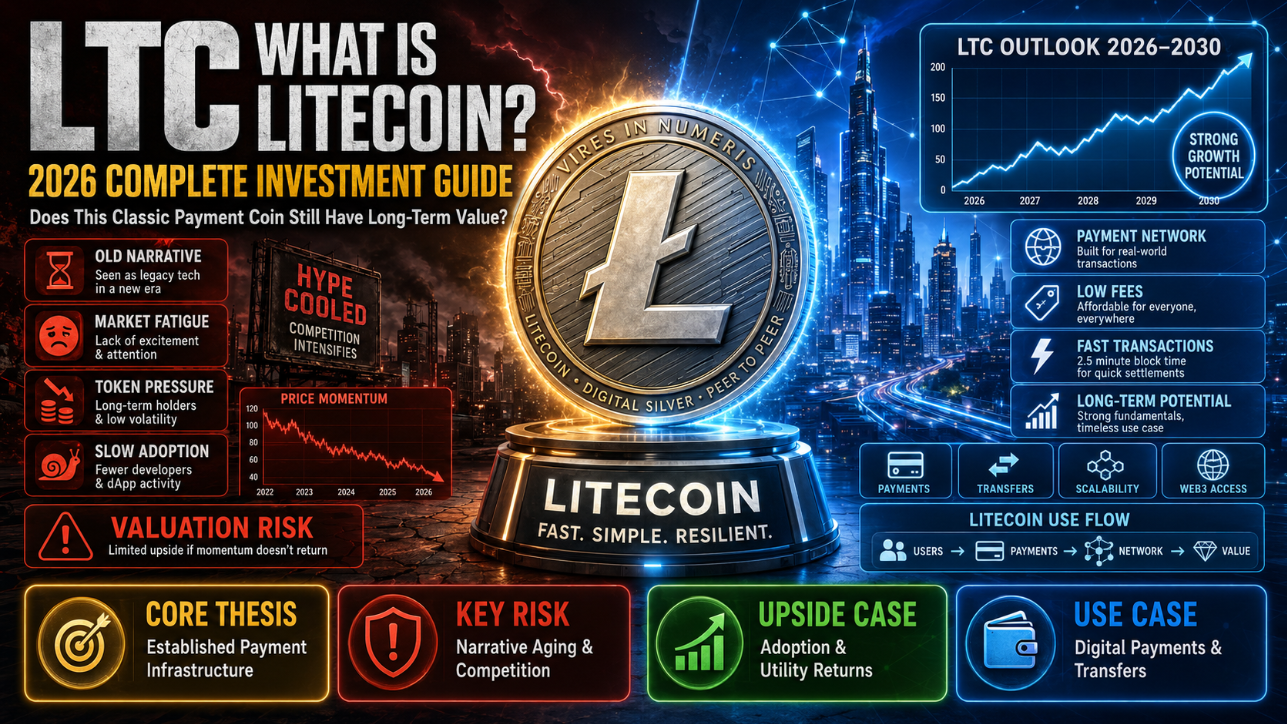
This is precisely why veteran crypto participants love to use a classic analogy: Bitcoin is gold, Litecoin is silver.
While this shorthand is helpful, it is not entirely accurate. BTC operates primarily as a long-term store-of-value asset, whereas LTC acts more like a low-cost, high-velocity remittance and payment network. It may not consistently outperform BTC over long horizons, but it has carved out an institutional-grade moat in terms of deep market liquidity, universal exchange coverage, cheap transfer fees, and flawless network uptime.
As of May 2026, CoinMarketCap data shows LTC trading around $52, with a circulating supply of roughly 77.21 million tokens and a maximum supply capped at 84 million, putting its total market valuation around the $4 billion level. This indicates that while LTC remains a highly ranked legacy asset, it still sits at a considerable discount from its historical all-time highs.
This guide is structured to help you address three core questions:
- What exactly is LTC, and why has it managed to survive for over a decade?
- What stage of its lifecycle is LTC in as of 2026, and is it a viable investment?
- If you decide to allocate capital to LTC, how do you execute purchases, manage your holdings, and control risk on HIBT?
II. What Exactly Is LTC? Explaining Litecoin in Plain English
2.1 What Is the Relationship Between LTC and BTC?
LTC can be best understood as the earliest and most successful "lightweight optimization" of Bitcoin.
It was never designed to fully replace BTC, but rather to complement it by optimizing the retail payment experience. While Bitcoin produces a block roughly every 10 minutes, Litecoin cuts that time down to approximately 2.5 minutes. Furthermore, while Bitcoin enforces a strict supply cap of 21 million tokens, Litecoin sets its maximum cap at 84 million—precisely four times that of Bitcoin.
Thus, the "gold and silver" analogy serves as a great introductory mental model for newcomers:
- BTC acts as a high-value, macro-store-of-value layer.
- LTC acts as a low-friction, high-velocity medium of exchange.
However, do not fall into the trap of assuming that "silver will always follow gold point-for-point." In the crypto landscape, Bitcoin's core consensus is orders of magnitude stronger than Litecoin's. Litecoin’s value proposition is not anchored in merely looking like BTC, but rather in its decade-plus track record of continuous network stability, rock-bottom transactional costs, deep exchange pairs, and seamless transaction throughput.
2.2 Four Core Technical Characteristics of LTC
- Accelerated Block Confirmation times: LTC prints a block every 2.5 minutes, compared to Bitcoin's 10-minute intervals. For everyday users, this means LTC settles on the base layer much faster, making it far better suited for microtransactions and rapid wallet-to-exchange arbitrage.
- A Strict 84 Million Supply Cap: LTC is not an inflationary asset. It enforces a hard programmatic limit, offering an element of mathematical scarcity, although its social scarcity consensus is naturally softer than Bitcoin's.
- The Scrypt Consensus Algorithm: Litecoin deliberately launched with the Scrypt algorithm to differentiate its hardware mining requirements from Bitcoin’s SHA-256 framework. While this originally allowed retail CPU/GPU setups to mine the asset, the industrialization of mining has fully transitioned LTC into the ASIC era. Today, Scrypt ensures Litecoin maintains its own dedicated, independent miner ecosystem rather than cannibalizing Bitcoin’s hashrate security.
- A Proven Technical Testing Ground for Bitcoin: Historically, Litecoin has deployed major cryptographic implementations—such as Segregated Witness (SegWit) and the Lightning Network—well ahead of Bitcoin. Founder Charlie Lee frequently outlined that Litecoin could serve as an active testing ground to de-risk scaling innovations before their implementation on Bitcoin. Institutional research reports from Fidelity Digital Assets reiterate that Litecoin successfully activated SegWit ahead of Bitcoin, and its layer-2 Lightning Network implementation predates Bitcoin's deployment.
This proves that while LTC might not be the flashiest asset in the room, it maintains a highly respected structural position within crypto’s technical evolution.
2.3 The Charlie Lee Divestment Controversy
Litecoin's founder, Charlie Lee, remains one of the most visible and heavily debated figures in the project's history.
In December 2017, at the absolute peak of that market cycle, Lee announced that he had sold or donated nearly his entire personal holding of LTC. His stated reasoning was to eliminate a fundamental conflict of interest, as his public commentary heavily influenced market prices.
This move triggered massive, long-lasting debate. Proponents viewed it as a noble step toward complete decentralization, removing founder manipulation risks. Detractors, however, interpreted it as a founder dumping at the local top, dealing a psychological blow to retail confidence.
Looking back today, this event remains a complex historical stamp on the asset. On one hand, LTC is completely free of founder centralization risks; on the other hand, the memory of the top-tick exit keeps many veteran investors cautious regarding LTC’s long-term upside velocity.
III. What Real-World Problems Does LTC Solve? Assessing Its Utility
3.1 Everyday Micro-Payments
One of Litecoin's strongest real-world use cases is cheap global remittance. Data from tracking platforms like BitInfoCharts confirms that Litecoin regularly processes around 180,000 daily transactions, with average base-layer fees hovering at a fraction of a cent (e.g., 0.000049 LTC, or roughly $0.0026), with median transaction costs sitting even lower.
If you need to move a small amount of value globally, executing it on the Bitcoin mainnet can be slow and expensive during periods of high congestion, while Ethereum can suffer from aggressive Gas price spikes. LTC consistently offers an incredibly cheap, fast alternative.
Granted, stablecoins running on high-throughput networks like TRON, Solana, and Base have captured a massive share of the global remittance market. LTC is no longer the sole alternative, but its competitive edge lies in its longevity, universal native integration across global point-of-sale systems, and deep exchange liquidity.
3.2 Inter-Exchange Arbitrage Transfers
A massive, ongoing utility for LTC is serving as a liquidity bridge between global cryptocurrency exchanges. Day-traders and arbitrageurs heavily utilize LTC to transfer value across platforms because its deposits and withdrawals settle rapidly, fees are practically zero, and almost every global digital asset exchange supports native LTC pairs. It offers far greater structural stability than transferring value via highly volatile, low-cap altcoin chains.
3.3 MWEB (MimbleWimble Extension Blocks) Privacy Upgrades
In 2022, Litecoin successfully activated its MimbleWimble Extension Blocks (MWEB) upgrade. Official development updates detail that MWEB operates as an opt-in, parallel extension layer running alongside the main Litecoin chain, facilitating confidential transactions and structural data pruning while maintaining backwards compatibility with standard wallets and ecosystem services.
MWEB’s core goal is to bolster personal transaction privacy and asset fungibility. While standard public blockchain transfers are completely transparent, MWEB allows users to obscure sender data, receiver data, and transaction amounts within the extension block.
However, privacy-enhancing tech is a double-edged sword. While it introduces exceptional technical utility, it also introduces compliance frictions with strictly regulated centralized exchanges and global financial watchdogs. Investors should view MWEB as an additive technological feature rather than misclassifying LTC as a pure privacy coin, while remaining mindful of regional regulatory landscapes.
3.4 Active On-Chain Metrics
Litecoin is far from a dead, unutilized legacy network. BitInfoCharts shows that the network maintains consistent, high-volume transactional throughput. Market reports from early 2026 highlight that Litecoin’s active addresses regularly break above 230,000, frequently outpacing legacy peer payment networks like Bitcoin, Dogecoin, and Dash in pure on-chain address activity.
This data proves that LTC retains real, active utility. However, investors must separate network utility from price appreciation: active transactional use does not automatically mean the asset will outperform BTC. Litecoin’s structural challenge is that its utility is fundamentally utilitarian, lacking the speculative narrative amplification found in newer sectors.
IV. Litecoin Tokenomics: Supply, Halvings, and Mining Dynamics
4.1 Fixed Cap vs. Circulating Float
Litecoin enforces a maximum supply cap of 84 million tokens. CoinMarketCap records show that approximately 77.21 million tokens (over 90%) are already fully circulating. This means the vast majority of the structural supply has already been distributed into the market, with remaining token emissions routed strictly through programmatic miner rewards.
This sets LTC apart from modern VC-backed tokens; there are no looming team unlocks, seed investor cliffs, or foundational treasury distributions. Its emission schedule follows a pure, clean PoW mining model mirroring Bitcoin.
4.2 The Programmatic Litecoin Halving Schedule
Litecoin reduces its block rewards by 50% every 840,000 blocks (roughly every four years). Its next halving event is projected to occur around the mid-to-late stretch of 2027. Countdown trackers on major networks like NiceHash and educational breakdowns on Binance Square estimate the next halving milestone around July 2027, with precise timing shifting dynamically based on aggregate network hashrate velocity.
Historical data shows that many newcomers buy into a halving event on the assumption that "a halving guarantees an immediate price explosion." In reality, LTC has historically front-run its halving milestones through speculative accumulation months prior, followed by a correction once the event completes—a classic display of “buy the rumor, sell the fact.”
Therefore, trading LTC purely based on a halving date is dangerous. You must actively evaluate: Has the market already priced in the supply shock? Are miners under extreme capitulation pressure? Is macro liquidity supportive? Is the LTC/BTC ratio trading at historical accumulation lows?
4.3 Miner Economics and Price Floors
As a PoW blockchain, Litecoin requires heavy capital expenditures from miners covering electricity, specialized ASIC hardware, and facility operations. If the spot market price of LTC drops below aggregate production costs for an extended period, inefficient miners are forced to take their rigs offline, leading to a localized drop in network difficulty.
Because Litecoin's miner ecosystem is highly mature and thoroughly distributed, short-term spot market volatility can squeeze mining profitability, but it poses zero systemic risk to network security. For investors, mining cost models are useful sentiment markers: when spot prices drop directly to aggregate mining cost floors, the market is often in deep value accumulation territory; conversely, when spot prices stretch exponentially above mining costs alongside manic retail sentiment, a local cycle top is likely forming.
V. Litecoin’s Competitive Landscape: Why Has It Survived?
5.1 BTC: The Ultimate Anchor and Competitor
Bitcoin is both Litecoin’s primary benchmark and its largest long-term competitor. If Bitcoin’s layer-2 scaling architectures, specifically the Lightning Network, achieve seamless, ubiquitous, global retail implementation, Litecoin’s core payment thesis faces compression.
Academic and institutional research outlines that the Lightning Network effectively achieves instant, near-zero-cost off-chain settlements via peer-to-peer payment channels, resolving the base layer's scalability limitations. However, in practice, institutional and retail markets continue to view BTC overwhelmingly through a store-of-value, "digital gold" lens rather than using it for day-to-day coffee transactions, keeping a clear window open for Litecoin's frictionless base-layer remittance network.
5.2 Legacy Peer Payment Networks (BCH, DASH, ZEC)
Assets like Bitcoin Cash (BCH), Dash (DASH), and Zcash (ZEC) launched with similar transactional mandates. Litecoin has maintained its dominance over these peers due to its deeper institutional liquidity, immaculate security record, and universal centralized exchange integration. While alternative payment networks fractured over technical governance forks, regulatory delistings due to mandatory privacy tech, or community infighting, Litecoin remained perfectly steady, simple, and universally accessible.
5.3 The Explosive Growth of Global Stablecoins
The rise of stablecoins (USDT, USDC) running on low-cost networks like TRON or Solana represents the largest structural headwind to Litecoin’s everyday payment use case. If a consumer simply wants to transfer fiat purchasing power cross-border, stablecoins are naturally more efficient because they eliminate intraday asset volatility.
While stablecoin dominance has noticeably eaten into Litecoin’s market share for everyday consumer payments, LTC retains a distinct advantage: it carries zero centralized counterparty or credit risk. It does not rely on a centralized issuer’s asset backing, it cannot be programmatically frozen by a corporate smart contract administrator, and it operates as a completely sovereign, permissionless PoW crypto-asset.
VI. Historical Market Cycles: Critical Lessons for Investors
- The 2013 Cycle: LTC experienced explosive growth driven by early speculative capital flowing into any viable, working alternative to Bitcoin. It cemented its status as a premier blue-chip altcoin, followed by a painful macro contraction as early liquidity dried up.
- The 2017 Cycle: LTC booked a phenomenal parabolic run, culminating in Charlie Lee's famous exit at the cycle peak. The lesson here was clear: when retail mania hits an absolute fever pitch and a founder publicly divests to eliminate conflicts of interest, it is time to capture profits rather than assuming the trend is permanent.
- The 2020–2021 Cycle: While LTC achieved notable nominal gains, its relative performance significantly lagged behind Ethereum, Solana, DeFi platforms, and the NFT sector. The structural lesson was simple: the market's core narrative had shifted. Capital favored programmable smart contract architectures and yield-bearing layers over simple payment networks.
- The 2023 Halving: LTC logged a solid pre-halving accumulation rally, followed by a sharp post-event selloff. This served as a classic reminder to buy structural valuation lows months ahead of programmatic events rather than chasing headlines at the actual halving date.
VII. 2026 Market Positioning: Where Does LTC Stand Today?
As of mid-2026, LTC trades around $52, with a market cap near $4 billion and consistent 24-hour exchange volumes hovering around $230 million. This structural data confirms that LTC is a highly liquid, permanently established asset layer. It is not a speculative micro-cap altcoin, nor is it a forgotten network abandoned by the market.
Core 2026 Narratives:
- Rock-solid, permissionless global micro-payments.
- Long-term accumulation positioning ahead of the 2027 programmatic halving.
- Enhanced transactional optionality via opt-in MWEB privacy layers.
- Institutional vehicle expansion and spot ETF filings.
The institutional narrative is an interesting new variable. Financial press reports note that asset managers like Canary Capital have formally filed registration statements with the SEC to launch spot Litecoin ETFs, aiming to provide direct price exposure to institutional investors. While approved spot vehicles would significantly de-risk institutional capital inflows, investors should avoid trading strictly on regulatory timelines, as these expectations are often priced into the market long before approval.
Litecoin’s core dilemma is unchanged: it boasts exceptional architectural stability but lacks an explosive narrative amplifier. It is a defensive, highly reliable infrastructure asset, not an explosive, speculative lottery ticket.
VIII. Step-by-Step Guide to Purchasing and Managing LTC on HIBT
Step 1: Account Registration and KYC Verification
To purchase LTC on HIBT, register an account utilizing a secure email or mobile phone number, establish a robust password, and execute the mandatory Know Your Customer (KYC) onboarding. Ensure all submitted identity data matches your official documentation exactly; utilizing falsified data will lock account withdrawals and restrict asset management features. Immediately activate mandatory Two-Factor Authentication (2FA) via Google Authenticator to secure your account infrastructure.
Step 2: Capital Funding
Acquire a baseline liquidity layer, typically denominated in USDT. You can onboard cash capital via platform-supported fiat gateways, or route existing USDT holdings from an external hardware wallet straight to your dedicated HIBT deposit address. Always double-check your network architecture (e.g., TRC-20, ERC-20, BEP-20) when executing deposits; routing funds over incompatible networks will result in permanent capital loss.
Step 3: Executing the Trade
Navigate to the HIBT Spot Trading interface and enter "LTC" into the asset search matrix.
- LTC/USDT: The most direct, intuitive pair for everyday retail investors, directly reflecting the asset's spot value in US dollars.
- LTC/BTC: Tailored for experienced market participants tracking whether Litecoin is fundamentally gaining or losing structural strength against Bitcoin.
Step 4: Order Type Optimization
- Market Orders: Execute instantly at the prevailing market spot price. Best suited for immediate fills, though vulnerable to local spread slippage during thin market hours.
- Limit Orders: Allow you to define your exact desired entry price. The order rests on the book and executes only if the spot market touches your specified threshold. Limit orders are highly recommended for new investors looking to avoid chasing short-term price spikes.
Step 5: Secure Asset Custody
Once your order fills, your LTC balance will be visible within your HIBT spot asset ledger. If you are executing short-term swing trades or technical rebalancing, keeping assets within your exchange account is perfectly practical. However, if you are committing to a multi-year investment horizon, best practices dictate withdrawing your capital to a non-custodial wallet (e.g., Litewallet or an institutional hardware device like a Ledger). Always execute a small test withdrawal before routing large capital balances.
IX. Advanced HIBT Product Suites for LTC Management
- Automated Capital Allocation (DCA): If supported by the HIBT platform, implementing an automated daily, weekly, or monthly Dollar-Cost Average strategy into LTC removes short-term emotional trading risks, flattening your aggregate cost basis across long cycles.
- Perpetual Contract Interfaces: HIBT's perpetual futures suite allows experienced traders to utilize leverage to trade LTC directional price actions. Warning: Leverage aggressively amplifies both capital returns and liquidation losses. Newcomers should completely avoid leveraged derivatives trading; even a minor 3% adverse spot move can completely wipe out a highly leveraged position.
- Yield-Bearing Ledger Products: If HIBT offers flexible or fixed-term savings vaults for LTC, you can commit your idle assets to accumulate yield. Note that because Litecoin is a PoW chain, these yields are generated via platform-level lending markets rather than native PoS network validation staking. Thoroughly analyze lockup terms and redemption rules before committing capital.
- Tiered Fee Schedules: HIBT applies a sliding-scale transaction fee model based on your 30-day aggregate trading volume and native platform token holdings. High-frequency traders should actively optimize their tier placement to reduce long-term frictional trading costs.
X. Strategic Allocation Frameworks for LTC
- The Tactical Core/Satellite Model: Treat BTC as your core portfolio anchor. Allocate a minor satellite position (e.g., 1%–5%) to LTC to capitalize on localized altcoin liquidity rotations or pre-halving momentum spikes, without exposing your broader net worth to excessive asset risk.
- The Pre-Halving Swing Strategy: Track historical cycle charts to accumulate structurally depressed LTC positions 6 to 9 months ahead of its programmatic halving milestones, systematically scaling out of the position as retail hype peaks ahead of the actual event.
- The LTC/BTC Ratio Play: Professional traders actively watch the LTC/BTC ratio chart. When Litecoin hits multi-year cyclical lows against Bitcoin, they execute a rotation out of BTC into LTC, anticipating a violent mean-reversion bounce, before routing the profits right back into Bitcoin. This strategy requires advanced chart expertise and strict capital discipline.
XI. Five Critical Pitfalls Newcomers Must Avoid
- Underperforming the Bitcoin Benchmark: The single largest structural risk of holding LTC long-term is not that the asset will drop to zero, but that it faces a historical tendency to underperform BTC across multi-year horizons. If your primary investment mandate is maximizing alpha, holding a heavy concentration of LTC over BTC requires a highly disciplined near-term exit plan.
- FOMO-ing Into actual Halving Dates: Chasing LTC at local tops right as the countdown timer hits zero is a historical recipe for capital drawdowns. Understand that smart money accumulates weeks prior and uses the actual event liquidity to distribute positions.
- Leaving Massive Allocations Idle on Exchanges: Keeping small trading balances on a highly secure platform like HIBT is perfectly normal. However, allowing your multi-year generational wealth to rest indefinitely on any centralized exchange exposes your capital to systemic counterparty and regulatory platforms risks.
- Mismanaging Position Sizing: Never allow a legacy payment asset like LTC to swallow up 30%, 50%, or 100% of your total liquid crypto allocation. Keep your exposures firmly capped within a managed 5%–10% bracket.
- Ignoring the Narrative Shift: Blindly assuming that a token will recover to its 2017 or 2021 nominal dollar highs simply because it is an "old, established blue-chip" is a cognitive bias. Always analyze whether expanding stablecoin networks or layer-2 scaling solutions are permanently compressing the asset's addressable payment market share.
XII. Conclusion: Is LTC Right For Your Portfolio?
Litecoin is a defensive crypto-asset. It is thoroughly battle-tested, highly liquid, and structurally decentralized. It won’t give you 100x speculative returns, but it isn't going to vanish overnight either. Before deploying capital, demand clear answers from yourself on three fronts:
- What is my exact execution thesis? Am I buying for a near-term halving trade, or utilizing the network for cheap global remittance?
- Can my psychology handle a structural 70%+ drawdown during a macro bear market while watching the asset underperform Bitcoin for months at a time?
- Have I established a rock-solid baseline position in BTC first?
If your investment goal is maximizing speculative upside in search of the next hidden gem, LTC is fundamentally the wrong asset class for your profile. To compare how different cryptographic infrastructure models operate across long horizons, you can read our comparative insights on What Is GRT to analyze Web3 data indexing protocols, alongside What Is MINA to evaluate lightweight Zero-Knowledge public blockchains.
Placed side-by-side, it becomes instantly clear how the investment mechanics of a B2B data indexing layer or a ZK-proof network differ fundamentally from a legacy, pure-play PoW payment network like Litecoin.
Final Verdict:
LTC is an exceptional, low-cost utility tool for global traders and a highly predictable cyclical asset for disciplined swing traders. However, it should never be utilized as a speculative substitute for a portfolio's core Bitcoin foundation.
FAQ: Frequently Asked Questions Regarding LTC
What is LTC?
LTC is the native cryptocurrency of Litecoin, a decentralized Proof-of-Work blockchain launched in 2011. It was engineered to serve as a lighter, faster, and highly economical alternative to Bitcoin, featuring a 2.5-minute block time and a hard 84 million supply cap.
How does LTC differ fundamentally from BTC?
While BTC has evolved decisively into a macro store of value ("digital gold"), LTC is optimized for high-velocity transaction throughput ("digital silver"). LTC implements the Scrypt hashing algorithm and processes blocks four times faster than Bitcoin's SHA-256 framework.
When is the next Litecoin halving event?
Based on current block production metrics, the next programmatic block reward halving is estimated to occur around the mid-to-late stretch of 2027, shifting dynamically depending on aggregate hashrate conditions.
Can I purchase LTC on HIBT?
Yes. HIBT provides comprehensive fee metrics and withdrawal infrastructure supporting Litecoin. Always verify active spot market pairs, perpetual contract listings, and yield-bearing account availability straight through the live HIBT trading terminal.
Kindly Reminder
The contents of this article are intended strictly for educational and research purposes and do not constitute financial or investment advice. While Litecoin boasts a pristine security track record, cryptocurrency assets carry high volatility and structural market risks. Capital preservation should always remain your highest priority: avoid over-leveraging, enter positions in measured tranches, and consistently track on-chain transaction data, miner difficulty metrics, and official development roadmaps before committing capital.