
I. Introduction: Polkadot Has Preached the "Internet of Blockchains" for Years—How Much Has It Actually Delivered?
DOT was once one of the most brilliant stars in the crypto universe.
During the previous bull market, expectations for Polkadot were sky-high. Its core thesis was the "Internet of Blockchains"—not just building another standard Layer 1, but engineering a foundational network capable of connecting multiple blockchains. The goal was to let completely separate chains securely talk to each other, pool their security, and seamlessly exchange assets and data.
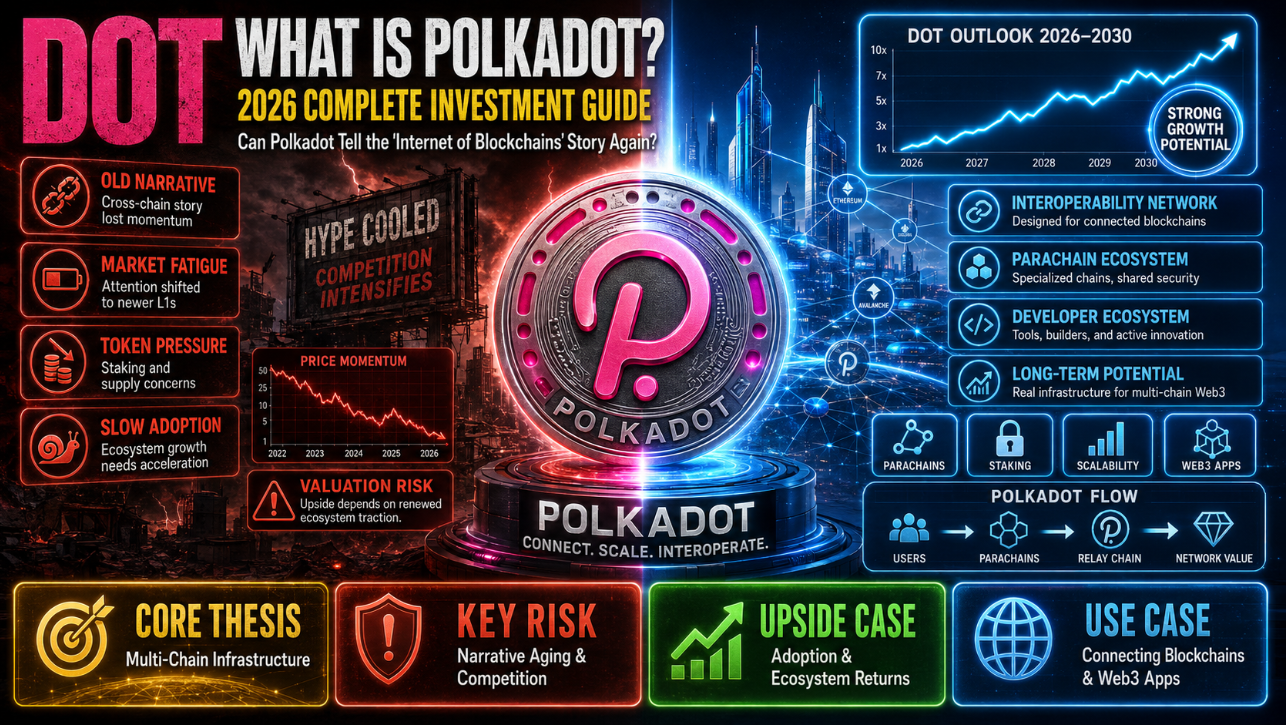
It was a massive, highly compelling pitch. For years, the crypto industry has suffered from siloed ecosystems: Ethereum, Solana, BNB Chain, Avalanche, Cosmos, and Bitcoin operate as isolated digital islands, making it incredibly difficult for assets and data to move freely. Polkadot wanted to build the bridges to fix this problem permanently.
However, by 2026, market sentiment surrounding DOT has grown noticeably complex.
On one hand, Polkadot remains a highly sophisticated technical project with an active development pipeline, robust governance, established parachains, and ongoing upgrades like XCM, Agile Coretime, and JAM. On the other hand, the spot price of DOT has experienced a severe drawdown from its historic peaks, and its market capitalization ranking has slipped significantly. CoinMarketCap data highlights DOT trading around $1.20, with a market cap near $2 billion and a circulating supply of roughly 1.68 billion tokens, placing it around #37 in the global digital asset rankings.
This underscores an important reality: Polkadot isn’t dead, but it has shifted from a speculative, narrative-driven darling into a brutal execution phase. The market is no longer willing to buy into pure technical visions; investors are demanding hard ecosystem data, active user counts, protocol revenue, and an undeniable value-capture model for the DOT token.
This guide is designed to help newcomers navigate three core milestones:
- What exactly is DOT, and how does its architecture differ from a standard Layer 1?
- What stage of its lifecycle is Polkadot in as of 2026, and does the token still offer structural investment value?
- If you choose to allocate capital, how do you purchase DOT on HIBT while managing your risk exposure?
II. What Exactly Is DOT? The Three-Tier Architecture Newcomers Must Know
2.1 Tier 1: The Relay Chain—Polkadot’s "High-Speed Rail Spine"
The absolute nucleus of Polkadot’s design is the Relay Chain.
Think of the Relay Chain as the high-speed rail spine of the entire network. It doesn't host complex end-user applications, nor does it try to force every DApp to deploy directly on the main chain like Ethereum does. Instead, its sole, vital responsibility is supplying ironclad network security, consensus validation, and cross-chain communication.
This contrasts sharply with traditional single-chain architectures. On a standard Layer 1, every application runs on the exact same road. DeFi protocols, NFT mints, games, social dApps, and staking modules are all crammed into one network. When a single application blows up in popularity, the entire highway congests, gas fees spike, and the user experience degrades for everyone.
Polkadot’s thesis is entirely different: the main chain handles only the most critical security and coordination tasks, while specialized applications are offloaded to individual, dedicated chains.
2.2 Tier 2: Parachains—Polkadot’s "Regional Rail Feeders"
Parachains are where the actual applications, smart contracts, and business logic live within the Polkadot ecosystem.
Each parachain can optimize for a specific use case: one might focus strictly on high-throughput DeFi, another on EVM compatibility, a third on privacy-preserving computation, or others on gaming and enterprise solutions.
Crucially, parachains do not have to source or bootstrap their own independent security. By plugging into the Relay Chain, they instantly hook into Polkadot’s shared security umbrella.
This was Polkadot's flagship selling point early on: developers didn't need to spin up a completely independent validator set or convince thousands of miners to secure their new chain from scratch. They could simply rent Polkadot’s collective enterprise-grade security. This lowers the barrier to entry significantly, as bootstrapping a secure consensus layer is one of the hardest, most expensive milestones for any new Web3 project.
2.3 Tier 3: Bridges—Connecting to the Outside World
Polkadot doesn't just want to connect its native internal parachains; its ultimate goal is interoperability with external networks like Ethereum and Bitcoin. This requires bridges.
Historically, cross-chain bridges have been the highest-risk vectors in the crypto space, suffering catastrophic exploits. The engineering behind cross-chain transfers is incredibly complex: you have to cryptographically prove the state of an asset on Chain A, lock or burn it, and mint or release a representative asset on Chain B. If any link in that validation chain breaks, the exploit can be fatal.
Polkadot’s long-term roadmap aims to mitigate these vulnerabilities by leveraging deeply integrated cross-chain communication protocols and shared security primitives. From an investment perspective, however, the mere existence of a bridge isn't a winning thesis. What matters is the velocity of capital: Are users actually routing real value through Polkadot’s infrastructure? Are applications leveraging this multi-chain setup to deliver a superior user experience?
2.4 Who Is Gavin Wood and Why Does He Matter?
Gavin Wood is one of the co-founders of Ethereum, the primary architect of the Solidity programming language, and the author of the Ethereum Yellow Paper. He eventually left Ethereum to realize a more complex multi-chain vision, founding Parity Technologies (the core engineering firm behind Polkadot) and launching the Web3 Foundation.
Wood’s technical prestige gave DOT an immediate pedigree from day one. His fundamental thesis was that the future would not be dominated by a single monolithic chain trying to do everything. Instead, it would belong to an interconnected ecosystem of parallel, application-specific chains communicating seamlessly under a shared security layer.
While his architectural vision was highly forward-thinking and deeply influenced the modern multi-chain trend, technical genius doesn’t guarantee market dominance. Rivals like Ethereum Layer 2s, Cosmos, Avalanche Subnets, LayerZero, and Wormhole are all attacking the multi-chain interoperability problem using entirely different approaches. Gavin Wood is a massive asset to the project, but his technical brilliance shouldn't be your sole reason for buying the token.
2.5 The Three Core Utilities of the DOT Token
DOT is not a simple transaction coin. It drives three core operational loops within the Polkadot network:
                  ┌──────────────────────────────┐
                  │          DOT Token           │
                  └──────────────┬───────────────┘
          ┌──────────────────────┼──────────────────────┐
          ▼                      ▼                      ▼
┌──────────────────┐   ┌──────────────────┐   ┌──────────────────┐
│    Governance    │   │     Staking      │   │  Coretime/Alloc  │
│  On-chain voting │   │ Secured via NPoS │   │ Pay for resource │
└──────────────────┘   └──────────────────┘   └──────────────────┘
- Governance: DOT holders actively dictate the path of the network, voting directly on-chain on runtime upgrades, parameter changes, and treasury capital deployments. Polkadot features one of the most active governance frameworks in Web3.
- Staking: Utilizing a Nominated Proof-of-Stake (NPoS) mechanism, holders back trusted validators with their DOT to secure the consensus layer, earning programmatic staking rewards in return.
- Coretime Allocation and Ecosystem Resources: In Polkadot's early days, DOT's primary demand driver was the Parachain Slot Auctions, where projects had to lock up massive amounts of DOT for years to secure a operating slot. With the rollout of Polkadot 2.0, the network has transitioned away from rigid slot auctions to an agile, on-demand market model known as Agile Coretime. DOT is now used to purchase raw blockspace resources dynamically as needed.
III. What Real-World Problems Does DOT Solve? The Friction of Cross-Chain Interoperability
3.1 The Blockchain Island Problem
The single greatest operational bottleneck in the digital asset landscape is fragmentation. An asset on Ethereum cannot natively interact with Solana; a dApp on Solana cannot seamlessly call a smart contract on Ethereum; and native BTC cannot directly participate in Ethereum DeFi without a wrapped intermediary.
It mirrors the real world prior to globalization: separate sovereign territories operating with different rail systems, distinct fiat currencies, and completely different languages. Cross-chain interoperability is the search for a unified global standard.
It is an incredibly complex engineering hurdle because every blockchain uses completely different consensus mechanisms, virtual machines (e.g., EVM vs. SVM), state structures, and cryptographic models. Building a secure, unified communication framework is far more difficult than deploying a basic wrapped asset token bridge.
3.2 The Shared Security Solved Vector
Polkadot’s primary solution to this vulnerability is shared security. On a standard sovereign Layer 1, the project must manually source validators, bootstrap economic value, and defend its own consensus layer. A parachain plugging into Polkadot, however, instantly inherits the absolute security validation of the entire Relay Chain.
This lowers the technical overhead for spinning up a new blockchain to near zero, while simultaneously making inter-chain communication highly trustworthy. Because parachains aren't completely alien external entities to one another—they exist under the exact same cryptographic security framework—they can interact with a level of trust that external chains cannot match.
3.3 XCM: Polkadot’s Universal Language
XCM (Cross-Consensus Messaging) is the universal language that enables this trust. It is a highly standardized formatting language that allows distinct parachains to exchange rich cryptographic messages, route assets, and trigger remote smart contract actions seamlessly. It isn't a bolt-on token bridge; it’s an underlying communication standard.
In a fully realized ecosystem, XCM unlocks complete cross-chain composability:
- A DeFi protocol on Parachain A can instantly leverage liquidity assets resting on Parachain B.
- A Web3 gaming asset can move seamlessly across multiple separate game worlds running on different chains.
- A single decentralized identity architecture can be instantly reused across the entire ecosystem.
3.4 Operational Realities in 2026
While Polkadot’s theoretical architecture is bulletproof, its core investment challenge has always been converting technical elegance into raw user adoption.
In 2026, Polkadot is in the midst of a massive structural pivot. Upgrades like Agile Coretime, Elastic Scaling, and JAM (Join-Accumulate-Machine) have made blockspace allocation incredibly fluid and cost-effective, but the broader market is still waiting for a breakout consumer application to validate this throughput. Parity’s recent infrastructure upgrades (such as Polkadot SDK 2509) successfully unified Asynchronous Backing, Agile Coretime, and Elastic Scaling into a highly polished tech stack, offering near-instant settlement and on-demand blockspace. For investors, the question is simple: Will this technical optimization successfully onboard a new wave of developers and retail capital?
IV. DOT Tokenomics: Moving Away From Infinite Inflation
4.1 The Legacy Controversies: Structural Inflation
Historically, the loudest bear case against DOT centered on its programmatic token supply model. The network launched without a fixed supply cap, relying on a relatively high inflation rate to continuously fund staking yields and the ecosystem treasury.
For passive token holders who chose not to stake their assets, this model meant their network ownership share was being systematically diluted year-over-year. In the crypto markets, holding a highly inflationary asset passively without offsetting it via staking is a direct recipe for structural underperformance.
4.2 The 2026 Tokenomics Rework
The year 2026 marked a historic turning point for DOT’s monetary policy. Polkadot governance passed Referendum 1710, executing a sweeping structural overhaul of the token’s economic engine.
The network officially instituted a hard maximum supply cap of 2.1 billion DOT. Simultaneously, the inflation mechanism was re-engineered to decay at a rate of 13.14% of the remaining unminted supply every two years, with the first programmatic step triggering in mid-March 2026.
       Old Tokenomics Model                    New 2026 Tokenomics Model
┌────────────────────────────────┐         ┌────────────────────────────────┐
│   • Infinite Token Supply      │   ───►  │   • Hard Cap at 2.1 Billion    │
│   • Permanent High Inflation   │         │   • Two-Year Decaying Inflation│
└────────────────────────────────┘         └────────────────────────────────┘
This structural shift cannot be overstated. By answering the multi-year criticism of "infinite supply dilution," the network has given macro investors a highly predictable supply curve. While it doesn't match the absolute static scarcity of Bitcoin, it is a massive upgrade over the legacy inflationary model.
4.3 Staking Dynamics vs. Spot Volatility
Staking rewards are paid out via programmatic token emissions. For active participants, staking serves as a direct hedge against the remaining localized inflation curve.
However, investors must clearly understand that DOT staking is not a risk-free savings account. You are actively exposing your principal capital to spot market price volatility, validator slashing parameters, and unbonding lockup schedules. If the spot market price of DOT experiences a severe macro decline, your accumulated staking APY will easily be wiped out by capital losses on your principal.
4.4 From Slot Auctions to Agile Coretime
As noted earlier, early ecosystem demand for DOT was driven artificially by Parachain Slot Auctions, which required teams to lock up massive blocks of DOT for up to two years. While this mechanics restricted the active circulating float and catalyzed the 2021 bull run, it introduced an unsustainable hurdle: it was too expensive for early-stage bootstrapped developers and made resource allocation completely rigid.
Agile Coretime completely disrupts this setup by transforming Polkadot’s blockspace into an open, fluid market where computing power can be purchased instantly on demand. While this is an exceptional upgrade for developers, it changes the short-term demand mechanics for the token. Instead of locking millions of DOT out of circulation via auctions, token utility is now driven by ongoing, systemic network consumption and coretime marketplace purchases.
V. The Polkadot Ecosystem Landscape: Assessing the Value Drivers
5.1 Acala and the DeFi Infrastructure
Acala was positioned early on as the decentralized financial hub of Polkadot, deploying native liquid staking, AMM configurations, and multi-chain stablecoin solutions. However, Polkadot’s native DeFi sector has historically struggled to scale its aggregate Total Value Locked (TVL) when compared directly against the deep capital concentration and institutional infrastructure anchoring ecosystems like Ethereum or Solana. The relative thinness of this liquidity layer remains a major structural hurdle for DOT value capture.
5.2 Moonbeam: The EVM Gateway
Moonbeam remains a vital infrastructure layer within the Polkadot ecosystem, acting as a fully EVM-compatible parachain. It allows Ethereum developers to clone and deploy their pre-existing Solidity codebases directly onto Polkadot without undergoing a complete architectural rewrite.
While minimizing developer friction is critical, Moonbeam faces intense competition. The market is saturated with highly liquid, hyper-aggressive EVM environments, including BNB Chain, Polygon, Arbitrum, Optimism, and Base. For an EVM parachain to win long-term, it cannot rely strictly on compatibility; it must leverage Polkadot's cross-chain architectures to offer a unique product that cannot be replicated on a standard Layer 2.
5.3 Specialized Parachains: Astar, Phala, and Bifrost
- Astar: Operates as a prominent multi-chain smart contract platform, commanding a highly respected developer footprint particularly within the East Asian corporate market.
- Phala Network: Focuses on privacy-preserving, off-chain computation, offering highly specialized cryptographic utility for advanced applications.
- Bifrost: Delivers specialized omni-chain liquid staking solutions, optimizing capital efficiency for DOT, KSM, and correlated ecosystem assets.
These applications prove that Polkadot hosts high-quality engineering teams. However, from an investment standpoint, the volume of projects is irrelevant if they fail to attract real users, deep TVL, consistent transaction volume, and out-of-ecosystem capital inflows.
VI. The Competitive Landscape: The Interoperability Arena
6.1 Cosmos: The Sovereign App-Chain Rival
Cosmos and Polkadot are the two legacy titans of multi-chain architecture, but they approach the problem from completely opposite directions:
Metric
Cosmos Network (Tendermint/IBC)
Polkadot Network (Substrate)
Security Model
Sovereign chains; each app-chain must source its own validator security layer.
Shared security model; every parachain inherits the economic backing of the Relay Chain.
Communication
Decentralized message passing via the IBC protocol.
Native, deeply integrated messaging standard via XCM.
Ecosystem Philosophy
Total chain sovereignty and total structural freedom from day one.
Strict architectural unification and structural alignment.
6.2 The Rise of Monolithic Chains and Ethereum Layer 2s
The largest structural threat to Polkadot’s long-term thesis does not come from Cosmos; it comes from the explosive expansion of Ethereum Layer 2 rollups (Base, Arbitrum, Optimism) and hyper-monolithic environments like Solana.
With frameworks like the Optimism Superchain and Arbitrum Orbit offering increasingly seamless inter-rollup bridging under the shared economic settlement of Ethereum, Ethereum is effectively building its own internal "Internet of Blockchains." With the massive distribution edge of networks like Base, mainstream developers increasingly choose to remain within the Ethereum orbit rather than migrating to a completely independent substrate framework.
VII. Market Cycle Analysis: Critical Lessons From DOT's Price Action
The 2021 Peak vs. the Modern Valuation Floor
During the 2021 bull run, DOT surged to an all-time high near $55, fueled by intense speculation surrounding the rollout of Parachain Slot Auctions. The structural lesson from that cycle was a classic text in market psychology: do not confuse programmatic token locking with permanent organic demand. Once the auctions concluded and speculative hype faded, the lack of immediate retail user adoption exposed the asset to a brutal macro correction.
During successive bear market drawdowns, DOT experienced deeper contractions than blue-chip layer 1s, as capital systematically abandoned complex infrastructure plays in favor of spot BTC and ETH. The clear lesson for modern investors is that institutional-grade engineering cannot preserve a premium market valuation if the network fails to generate consistent user fees and economic velocity.
VIII. Step-by-Step Guide to Onboarding and Managing DOT on HIBT
Step 1: Account Setup and Security Hardening
Go to the official HIBT portal, execute account registration utilizing an encrypted email or mobile number, and establish a complex password. Proceed immediately through the mandatory identity verification (KYC) matrix; ensuring your data is accurate avoids compliance withdrawal holds down the road. Once verified, configure your security settings by linking Google Authenticator to establish mandatory Two-Factor Authentication (2FA) for all login and transfer flows.
Step 2: Onboarding Capital (USDT)
Acquire a baseline liquidity layer of USDT. You can buy USDT via HIBT's integrated fiat-to-crypto gateways or route pre-existing USDT balances from an external wallet directly to your HIBT ledger. Always cross-verify your transfer network selections (e.g., TRC-20, ERC-20); processing assets over unmatched networks will result in complete capital loss.
Step 3: Accessing the DOT Trading Desk
Navigate to the HIBT Spot Exchange terminal and query the "DOT" asset ticker.
- DOT/USDT: The ideal trading pair for standard capital allocation, tracking Polkadot’s spot valuation cleanly against the US dollar stablecoin.
- DOT/BTC: Tailored for experienced macro traders monitoring whether Polkadot is gaining or losing relative valuation momentum against Bitcoin.
Step 4: Order Execution Selection
- Limit Orders: Highly recommended for strategic capital accumulation. You define your exact maximum entry price, and the order rests on the book, executing only if the market pulls back to your defined limit.
- Market Orders: Execute instantaneously at the top of the resting order book. Best suited for immediate fills, though vulnerable to local spread slippage during periods of thin market liquidity.
Step 5: Custody Management
Once your order fills, your asset balance will populate within your secure HIBT spot wallet. If your strategy involves short-term technical swing trading or automated rebalancing, maintaining capital within your exchange ledger is perfectly standard.
However, if you are executing a long-term multi-year macro allocation, best practices dictate migrating your tokens to a non-custodial wallet (such as Nova Wallet or a hardware device like a Ledger). Note: Polkadot addresses utilize the specialized SS58 formatting standard; never attempt to route native DOT straight to an EVM-formatted address. Always execute a micro test transfer prior to processing large asset balances.
IX. Advanced HIBT Product Configurations for DOT
- Programmatic Dollar-Cost Averaging (DCA): Setting up an automated periodic purchase schedule via HIBT flattens your macro entry basis, systematically accumulating assets during market corrections while removing emotional timing errors.
- Perpetual Futures Suites: HIBT's integrated perpetual contracts allow advanced traders to execute directional short-term plays with leverage. Warning: Leveraged derivatives carry extreme liquidation risks. Newcomers should completely avoid leverage; a minor 5% adverse market move can completely vaporize your entire margin position under aggressive multipliers.
- Earning and Vault Enhancements: If HIBT offers flexible or fixed savings instruments for DOT, you can opt-in to earn continuous passive yield on your resting balances. Carefully evaluate underlying lockup durations and redemption penalties prior to execution.
X. Strategic Portfolio Allocation Framework
- The Satellite Infrastructure Slot: Do not allow an infrastructure asset like DOT to dominate your core portfolio foundation. Position it strictly as a satellite allocation (e.g., 1%–5% of your total digital asset exposure), keeping the absolute bedrock of your capital anchored firmly in spot BTC and ETH.
- The Valuation Multiplier Comparison: To accurately gauge whether an infrastructure asset is overextended, benchmark its structural mechanics alongside peer networks. You can cross-reference Polkadot's positioning by reading our comparative guides on What Is GRT to evaluate Web3 data querying protocols, alongside What Is MINA to review lightweight zero-knowledge Layer 1 architectures. This provides a clear analytical framework for separating the investment mechanics of a data indexing protocol, a ZK-proof system, and an omni-chain shared security network like Polkadot.
XI. Five Critical Risk Factors Every DOT Investor Must Monitor
- Technical Execution and Delivery Lag: The deployment of cutting-edge architectures like JAM and Elastic Scaling requires near-flawless engineering execution. Technical complexity introduces delivery risk; if upgrades suffer persistent delays or fail to attract developers, the market will continue to compress DOT's valuation multiple.
- The Dilution Matrix for Passive Holders: Even with the newly implemented 2026 supply cap, DOT maintains a programmatic issuance curve to sustain network staking rewards. If you hold tokens passively on an exchange without active staking or yield optimization, your overall network ownership percentage will face ongoing dilution.
- Severe Underperformance Against Blue-Chips: The ultimate risk for any altcoin investor is opportunity cost. Historically, across multiple market phases, DOT has significantly underperformed BTC and ETH. If you are concentrating capital here, you must verify that the ecosystem is generating actual on-chain traction to justify the added risk.
- Failure to Onboard Consumer Adoption: Blockchains do not survive on technical prestige alone. If Polkadot 2.0 fails to secure high-velocity consumer applications, deep transactional volume, and sustainable network fees, the token will struggle to establish an organic valuation floor.
- The Layer 2 Convergence Moat: If the Ethereum L2 ecosystem continues to capture the vast majority of developer mindshare and liquidity, Polkadot's core value proposition as an independent interoperability layer could face permanent marginalization.
XII. Conclusion: The Definitive Verdict on Polkadot
Polkadot is a triumph of blockchain engineering, but a world-class technology stack does not automatically translate into a high-performing investment asset. It is a highly robust network with an immaculate uptime record and a massive war chest of technical talent—yet it faces intense competition from simpler, more liquid monolithic ecosystems and aggressive Layer 2 rollups.
Final Assessment:
DOT is appropriate for patient, long-term infrastructure investors who understand multi-chain architectures, are committed to offsetting inflation via active staking, and are willing to track Polkadot 2.0 and JAM development milestones over multi-year horizons. It is fundamentally unsuited for complete newcomers or as a primary portfolio foundation.
Spot price is a lagging indicator; sustained developer acquisition and structural value capture are the real variables.
FAQ: Common Questions Regarding DOT
What is DOT?
DOT is the native utility token of the Polkadot network, engineered to drive decentralized on-chain governance, protocol staking, network security validation, and dynamic resource allocation via the coretime marketplace.
How does Polkadot differ from a standard Layer 1?
Standard blockchains process all transactions, smart contracts, and dApps on a single shared network. Polkadot implements a specialized multi-chain architecture split between a central coordination layer (the Relay Chain) and an ecosystem of custom, application-specific parallel networks (Parachains) that share its pooled economic security.
Does DOT have a maximum supply cap?
Yes. Following the activation of Referendum 1710 in early 2026, Polkadot transitioned away from its legacy infinite-issuance model to enforce a strict maximum supply cap of 2.1 billion DOT, paired with a predictable, decaying two-year inflation schedule.
Can I trade DOT on HIBT?
Yes. HIBT provides fully integrated spot market liquidity, advanced chart instruments, and dedicated fee structures for DOT trading. Always confirm live trading pairs, contract parameters, and network asset configurations directly within the active HIBT application terminal.
Kindly Reminder
The contents of this article are intended strictly for educational and research purposes and do not constitute financial or investment advice. Digital assets carry extreme spot volatility and structural market risks. Always protect your capital base: maintain strict position sizing parameters, avoid excessive leverage, accumulate in measured tranches, and consistently track verified on-chain metrics across Subscan, official Polkadot governance portals, and live HIBT terminal readouts before committing capital.