
Introduction: SLX is a Newly Launched Token, with Opportunities and Risks Existing Side by Side
SLX is the governance and utility token launched by Solstice Finance. Unlike many projects that adopt a "token first, product later" approach, Solstice had already established a substantial protocol foundation centered around its USX stablecoin and YieldVault yield products before SLX went live. According to DeFiLlama data, Solstice USX currently boasts a TVL (Total Value Locked) fluctuating around $400 million, with its primary deployment on Solana.
This is precisely why SLX captured so much attention upon launch: it isn't a completely blank-slate new token. Instead, it is intrinsically tied to a DeFi protocol that already possesses a proven TVL, functioning yield products, and an established position within the Solana ecosystem.
However, the defining characteristic of any newly launched token is extreme uncertainty. CoinGecko data shows that SLX reached its all-time high (ATH) of approximately $0.3556 on May 25, 2026, before experiencing a rapid and significant retracement, hitting an all-time low (ATL) near $0.155. CryptoRank also indicates that SLX has a maximum supply of 1 billion tokens, a current circulating supply of roughly 242 million, and a 24-hour trading volume that initially surged into tens of millions of dollars.
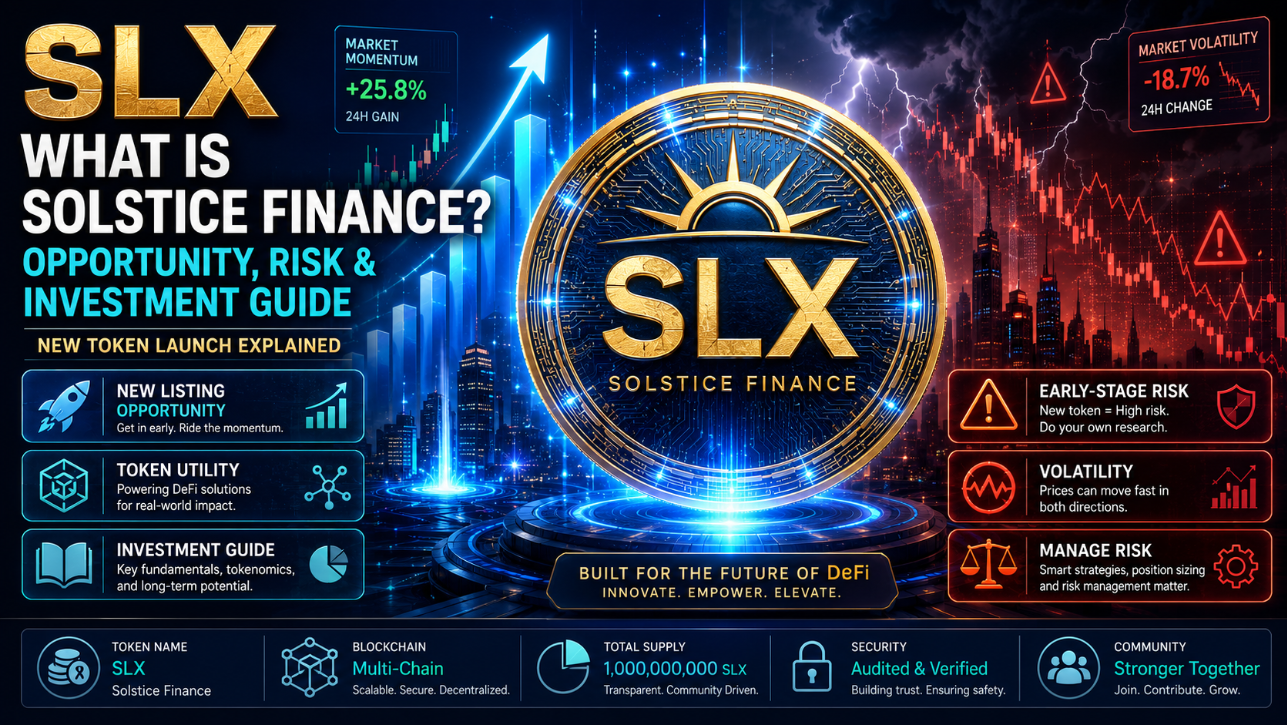
Therefore, the investment logic for SLX cannot be evaluated purely through superficial metrics like "just launched, highly hyped, and massive trading volume." It is far better to break it down across four core dimensions:
- Whether Solstice Finance itself is a real, competitive yield protocol.
- Whether the SLX token can capture genuine, structural demand from the protocol's growth.
- Whether the initial post-launch price correction represents healthy price discovery or a warning sign of early selling pressure.
- How average investors can manage the inherent risks of a new token rather than letting day-one hype cloud their judgment.
As explicitly outlined in your provided framework, SLX is a new token project that demands a multi-faceted analysis spanning protocol fundamentals, tokenomics structure, launch metrics, the purchasing pipeline, and risk management, rather than superficial price predictions.
Chapter 1: What Exactly is Solstice Finance?
1.1 Solstice is Not Just Another Ordinary DeFi Protocol; It Is a Stablecoin Yield Protocol Packaged as "Institutional-Grade Yield"
Solstice Finance is a DeFi protocol built on the Solana ecosystem, whose core product suite revolves around USX, YieldVault, and SLX. Put simply, Solstice aims to allow users to achieve on-chain yields akin to sophisticated institutional strategies by utilizing stablecoin-like assets.
According to Solstice's official website, eUSX is the yield-bearing token users receive upon depositing USX into YieldVault. As delta-neutral strategies generate returns, the underlying value of eUSX grows accordingly.
The essence of this product line does not hinge on "token price speculation" but rather on "whether the yield strategy is sustainable and stable." It is a hybrid model blending on-chain wealth management, synthetic stablecoins, yield-bearing assets, and institutional strategies.
While many crypto newcomers might find the term "institutional-grade yield" incredibly premium, it can be translated into simpler terms:
Solstice wants to package complex yield strategies—which were historically only accessible to institutional players—into an on-chain product that everyday DeFi users can easily access.
In this framework, the biggest allure is the yield, and the biggest risk is also the yield.
- If the source of yield is transparent, the strategy robust, the collateral provable, and risk management stringent, Solstice could become a vital yield infrastructure component within the Solana ecosystem.
- If the yield relies on high-risk strategies, vulnerable market liquidity, or unsustainable token subsidies, it could easily expose structural flaws during black swan market events.
1.2 What is a Delta-Neutral Strategy? Why Do Institutions Love It?
A delta-neutral strategy can be summarized in one sentence: It avoids betting on market direction, choosing instead to harvest yields embedded within market structures.
For example, a strategy might simultaneously hold spot assets while opening an equivalent short futures contract, ensuring that price increases or decreases leave the net value of the overall portfolio relatively unchanged. Its goal is not to profit from asset appreciation, but to capture funding rates, arbitrage spreads, basis spreads, or other structural inefficiencies in the market.
Institutions prefer these strategies because, theoretically, they are far more stable than simply buying and holding a long position. As long as risk management is executed properly, delta-neutral strategies can consistently generate yield even in a flat or volatile sideways market.
However, it is not risk-free.
Extreme market conditions, liquidity crunches, exchange counterparty failures, sudden funding rate reversals, hedging execution failures, collateral volatility, and smart contract bugs can all inflict losses on the strategy. Many DeFi projects package "delta-neutral" as a low-risk buzzword, but retail investors must always remember: Low directional risk does not mean zero risk.
Chainwire press releases regarding the launch of Solstice USX and YieldVault note that Solstice claims its strategies historically achieved a 13.96% Net IRR without recording a single negative month since inception. Furthermore, the project has garnered backing from prominent names like Galaxy Digital, MEV Capital, Bitcoin Suisse, Auros, and Deus X Capital.
While these milestones suggest that Solstice possesses legitimate institutional resources and a verified strategy track record, investors must still continuously monitor whether future yields can be sustained, whether the yields will dilute as the strategy scales up, and how robust it truly proves to be under extreme market stress.
1.3 What are USX, eUSX, and SLX Respecitvely?
The product architecture of Solstice can be divided into three core components:
- USX is Solstice’s synthetic stablecoin and the foundational asset of the protocol. Users use USX to enter the Solstice yield ecosystem.
- eUSX is the yield-bearing token. Users receive eUSX upon depositing USX into YieldVault. As the underlying strategy yields returns, the value of eUSX increases to reflect those gains. Solstice's official website clearly outlines that eUSX serves as the yield-bearing token received when staking USX into YieldVault.
- SLX is the governance and utility token. CryptoBriefing reports note that SLX, introduced by Solstice, functions as the utility and governance token for its ecosystem.
The relationship between these three can be conceptualized as follows:
- USX is the asset gateway.
- eUSX is the yield vehicle.
- SLX represents protocol equity and governance tooling.
The real question investors must ask is: Can SLX capture enough tangible value from the growth of USX and eUSX?
- If USX's TVL expands but SLX remains solely a nominal voting token, the token price may not benefit in the long run.
- If SLX is integrated into revenue distribution, exclusive strategy access, protocol incentives, ecosystem allocations, or other real utility use cases, only then can it foster sustained buying pressure.
1.4 What Does Institutional Backing Signify?
One of Solstice’s primary selling points is its network of institutional resources and partnerships. Publicly available launch materials for Solstice USX reveal that the project is backed by Galaxy Digital, MEV Capital, Bitcoin Suisse, Auros, and Deus X Capital, among others.
This caliber of backing carries three key implications:
- It proves the project is not a completely grassroots, anonymous setup. It is likely superior in early capitalization, liquidity access, market-making partnerships, and strategy execution.
- It aids in cultivating market trust. For yield-focused DeFi protocols, trust is paramount. Users must trust the protocol’s strategy capabilities, risk mitigation frameworks, collateral transparency, and asset security.
- It also implies future token unlocking and selling pressure. Institutional participation is not a permanent net-positive. If institutions acquired tokens at a very low cost basis, the schedule of their subsequent token unlocks or exits will heavily dictate secondary market price action.
Therefore, institutional backing should be treated as an added bonus rather than a reason to buy blindly. Average investors need to watch whether this institutional backing translates into sustained TVL, consistent yields, deep liquidity, and genuine product adoption—rather than remaining purely on a press release level.
1.5 Where is the Differentiation Between Solstice and Ethena, Pendle, or Ondo?
The sector SLX occupies is far from an empty playing field.
- Ethena has already commanded immense market attention through USDe and its yield-bearing stablecoin narrative.
- Pendle dominates the yield-splitting and interest-rate trading niche.
- Ondo is heavily anchored in Real World Assets (RWA) and institutional tokenized US Treasuries.
Solstice’s primary differentiation lies in being Solana-native, utilizing institutional-grade delta-neutral yields, and leveraging its USX stablecoin + YieldVault combination.
- Its Opportunity: The Solana ecosystem boasts blistering speeds, negligible transaction fees, and high user activity, making it perfect for high-frequency DeFi operations and scalable yield products. If Solana continues its expansion, Solstice has a strong chance to emerge as a premier yield infrastructure layer on the chain.
- Its Risk: Yield-bearing stablecoins and institutional DeFi already face fierce competition. Ethena’s USDe possesses a massive first-mover advantage, Pendle captures the dominant mindshare for yield trading, and Ondo leads the compliant RWA narrative. For Solstice to truly stand out, it cannot simply say "we also provide yields." It must actively prove it offers higher capital efficiency, superior risk controls, deeper liquidity, and more reliable yields right on Solana.
Chapter 2: What is the Real Value of the SLX Token?
2.1 A Great Protocol Does Not Automatically Equal a Token Worth Buying
This is the single most critical realization when analyzing SLX.
Many beginners see that Solstice has high TVL, strong institutional backing, and attractive yields, and immediately jump to the conclusion that "SLX is a great buy." This logic is incomplete.
- A great protocol indicates that the product itself is seeing real demand.
- A great token indicates that the token architecture effectively captures the protocol's underlying growth.
These two concepts are fundamentally distinct.
A protocol can generate massive revenue, but if its token is only used for governance without any programmatic value capture mechanisms, the token price can remain stagnant indefinitely. Similarly, a protocol can boast a massive TVL, but if token emissions are too high, early unlocks too aggressive, or utility scenarios too weak, the secondary market price will struggle.
Therefore, when evaluating SLX, you must look beyond how well Solstice Finance is running and analyze exactly what irreplaceable role SLX plays within the overall ecosystem.
2.2 Where Does the Core Value of SLX Come From?
According to public reports, SLX is positioned as the governance and utility token of the Solstice ecosystem. CryptoBriefing reports highlighted that upon its launch, SLX simultaneously opened trading or received ecosystem support across major platforms including Binance Alpha, Gate.io, Bitget, OKX, and MEXC.
The common pitfall of governance tokens is well known: voting power sounds prestigious on paper, but it means very little to the average retail investor. Most retail holders do not actively vote, nor can they realistically tilt the protocol's direction.
Consequently, the real areas of focus for SLX shouldn't be "can it vote," but rather the following questions:
- Does SLX receive a cut of the protocol's revenue distribution?
- Can SLX be used to unlock access to higher-yield exclusive tranches?
- Is SLX dynamically tied to the issuance and velocity of USX and eUSX?
- Are there staking, locking, fee discount, or ecosystem incentive mechanisms tied directly to SLX?
- Does an expanding protocol TVL create structural, programmatic buying pressure for SLX?
If the answers to these questions become increasingly concrete over time, the fundamental thesis for holding SLX strengthens. If SLX ultimately boils down to nothing more than "governance + sporadic airdrops + speculative volume," it will easily fall into the value trap plaguing standard governance tokens.
2.3 Fixed Supply Does Not Equal No Selling Pressure
CryptoRank data reveals that SLX has a maximum supply capped at 1 billion tokens, with its current circulating supply sitting around 242 million. This means a substantial portion of the total supply has yet to enter circulation.
While a fixed-supply model is fundamentally positive—as it provides far more predictability than an inflationary printing model—the absolute crux for any new token is its unlock schedule.
- When do the remaining tokens unlock?
- What percentage is allocated to the team and ecosystem foundation funds?
- What share is held by early seed contributors and market makers?
- Will airdrop claims trigger relentless early dumping?
- What is the projected net increase in circulating supply over the next 3, 6, and 12 months?
These structural distribution mechanics matter vastly more than the headline "1 billion total supply" figure.
The most common trajectory for new tokens is an early low-circulating supply phase. This keeps the initial circulating market cap deceptively small, making it easy for hype to pump the price. However, as the unlock schedule kicks in and supply expands, the token price faces severe structural headwinds. If the protocol's growth rate cannot outpace the velocity of token unlocks, investors will find themselves holding a project that is "doing great fundamentally, but whose token price is perpetually suppressed by unlocks."
2.4 Can the SLX Flywheel Successfully Spin?
The ideal ecosystem flywheel envisioned by Solstice looks something like this:
[USX TVL Grows] ➔ More Capital Enters Protocol
       ▲                               │
       │                               ▼
[SLX Value Rises]            [YieldVault Stays Stable] ➔ More Users Hold eUSX
       ▲                               │
       │                               ▼
[SLX Utility Triggered] ◄─── [Protocol Scales Up] ➔ More Partners & Use Cases
While this flywheel is theoretically sound, it requires validation via hard on-chain data.
The most critical point of validation is this: When USX TVL grows, does SLX experience synchronous, programmatic buying demand? If TVL expands purely because stablecoin yields are attractive, but users have no structural requirement to purchase or hold SLX, the link between token performance and protocol growth remains incredibly weak.
Going forward, do not judge SLX solely by Solstice's TVL. Monitor the SLX staking ratio, unique holder addresses, long-term locking data, governance participation rates, token velocity, and protocol revenue buyback/distribution mechanics.
Chapter 3: What Do Early Post-Launch Metrics Tell Us?
3.1 Retracting from the TGE Day One High: Danger Sign or Normal Market Behavior?
SLX is an incredibly young token. CoinGecko shows it printed an all-time high of roughly $0.3556 on May 25, 2026, before swiftly retracing to an ATL around $0.155.
A sharp spike on day one of a Token Generation Event (TGE) followed by a pronounced pullback is standard market behavior for new listings. It occurs due to multiple overlapping forces: early airdrop recipients locking in risk-free gains, market makers recalibrating liquidity brackets, short-term momentum traders exiting, fragmented price discovery across exchanges, and the market lacking a unified consensus on fair valuation.
Hence, a top on day one does not imply a failed project. But it absolutely confirms that SLX is currently in a highly volatile, unestablished phase of price discovery.
The greatest danger during this period is retail investors confusing "launch hype" with "long-term value." In reality, a token's price action during its first few days is heavily dictated by speculative volume, market maker books, airdrop liquidation pressure, and exchange campaign mechanics—possessing a very loose correlation with long-term fundamentals.
3.2 Is High Trading Volume a Good Sign or an Indicator of Risk?
CryptoRank data indicates that SLX's 24-hour trading volume previously reached approximately $47.13 million, and corresponding CoinGecko data confirms highly active early turnover.
Massive trading volume is a double-edged sword:
- The Bull Case: It reflects strong market interest and deep immediate liquidity, allowing short-term participants to enter and exit positions easily. For a newly launched token, low volume is actually far more dangerous, as the order book can easily be manipulated by thin capital.
- The Bear Case: High volume does not automatically mean organic, long-term accumulation. In the immediate aftermath of a launch, a vast percentage of volume stems from market maker algorithmic adjustments, cross-exchange arbitrage bots, short-term scalpers, airdrop selling, and exchange-incentivized trading campaigns. It generates buzz, but it doesn't mean long-term conviction buyers are building core positions.
Thus, SLX's early volume simply tells us that "price discovery is highly active," not that the asset is fundamentally undervalued.
3.3 The Impact of Synchronous Multi-Exchange Listings
CryptoBriefing reports indicated that upon launching, SLX went live simultaneously for trading or ecosystem support across platforms including Binance Alpha, Gate.io, Bitget, OKX, MEXC, and HiBt.
A coordinated multi-exchange launch brings three primary consequences:
- Liquidity becomes decentralized across multiple venues, which accelerates global price discovery.
- It maximizes immediate retail and institutional exposure, attracting arbitrageurs and scalpers.
- Volatility can become exceptionally violent as market makers and arbitrage bots constantly flatten price spreads between order books.
For the project team, this represents a highly successful exposure launch. For the retail investor, it means navigate-at-your-own-risk volatility. If you buy the top during the initial rush, you risk severe drawdowns. If you wait for a pullback, you face the difficult task of discerning whether the dip is a healthy shakeout or the beginning of a prolonged sell-off driven by unlocks and airdrops.
3.4 How to Assess the Current Risk-to-Reward Ratio?
The hardest part about evaluating SLX right now is the complete lack of structural historical data. It does not possess the multi-cycle price history of legacy assets like BTC, ETH, SOL, or AVAX.
To accurately gauge its risk-reward profile, you must apply a pure new-token framework:
- Short-Term Focus: The primary variables are order book depth, exchange volume rankings, whether the price can reclaim and hold key post-launch support zones, and short-term ecosystem news catalysts.
- Medium-Term Focus: The core metrics are whether USX TVL continues to expand, whether YieldVault yields stay competitive, whether Solstice scales its Solana ecosystem integrations, and whether real utility or staking sinks materialize for SLX.
- Long-Term Focus: The ultimate question is whether Solstice can successfully evolve from a "hyped launch token" into a permanent piece of institutional-grade yield infrastructure on Solana.
The most dangerous assumption a retail investor can make is looking at the current price, seeing that it is substantially down from its brief ATH, and assuming it is automatically "discounted." New token ATHs are often artificial peaks manufactured by peak emotion and thin early liquidity—not fundamentally backed fair value.
Chapter 4: Six Core Variables Shaping SLX's Price Trajectory
4.1 The Solana Ecosystem Dictates the Macro Environment
Because SLX is a native asset within the Solana ecosystem, the overarching performance of SOL and Solana DeFi will heavily dictate SLX's path.
- If SOL remains highly bullish, Solana's aggregate TVL expands, and ecosystem user retention stays high, capital will actively seek out newer, high-yield plays on the chain. SLX will naturally benefit from this tide.
- If SOL experiences a macro downtrend, capital flees high-risk DeFi dApps, and Solana TVL drops, SLX—as a newly launched, lower-market-cap asset—will face significantly amplified downward pressure.
SLX does not trade in a vacuum; it carries a high Solana ecosystem beta. Its upside can be amplified by Solana's growth, but its downside will be equally magnified by any ecosystem corrections.
4.2 TVL Growth is the Absolute Lifeblood of Solstice
One of Solstice's strongest current moats is its existing ~$400 million asset base. DeFiLlama data shows Solstice USX TVL hovering at approximately $3.99 million, entirely deployed across the Solana network.
While TVL is critical for SLX, you must analyze its quality over absolute quantity:
- Healthy TVL growth is driven by sticky organic users, long-term capital allocators, institutional treasuries, and genuine stablecoin yield demand.
- Unstable TVL growth is driven by short-term mercenary capital hunting for airdrop allocations or heavily subsidized, unsustainable token rewards.
The key milestone to watch isn't simply whether TVL ticks up from 400M to 500M, but whether this capital remains loyal once early airdrop campaigns conclude, yields normalize, and market volatility spikes.
4.3 Yield Competition Dictates User Retention
The core engine of Solstice is yield, but DeFi yields are notoriously fluid.
When market funding rates are high, basis trading is lucrative, and on-chain liquidity is abundant, delta-neutral strategies yield excellent returns. However, when the market shifts into a low-volatility, compressed-funding environment, strategy yields will naturally drop.
- If Solstice consistently maintains a superior risk-adjusted yield compared to competing stablecoin products, the structural demand for USX and eUSX will solidify.
- If its yields decay to match standard market baselines, users will immediately pivot back to legacy alternatives with deeper track records, better brand equity, and superior liquidity profiles.
Therefore, the long-term price of SLX is intrinsically linked to Solstice’s ability to generate stable, risk-adjusted returns across vastly different market environments.
4.4 The Unlock Schedule is a Vital 12-Month Variable
The greatest threat to a newly launched token is not a lack of narrative, but an overly aggressive unlock schedule.
With a maximum supply of 1 billion and a current circulating figure of around 242 million, a massive wave of supply is slated to hit the market in the coming months and years. Markets notoriously price in structural unlock risks well ahead of the actual event dates.
- If protocol fundamentals are expanding exponentially, the market may easily absorb the newly unlocked tokens.
- If market sentiment is shaky, upcoming unlocks act as a psychological and structural ceiling on price.
Get into the habit of auditing a new token's precise vesting schedule on data platforms before you ever analyze its candlestick chart.
4.5 Regulatory Headwinds Cannot Be Overlooked
By operating at the intersection of institutional yields, synthetic stablecoins, and structured DeFi products, Solstice operates in a territory heavily scrutinized by global watchdogs.
Stablecoins, yield-bearing assets, institutional onboarding dApps, and synthetic assets are highly sensitive legal topics across jurisdictions like the US, EU, Singapore, and Hong Kong. Should regulatory frameworks tighten in the near future, Solstice may face increased operational costs to maintain compliance, clear audits, geo-fencing, and precise yield disclosures.
While compliance can ultimately serve as a formidable institutional moat, near-term regulatory uncertainty historically suppresses market valuations.
4.6 Established Competitors Like Ethena Compress SLX's Valuation Ceiling
SLX does not operate in a blue ocean. Ethena has already commanded massive mindshare and liquidity within the yield-bearing stablecoin narrative, Pendle retains a iron grip on yield-trading architecture, and Ondo remains the institutional gold standard for compliant tokenized RWAs.
Solstice’s value proposition must remain crystal clear: it must either dominate as the definitive native yield layer for the Solana ecosystem, or conclusively demonstrate that its institutional-grade delta-neutral strategies are safer, more transparent, and more capital-efficient than its multi-chain counterparts. If Solstice is perceived by the market as nothing more than a "Solana clone of Ethena," its long-term valuation ceiling will remain constrained.
Chapter 5: How to Acquire SLX on the HiBt Exchange
For users interested in trading SLX, the execution pipeline on HiBt follows standard exchange practices. (Note: If a token is in its pre-listing phase or temporarily undergoing maintenance, users should reference the official HiBt market tracking page or announcement channel).
5.1 Step 1: Register and Secure Your Account
Before depositing capital to purchase SLX, your absolute priority should be account security, not funding.
Upon registering your HiBt account, immediately bind and activate Two-Factor Authentication (2FA), preferably using hardware keys or authenticator apps. Relying solely on a basic login password leaves you highly vulnerable; if an exchange account is compromised via credential stuffing or phishing, recovering stolen digital assets is exceptionally difficult. Common rookie mistakes include reusing passwords across multiple platforms, neglecting email-linked verifications, and failing to securely back up 2FA master seed keys.
5.2 Step 2: Complete Identity Verification (KYC)
If HiBt enforces Know Your Customer (KYC) compliance policies for trading, depositing, or withdrawing SLX, ensure you clear this hurdle ahead of time.
KYC verification generally mandates submitting valid government-issued identification, clearing a live biometric selfie scan, or providing proof of address. Document verification times vary depending on regional queues. Common reasons for KYC failure include blurry image captures, mismatched data entry, heavy glare on ID surfaces, or attempting to register from restricted jurisdictions. Do not wait for a massive market move to initiate KYC, as a verification bottleneck could cause you to completely miss your desired entry or exit window.
5.3 Step 3: Fund Your Wallet with USDT or Base Assets
The vast majority of newly listed tokens are paired against stablecoins, primarily USDT. If HiBt opens an SLX/USDT spot pair, you will need to secure a USDT balance first.
When executing a deposit, the golden rule is stringent network validation. USDT exists across numerous independent blockchains, including TRC20, ERC20, BEP20, and Solana. You must verify with absolute certainty that your external sending network exactly matches the destination deposit network address provided by HiBt. Selecting mismatched networks will result in permanent asset loss. If you are moving substantial capital from an external wallet or exchange, always send a small test transaction first, verify its successful credit, and only then proceed with the remainder of your funds.
5.4 Step 4: Locate SLX and Execute Your Trade
Navigate directly to the HiBt Spot Trading terminal and input "SLX" into the asset search bar. Once the SLX/USDT interface populates, you can evaluate your execution style.
For highly volatile, newly listed tokens like SLX, retail traders should heavily favor Limit Orders over Market Orders. Early token pairs often suffer from thin, fluctuating order book depth. While a Market Order guarantees instant execution, it exposes you to severe slippage if the order book thins out during a sudden price spike or flush. A Limit Order grants you absolute control over your maximum entry price, ensuring you never buy higher than intended, even if it means your order remains unfilled if the market moves away from you. Avoid chasing green candles; it is far safer to let the market trade for a few hours or days until a clear trading range establishes itself before scaling in with small exploratory sizes.
5.5 Step 5: Post-Purchase Asset and Risk Management
Once your SLX order executes, do not simply sit and stare at your unrealized PnL. You must map out your structural execution plan ahead of time:
- Are you trading this purely for short-term momentum, or holding for a medium-term trend?
- What is the absolute maximum percentage drawdown you are willing to tolerate on this capital?
- At what exact technical price level will your hard stop-loss trigger?
- At what predetermined upside targets will you systematically scale out and take profits?
- If a major institutional unlock date approaches, will you proactively reduce your exposure?
- If Solstice's aggregate TVL starts deteriorating on DeFiLlama, will you cut the position?
These structural choices must be established prior to entering the market, not panicked through during a fast-moving correction. If you choose to migrate your SLX tokens to self-custody wallets to access native on-chain staking or governance pools, triple-check that you are interacting with official protocol domains, verified smart contract addresses, and legitimate wallet approval prompts to avoid draining malicious phishing signatures.
Chapter 6: The Mandatory Pre-Investment Risk Audit for SLX
6.1 The Initial 30-Day Post-Launch Window is the Highest Risk Zone
For a newly listed token like SLX, the primary threat rarely stems from whether the underlying project looks good on paper; it stems from the fact that the token has zero structural price history.
The first 30 days following a TGE are historically defined by intense structural volatility. Airdrop claims hit the market, market makers actively adjust their liquidity spreads, early venture capital or seed participants hunt for liquidity exits, cross-exchange price discrepancies occur, and community sentiment swings wildly. Plenty of tokens look incredibly strong on day one only to enter a multi-week slow bleed. Conversely, others crash aggressively at launch only to be heavily bought up later by market makers. The reality is that retail investors cannot accurately predict which path an unvetted token will take. Treat new listings as small-size experimental allocations, never as core foundational positions.
6.2 Protocol Architecture Risks Greatly Outweigh Simple Price Volatility
When you hold SLX, you are implicitly underwriting the technical and structural risks of Solstice Finance’s underlying strategies:
- Delta-neutral hedging mechanisms can fail or suffer execution lags during extreme, fast-moving market liquidations.
- The centralized or decentralized exchanges where Solstice routes its short hedging legs can experience liquidity blackouts or counterparty defaults.
- The core collateral backing USX could experience unexpected de-pegging or discount hair-cuts.
- Smart contract vulnerabilities or flash loan exploits can bypass audits and compromise the YieldVault infrastructure.
These structural vectors do not show up on a daily price chart, but if a failure occurs, the capital destruction can be absolute.
6.3 Unlock Pressure is a Variable That Demands Continuous Tracking
In any rigorous new token investment framework, the token emission curve must sit at the very top of your risk assessment sheet. Because SLX’s circulating supply represents only a fractional slice of its total 1 billion supply, a steady stream of tokens assigned to the core team, ecosystem foundations, private round investors, and ongoing liquidity incentives will continuously flow into the market. If protocol adoption and cash flow expand fast enough, the market can absorb this supply. If growth stalls, the unlock schedule becomes a persistent weight on price.
6.4 Do Not Confuse Trading Volume with Deep Organic Liquidity
Extremely high trading volume during a launch window is rarely an indicator of deep, structural, organic liquidity. A massive percentage of early volume is artificially generated by automated high-frequency market maker algorithms, cross-venue arbitrage scripts, and high-turnover day traders. True liquidity must be audited by looking closely at the actual order book depth, the bid-ask spread percentage, the price slippage cost for executing large blocks, and cross-exchange price stability. If you are trading with negligible capital, you will likely notice no friction. If your position size scales up, you will quickly find yourself pushing the price up on entry and driving it down on exit—a hidden, costly drag unique to young tokens.
6.5 The Five Questions You Must Answer Before Buying SLX
Do not authorize an SLX buy order until you can confidently answer these five fundamental questions:
- Do I accurately understand exactly where Solstice’s underlying yield originates, and can I explain its strategy mechanics?
- Am I fully aware of the exact dates and scales of the upcoming SLX token unlocks over the next 12 months?
- Is my personal portfolio psychology stable enough to handle a swift 50%+ drawdown on this position without panic-selling?
- Am I executing this trade to scalp short-term narrative momentum, or am I allocating capital based on long-term protocol cash flow capture?
- Will I immediately exit or re-evaluate my position the moment I see USX TVL or YieldVault APYs drop significantly?
If you cannot answer these questions clearly, you have no business taking a large position.
Chapter 7: Customizing Your SLX Investment Strategy by Risk Profile
7.1 Short-Term Scalpers: Trade the Volatility, Ignore the Faith
For momentum day traders, the operational thesis for SLX is incredibly straightforward: track volume profiles, monitor order book imbalances, scan exchange trending lists, and execute purely off technical price catalysts. You do not need to believe in Solstice’s 10-year vision to trade it. Your only objective is confirming that speculative capital is flowing into the pair, key local resistance zones are breaking, and pullbacks are meeting strong limit-order support. Hard stop-losses are mandatory; when a newly listed token breaks local support levels, the cascading drop can be instantaneous. Never let a short-term scalp turn into an involuntary long-term hold just because you are reluctant to take a small loss.
7.2 Medium-Term Trend Followers: Require Fundamental Metric Validation
If your target holding period spans roughly 3 to 6 months, stop hyper-focusing on 5-minute candlestick charts and start auditing Solstice’s macro fundamental metrics on a weekly basis:
- Is USX’s aggregate TVL showing steady, month-over-month expansion?
- Are the YieldVault strategy APYs holding steady relative to major market competitors?
- Is organic on-chain capital continuing to flow into the Solana ecosystem?
- Has the team rolled out concrete, functional staking sinks or fee-capture utility for SLX?
- Is trading volume transitioning away from volatile launch speculation toward stable, organic baseline turnover?
If these underlying metrics show linear improvement, your medium-term holding thesis remains intact. If the token price pumps while these data points decay, the move is driven purely by short-term sentiment and should be treated with extreme caution.
7.3 Long-Term Conviction Holders: Betting on the Definitive Institutional Yield Layer of Solana
To hold SLX for the long haul, you are making a concentrated bet that Solstice will successfully cement itself as a dominant, institutional-grade yield infrastructure pillar across the entire Solana ecosystem. This requires the protocol to maintain flawless security, absolute asset transparency, scalable strategy execution, and ironclad risk management over multiple market contractions. Furthermore, it requires the SLX token architecture to successfully extract structural value from that protocol growth.
Given that SLX is a newly minted asset with an unproven track record, a large uncirculated supply, and heavy competitive pressures, the long-term risk profile is exceptionally high. Long-term conviction should never be used as an excuse for reckless over-allocation.
7.4 Portfolio Allocation Guide: SLX Belongs Strictly in the Satellite Tranche
Assets featuring low market caps, fresh listings, and high volatility profiles like SLX should be strictly siloed within your high-risk "satellite" portfolio tranche, completely separate from your core foundational holdings.
Investor Risk Profile
Recommended Stance & Allocation Strategy
Conservative Investors
Monitor from the sidelines; maintain a 0% allocation until track records stabilize.
Moderate Investors
Utilize a fractional, negligible allocation purely to experiment with ecosystem tools.
Aggressive Investors
Maintain strictly capped position sizing; never scale beyond capital you are completely comfortable losing.
The great illusion of newly listed tokens is how fast they can run up. The great equalizer is how fast they can erase those exact gains.
Chapter 8: The Macro Long-Term Thesis: Where is the Ceiling for RWA and Institutional DeFi?
The structural upside narrative for SLX relies heavily on several secular macro trends:
- The Yield-Bearing Stablecoin Megatrend: The global demand for digital dollar surrogates that do not just store value, but programmatically yield returns on-chain, is growing rapidly. Users expect their capital to work for them.
- Institutional On-Chain Migration: Institutional allocators moving capital into the DeFi space require mature, transparent financial primitives. Pure meme projects, algorithmic farm emissions, and highly volatile triple-digit APR yield farms cannot attract sticky institutional treasuries. If Solstice proves it can scale verifiable, institutional-grade delta-neutral strategies, it can capture incredibly high-quality TVL.
- Solana’s Infrastructure Dominance: Should Solana maintain its trajectory as a leading public layer-1 network, its high transaction speeds and minimal fees provide the ideal playground for running complex, high-frequency DeFi strategy rebalancing—giving Solstice a distinct operational edge over protocols locked on high-fee networks.
- The Convergence of DeFi and RWA: While Solstice currently focuses on delta-neutral crypto strategies, the long-term merging of on-chain synthetic assets with tokenized real-world credit, treasuries, and institutional strategy access could massively broaden SLX’s addressable market.
However, a brilliant long-term macro thesis does not guarantee that the SLX token will appreciate.
The ultimate hurdle remains token value capture. If Solstice successfully scales its TVL to billions of dollars, but the SLX token lacks programmatically enforced revenue claims, mandatory utility locks, or deflationary supply-sink mechanisms, the protocol's success will fail to reflect in the token's price. This remains the definitive structural challenge that all governance tokens must navigate.
Conclusion: Investing in SLX is a Simultaneous Bet on Three Distinct Pillars
Allocating capital to SLX is far more nuanced than betting on a generic new token listing pump or looking at Solstice's headline TVL figures. It is an implicit wager that three distinct structural conditions will prove true simultaneously:
               ┌─────────────────────────────────────────┐
               │    1. Solana DeFi Scales Hyper-Growth   │
               └────────────────────┬────────────────────┘
                                    │
                                    ▼
               ┌─────────────────────────────────────────┐
               │ 2. Solstice Maintains Yield Integrity   │
               └────────────────────┬────────────────────┘
                                    │
                                    ▼
               ┌─────────────────────────────────────────┐
               │  3. SLX Token Architecture Successfully │
               │          Captures Protocol Value        │
               └─────────────────────────────────────────┘
- If you have strong conviction that all three variables will align, SLX represents a highly compelling addition to your programmatic asset watchlist.
- If you believe Solstice is an excellent yield protocol but remain highly skeptical of SLX’s structural value capture mechanics, your exposure should be kept strictly nominal.
- If you are attempting to enter the position purely because it is a fresh listing with high volume that looks "cheap" compared to its day-one ATH, you are taking on an extraordinary amount of uncompensated risk.
The Bottom Line: SLX is a newly launched Solana DeFi token that warrants close analytical monitoring, but it remains in its absolute infancy regarding price discovery. Short-term performance will be dictated by speculative hype and liquidity flows; medium-term trends will depend on USX TVL and YieldVault APY metrics; long-term survivability hinges on Solstice cementing itself as a permanent institutional yield protocol on Solana. Dive into the data, run your own audits, and manage your position sizing with extreme discipline.
FAQ: Frequently Asked Questions Regarding SLX and Solstice Finance
What kind of cryptocurrency is SLX?
SLX is the native governance and utility token of the Solstice Finance ecosystem. Solstice operates as a specialized DeFi yield protocol within the Solana ecosystem, built around its flagship USX synthetic stablecoin and YieldVault strategy structures. The structural long-term valuation of SLX depends entirely on whether it can capture tangible utility demand as the protocol scales.
What exactly does Solstice Finance do?
Solstice Finance engineers stablecoin-based wealth management products centered on USX, eUSX, and YieldVault. By running institutional-grade, delta-neutral yield strategies, it packages complex institutional financial frameworks into user-friendly on-chain products for everyday DeFi participants. As stated on Solstice’s web domain, eUSX serves as the yield-bearing asset issued programmatically to users who stake their USX into the YieldVault system.
Why did SLX command so much market attention immediately upon launch?
Unlike a standard speculative token launch backed by nothing more than a whitepaper, SLX went live alongside a functioning protocol with substantial capital already locked in. DeFiLlama records show that Solstice USX commands a TVL floating around the $400 million range. This existing capital baseline, combined with simultaneous support from prominent global trading platforms, triggered high early trading volumes.
What are the primary risk factors associated with SLX?
The core risks include severe early-stage price discovery volatility, an impending wave of circulating supply unlocks, technical execution risks inherent to delta-neutral trading strategies, broader Solana network macro fluctuations, aggressive competition from sector leaders, and the risk of weak value-capture architecture within the token itself. Always separate the operational growth of the Solstice protocol from the independent price action of the SLX token.
Is right now an appropriate time to purchase SLX?
This depends entirely on your personal capital risk parameters. If you are an inexperienced market participant, chasing green candles or allocating substantial capital into a fresh listing is highly discouraged. A far more calculated approach involves waiting for a defined, multi-week price range to establish itself while closely auditing ongoing USX TVL trends, YieldVault net strategy performance, token emission velocity, and upcoming utility integrations. Treat new assets as experimental size plays.
Is SLX a viable candidate for long-term buy-and-hold strategies?
A long-term holding strategy is only logical if you have thoroughly back-tested the project and genuinely believe that Solstice will emerge as a definitive institutional yield infrastructure layer on Solana, and that the SLX tokenomics are programmatically optimized to capture that growth. Lacking that conviction, SLX should be managed strictly as a high-volatility speculative asset rather than a foundational multi-year portfolio hold.
⚠️ Risk Disclaimer
The analytical content presented within this document is structured exclusively for educational, research, and informational purposes and does not constitute financial, investment, or professional advice. SLX is a highly volatile token that launched in May 2026 and remains in a fragile state of early price discovery. CoinGecko data explicitly highlights that the token has already experienced steep, rapid drawdowns from its initial lifetime highs shortly after going live.
Investing in newly launched cryptographic assets carries a vastly higher risk profile than allocating capital to legacy, blue-chip networks. Never allow headline TVL figures, institutional investor rosters, or prominent exchange listings to blind you to the stark realities of structural price volatility, impending token unlock pressure, and smart contract execution risks. A retracement from an all-time high should never be lazily interpreted as a buy signal or a guaranteed discount.
The only professional approach to navigating new assets is to thoroughly audit the protocol architecture, break down the vesting schedules, observe early market movements with minimal capital, and ruthlessly verify project claims using hard on-chain data. If your personal financial position cannot comfortably absorb a total write-off of your principal capital, you should not be participating in new token listings.
About the Author
Author: Lucas | Web3 SEO & Crypto Research
Lucas is a veteran market analyst focusing heavily on digital asset trends, exchange infrastructure, Web3 growth vectors, and Google SEO data-traffic architecture. His research focuses on crypto asset price modeling, exchange scaling mechanics, detailed on-chain data forensics, Layer-1/Layer-2 ecosystem friction, public chain competitive landscapes, tokenized RWAs, DeFi frameworks, stablecoin yield primitives, and retail investor risk education.
When compiling structural research, Lucas prioritizes building rigorous logical frameworks over distributing speculative, arbitrary price targets. He specializes in deconstructing the long-term value of digital assets by evaluating core project fundamentals, macro market cycles, programmatic on-chain metrics, sector competition, token economics, risk mitigation, and market sentiment. This comprehensive analysis of SLX and Solstice Finance is built specifically to empower readers to develop rigorous, independent market judgment rather than relying on singular conclusions to execute investment decisions.