
ANTFUN is the token of the AntFun ecosystem. AntFun is not simply building a narrative around a single token; it is trying to integrate a non-custodial wallet, DEX trading, on-chain data, wallet monitoring, social channels, and an AI assistant into one product.
This gives ANTFUN more research value as a product than an ordinary meme coin, but it also raises a question that is often overlooked: a platform having user value does not mean ANTFUN will necessarily capture that value. Users may like AntFun’s quotes, wallet tracking, or social features without necessarily having to buy or hold ANTFUN long term.
Therefore, my current view of ANTFUN is this: the product direction is worth tracking, but the token still needs to pass four checks: real adoption, value capture, supply transparency, and market liquidity. Until these conditions are met at the same time, one should not conclude that ANTFUN is a long-term bullish bet simply because of the Social DEX, SocialFi, or AI trading narrative.
As of October 26, 2026, the ANTFUN live quote can be used to observe price, price changes, and trading activity, and the ANTFUN price prediction can serve as a reference for model expectations, but neither can replace verification of the contract, product, supply, and liquidity.
Data note: The market data in this article was captured at Beijing time on October 26, 2026. Crypto asset prices, supply, trading channels, and depth change continuously, so they must be reconfirmed before any actual trade.
8 Things to Know Before Investing in ANTFUN
- AntFun’s core positioning is a Social Trading Wallet and Social DEX, not a product under Ant Group.
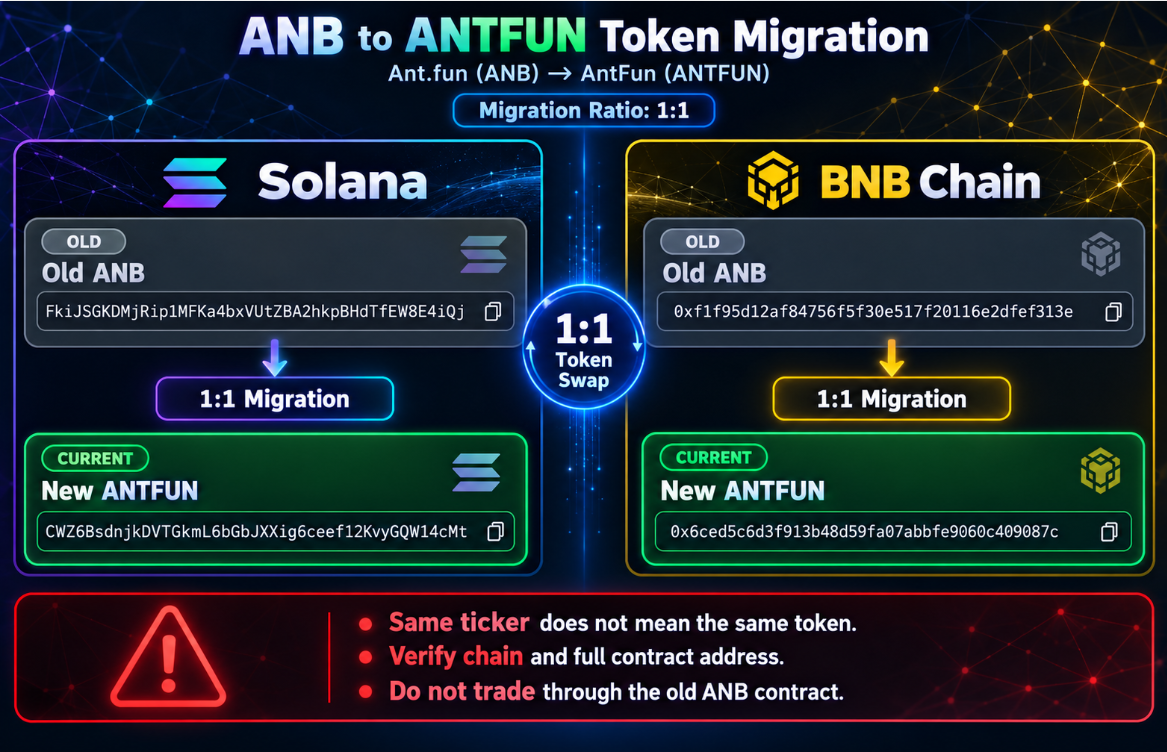
- The project has been renamed from ANB to ANTFUN and involves a 1:1 replacement of old and new contracts on Solana and BNB Chain.
- The new Solana contract is
CWZ6BsdnjkDVTGkmL6bGbJXXig6ceef12KvyGQW14cMt. - The new BNB Chain contract is
0x6ced5c6d3f913b48d59fa07abbfe9060c409087c. - Products publicly listed on the official website include the wallet, DEX trading, on-chain analysis, channels, wallet tracking, alerts, and social trading.
- Product features and token utility must be verified separately. At present, governance, buybacks, or burns cited by third parties cannot all be treated as already executed mechanisms.
- Public platforms show a maximum supply of 10 billion tokens and a circulating supply of about 1.888 billion tokens. A low float ratio can magnify FDV and future supply risk.
- “Where to Buy ANTFUN” cannot simply list exchange names. It must also confirm spot or futures, network, full contract, and actual depth.
1. What Exactly Is ANTFUN Token? First Verify the Relationship Among ANT.FUN, ANB, and ANTFUN
What is the relationship between ANT.FUN and AntFun?
ANT.FUN was the product name commonly used by the project before. AntFun is the current brand expression, and ANTFUN is the token ticker used after migration. CoinMarketCap’s asset page explicitly states that Ant.fun (ANB) has been renamed AntFun (ANTFUN), and the old Solana and BNB Chain contracts migrate 1:1 to the new contracts.
Two things need to be distinguished:
- A brand rename changes the name used for the project and token;
- A contract migration changes the on-chain asset address and involves how old tokens are swapped for new tokens.
This means that price, holder, liquidity, and supply data for old ANB cannot be applied directly to new ANTFUN without qualification. If a wallet still shows ANB, that does not mean the asset still has normal liquidity or will be accepted by trading platforms.
What are the old and new contracts?
According to the explorer records linked from CoinMarketCap, the currently verifiable addresses include:
- New Solana ANTFUN:
CWZ6BsdnjkDVTGkmL6bGbJXXig6ceef12KvyGQW14cMt - Old Solana ANB:
FkiJSGKDMjRip1MFKa4bxVUtZBA2hkpBHdTfEW8E4iQj - New BNB Chain ANTFUN:
0x6ced5c6d3f913b48d59fa07abbfe9060c409087c - Old BNB Chain ANB:
0xf1f95d12af84756f5f30e517f20116e2dfef313e
Solscan shows that the new Solana contract is named AntFun, has 6 decimals, and its Authority is currently marked N/A. The old contracts still have on-chain records, but existence does not mean they are still the target assets the project recommends for trading.
Is ANTFUN on Solana the same asset as ANTFUN on BNB Chain?
From the perspective of project migration and market aggregation, ANTFUN on the two chains is tracked as the same brand asset, but they are still two contracts on different networks, with their own trading pools, liquidity, and on-chain holders.
Users cannot treat tokens on the two chains as the same balance that can be freely transferred directly between them. If cross-chain transfer is needed, use migration or cross-chain channels explicitly supported by the project and verify:
- Whether the sending network and receiving network match;
- Whether the platform supports deposits and withdrawals on the corresponding chain;
- Whether the bridge used is a project-approved channel;
- Whether the target chain has sufficient liquidity;
- Whether what you receive after migration is the new ANTFUN contract.
There is also a boundary worth stating clearly here: AntFun documentation still lists Solana as the current main product chain and BNB Chain as an expansion direction; however, the new BNB Chain contract and PancakeSwap market already exist. Therefore, “the token already circulates on BNB Chain” should not automatically be written as “all AntFun product features fully support BNB Chain.”
Is ANTFUN related to Ant Group?
There is no official relationship. AntFun’s disclaimer explicitly states that the platform has no affiliation, cooperation, investment, authorization, or business relationship with Ant Group, Alipay, or their affiliates.
If the investment case is based on “it might be Ant Group’s Web3 project,” you should stop immediately. Based on the project’s official disclaimer, that judgment is simply wrong.
2. What Is AntFun? What Problems in DEX Trading Is It Trying to Solve?
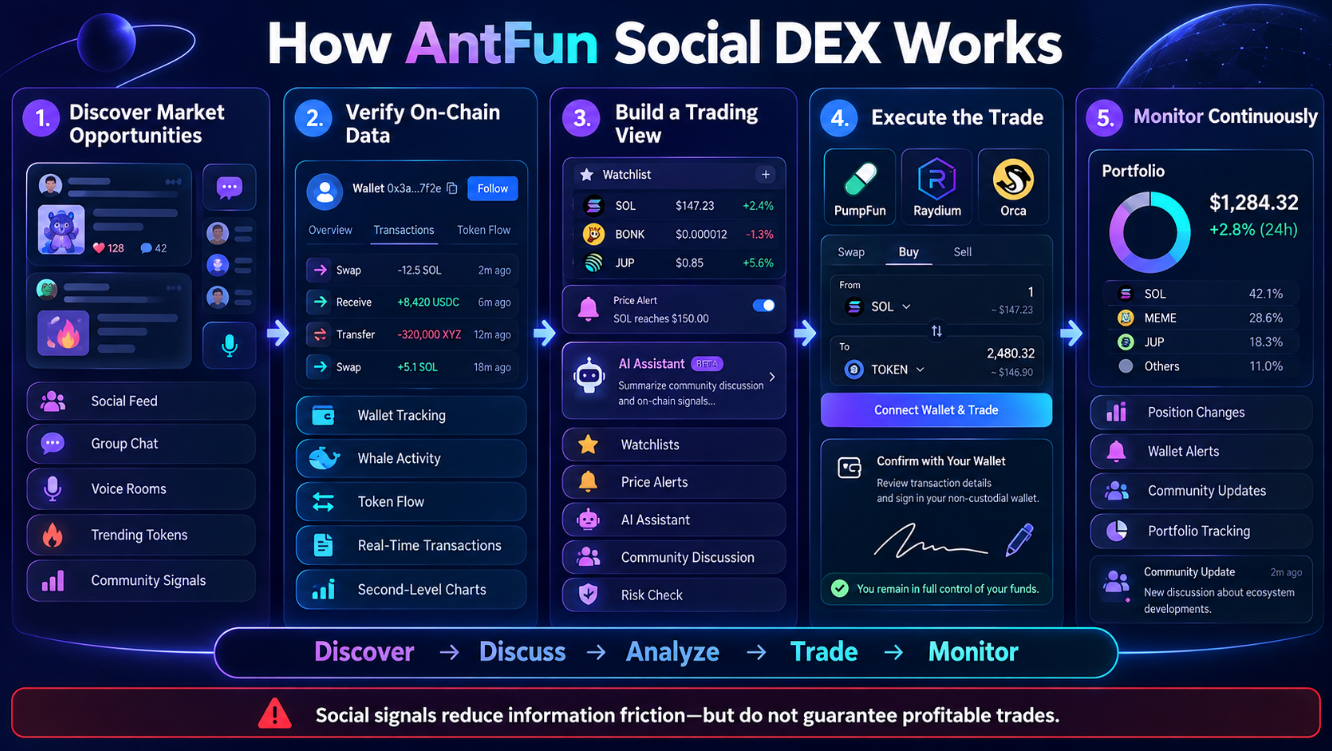
Ordinary on-chain traders often switch back and forth between multiple tools: first discovering a project on social media, then opening a quote website to check the price, then going to a block explorer to track wallets, and finally moving to a DEX to complete the trade. This switching process not only increases operating costs but may also cause traders to miss brief market opportunities.
AntFun tries to compress this path into one product. According to the official documentation, its positioning is a Web3 Social Trading Wallet that integrates a self-custodial wallet, DEX trading, real-time market discovery, social rooms, an AI assistant, and community trading signals into the same platform.
What core features have been disclosed?
Features disclosed in AntFun documentation mainly include:
- Connect, create, or import a non-custodial wallet;
- Trade on markets such as PumpFun, Raydium, and Orca;
- View second-level candlesticks, prices, volume, and on-chain transactions;
- Create up to 5 channels, each monitoring up to 200 wallet addresses;
- Subscribe to other channels and receive wallet activity signals;
- Create watchlists and custom price alerts;
- View on-chain activity of whale wallets, project addresses, and other public addresses;
- Use social channels, group chats, voice rooms, and trade feeds;
- Use the AI assistant to query prices or addresses or help set up trades.
The product page also shows broader trading directions such as stocks, forex, RWA, meme coins, and perpetual contracts. When publishing an article, separate “the product vision shown on the website” from “features users can currently execute reliably.” In particular, livestreaming, prediction markets, and some multi-chain features may still be rolling out.
How is AntFun different from an ordinary DEX aggregator?
The core value of an ordinary DEX aggregator is usually finding better trading routes and quotes. AntFun aims to cover the entire process of “discovery—discussion—verification—trading—review.”
Its differentiation is not simply adding more market data, but trying to let users observe trusted addresses in channels, discuss trading views, view on-chain actions, and directly initiate trades. In theory, this can reduce tool switching and information delay.
But this model also adds new risks: social signals can be wrong, popular channels can amplify momentum-chasing sentiment, and so-called smart wallets may be selling their holdings to followers. Social features improve trading efficiency, but they do not necessarily improve investment outcomes.
Do the feature lists already create a moat?
It is not yet possible to conclude based only on feature count. Wallet tracking, alerts, social channels, and DEX trading can all be copied by other products. A real competitive moat needs to be reflected in:
- Whether users retain long term;
- Whether high-quality traders and communities create network effects;
- Whether wallet labels and signals are accurate;
- Whether data speed, execution experience, and security are stable;
- Whether social information helps users improve decisions rather than create more noise.
What is most worth verifying about AntFun is not “the feature list looks long,” but whether these features can keep users coming back and generate real trading activity.
3. What Value Do Social Trading and AI Analysis Provide? Signals Are Not Profits
What can wallet address tracking reveal?
On-chain addresses are public, so users can observe target wallets’ buys, sells, transfers, and position changes. Channel features can combine multiple addresses and reduce the cost of manually refreshing a browser.
It can help users discover:
- Whether certain wallets are starting to buy an asset intensively;
- Whether project or early addresses are transferring tokens to trading pools;
- Whether large funds are moving between multiple addresses;
- Whether a trader has recurring trading patterns;
- Whether capital activity in hot assets is synchronized with social discussion.
Why can following large holders still lead to losses?
Public wallets only show on-chain actions, not the full strategy. An address buying a token may simultaneously be shorting on a centralized exchange, or it may be only one of multiple wallets. Followers usually cannot see the full cost basis, position size, and risk budget.
In addition, there is delay in signal propagation. Large holders buy at low prices first, an alert appears in a social channel, and by the time users chase the trade, the price may already have risen significantly. Then the large holder sells, while followers bear higher costs and worse liquidity.
Therefore, wallet signals are better used as research leads, not as buy or sell instructions to copy directly.
Can AI analysis accurately predict markets?
AI capabilities need to be broken into three layers:
- Information organization: quickly summarize on-chain transactions, prices, and social content.
- Signal identification: flag abnormal wallet activity or potential opportunities from large datasets.
- Strategy effectiveness: after deducting slippage, fees, and failed trades, whether the signal can generate positive returns over the long term.
The first two layers can improve research efficiency; the third determines investment value. If the project has not disclosed enough historical samples, drawdowns, failed signals, and net returns, the AI assistant cannot be described as a proven prediction system.
4. What Is ANTFUN Token Used For? How Does Product Value Flow to the Token?
This is the most critical question in the entire article. Growth in platform trading volume will not automatically make ANTFUN rise. There must be a verifiable connection between product use and token demand.
Which use cases can already be confirmed?
Official documentation confirms that AntFun has a referral program: after users invite other traders, they can earn commissions based on the invited users’ trading activity. The documentation also states that some advanced features or higher usage limits may charge fees in the future.
However, based on public documentation, there is still a lack of a sufficiently complete, clear, and independently verifiable new ANTFUN Tokenomics page that simultaneously explains:
- Which features must use ANTFUN;
- Whether it carries governance voting rights;
- Whether it is used for fee discounts or membership;
- Whether staking exists;
- Whether buybacks or burns are used;
- The buyback ratio, funding source, and execution address;
- Which asset is actually used to pay referral rewards.
Third-party materials mention governance, referral commissions, and burn mechanisms as leads to be verified, but they cannot be written directly as official facts that have already been executed.
Why does user growth not necessarily push ANTFUN higher?
Three links must be completed in sequence:
Platform user growth → real revenue or usage demand → users must buy or consume ANTFUN.
If traders can use SOL, USDT, or other assets to complete all core functions, and ANTFUN is only an optional reward or a market trading asset, then the relationship between product growth and token demand is relatively weak.
Even if ANTFUN can receive fee discounts, you still need to judge whether the fees saved are enough to encourage users to hold long term; even if rewards exist, you need to judge whether the rewards will become persistent sell pressure.
How can buyback or burn mechanisms be verified?
If the project later announces buybacks or burns, at least the following should be verified:
- Which product activities generate the fees;
- Whether revenue data can be publicly verified;
- The percentage used for buybacks and the execution schedule;
- Whether market buy transactions can be traced on-chain;
- Burn addresses, amounts, and cumulative supply changes;
- Whether the project retains the right to adjust or terminate the mechanism.
“Planned buyback” is not the same as “continuous buyback,” and “sent to an address” does not necessarily mean “permanently burned.”
5. ANTFUN Tokenomics: What Does a 10 Billion Supply Mean?
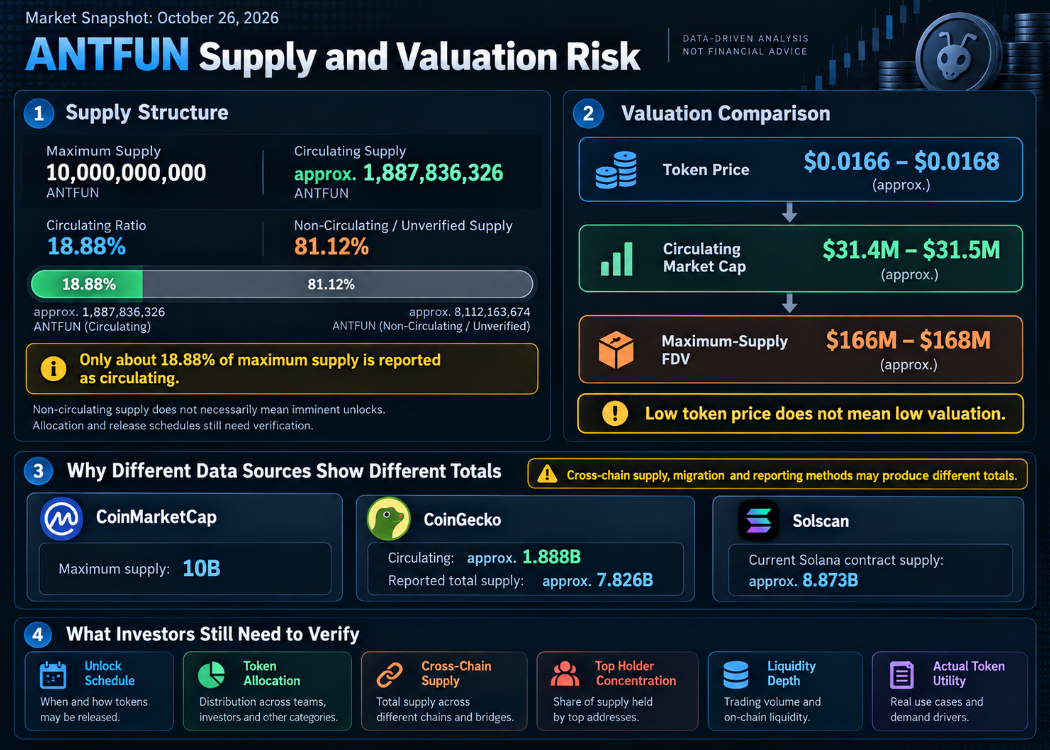
As of October 26, 2026, CoinMarketCap shows ANTFUN’s maximum supply as 10 billion tokens, circulating supply at about 1.8878 billion, and a circulating ratio of about 18.88%. CoinGecko also shows close to 1.888 billion circulating, but its total supply metric is about 7.826 billion; Solscan shows current supply for the new Solana contract at about 8.873 billion.
These figures are not fully consistent and may be affected by cross-chain supply, migration, burns, snapshot timing, and data platform methodology. The article cannot choose only the most favorable number to reach a conclusion.
What does a circulating ratio below 20% mean?
Based on the maximum supply:
Circulating ratio=10B/1.8878B≈18.88%
This means the market currently forms a price using relatively little circulating supply, while a large amount of maximum supply has not yet been counted as circulating. But it does not mean the remaining tokens will immediately enter the market, nor does it mean all non-circulating portions belong to the team.
Investors must continue to look for allocation, lockups, cross-chain mapping, and release plans. Without a complete unlock schedule, a low circulating ratio is itself an information-transparency risk, not a bullish factor of “fewer coins so it is easier to rise.”
How should circulating market cap and FDV be calculated?
On October 26, 2026, CoinMarketCap and CoinGecko price snapshots were about 0.0166–0.0168, with circulating market cap about 31.40–31.50 million.
If calculated based on 10 billion maximum supply:
Max-supply FDV≈0.0167×10B≈$167M
The CoinGecko page at the time showed FDV of about $130.4 million, closer to a calculation based on its “total supply of about 7.826 billion tokens.” This shows different platforms may use different denominators for FDV.
Therefore, when writing “What is ANTFUN’s FDV,” the calculation basis must be specified:
- Calculated on circulating supply, it is circulating market cap;
- Calculated on currently reported total supply, it is one type of diluted valuation;
- Calculated on 10 billion maximum supply, it is a stricter max-supply valuation.
This difference itself is a data risk investors need to note.
What other supply risks should be checked?
- Who owns non-circulating tokens;
- Whether there are team, foundation, marketing, or ecosystem reserves;
- Whether there are clear lockups and monthly unlocks;
- Whether Solana and BNB Chain supply is double-counted;
- Whether cross-chain migration uses lock-and-mint or another model;
- Which of the top ten addresses belong to exchanges, liquidity pools, or project-controlled addresses;
- Whether large addresses continuously transfer tokens to trading markets.
ANTFUN’s low unit price does not mean low valuation. What determines risk is total supply, FDV, future circulating supply, and real demand.
6. Where to Buy ANTFUN? Which Purchase Channels Can Currently Be Verified
As of October 26, 2026, the ANTFUN spot markets verifiable on CoinGecko mainly include Meteora, PancakeSwap V3, and Gate, with market records also listed for KuCoin and others. Because listing status, deposit networks, and trading depth change, you should still open the relevant platform and reconfirm before placing an order.
Buying ANTFUN through Meteora
Meteora was one of the most active markets by volume at the time, mainly trading ANTFUN/USDT on Solana. Before buying, prepare a Solana-compatible wallet and a small amount of SOL for network fees, then:
- Copy the new Solana contract from an official source;
- Select the correct trading pool on Meteora;
- Verify the contract, trading pair, and pool assets;
- Check the quote, slippage, and price impact;
- First complete a test trade with a small amount;
- Verify the final received tokens on Solscan.
Buying ANTFUN through PancakeSwap
The PancakeSwap V3 market corresponds to the new BNB Chain contract. Users need a BNB Chain wallet and a small amount of BNB for Gas, and must confirm they enter:
0x6ced5c6d3f913b48d59fa07abbfe9060c409087c
The same trading platform may have multiple ANTFUN-related pools with very different depth. Prioritize the official contract, mainstream quote assets, and pools with higher liquidity, rather than only the pool with the cheapest price.
Buying ANTFUN through centralized exchanges
CoinGecko at the time listed Gate’s ANTFUN/USDT spot market and also showed a KuCoin market record. However, an aggregation page itself cannot guarantee that trading is available in your region, nor can it guarantee that deposits and withdrawals support both chains.
Before trading, confirm item by item:
- Whether this is spot or a perpetual contract;
- Whether the trading pair is actually open;
- Whether deposits and withdrawals are enabled;
- Whether it supports Solana, BNB Chain, or only one of them;
- Whether the contract shown on the withdrawal page is the new ANTFUN;
- Whether order book depth and bid-ask spreads are reasonable.
Can ANTFUN be bought on Binance?
Binance has a price page or Web3 Wallet purchase guide page for ANTFUN, but that does not mean Binance’s centralized exchange has opened an ANTFUN spot market. Obtaining tokens through a Web3 wallet via an on-chain DEX swap is not the same as buying and selling directly on Binance’s spot order book.
To determine whether it is listed, you must find a valid trading pair in Binance spot market search and confirm it via an official announcement. A price tracking page or a “How to Buy” page cannot substitute for listing evidence.
Perpetual contracts are not the same as buying ANTFUN Token
Platforms such as Bitrue may offer ANTFUN/USDT perpetual contracts. Perpetual contracts are only price exposure; users do not thereby hold ANTFUN on-chain and also bear leverage, funding rates, liquidation, and platform risks.
The correct answer to “Where to Buy ANTFUN” must distinguish:
- DEX spot: trade directly with on-chain pools;
- CEX spot: hold tokens in a centralized exchange account;
- Web3 Wallet Swap: the wallet accesses on-chain liquidity;
- Perpetual contracts: trade derivative price exposure and do not represent token ownership.
7. ANTFUN Market Performance: Why Price, Volume, and Liquidity Must Be Viewed Together
As of October 26, 2026, the CoinGecko snapshot shows:
- Price about $0.01679;
- 24-hour volume about $3.788 million;
- Circulating market cap about $31.47 million;
- Circulating supply about 1.888 billion tokens;
- All-time high about $0.09153;
- Current price is about 81.8% below the all-time high.
CoinMarketCap over the same period showed a price of about $0.01666, circulating market cap of about $31.44 million, and 24-hour volume of about $5.35 million. The differences indicate different snapshot timing and market coverage; dynamic data must be cited with source and time.
Why can’t the all-time high be used directly as a target price?
ANTFUN hit a high of about $0.0915 around September 15, 2026, but “it once reached that level” cannot prove “it will necessarily reach it again.” The high may have come from migration, listings, short-term traffic, or concentrated capital inflows.
If calculated at about $0.0167, returning to $0.0915 would require a rise of about 4.5x; at the same time, the theoretical valuation based on 10 billion maximum supply would also expand significantly. Investors cannot look only at the price multiple while ignoring whether circulating supply and market depth will have changed by then.
Why does high volume not mean easy to sell?
Volume is the cumulative amount of repeated buying and selling within a certain period. Liquidity and order depth determine the price impact of a large trade.
CoinGecko at the time showed that the main Meteora market had about $355,000 depth within ±2%; the larger PancakeSwap V3 pool had about $32,000; Gate’s order book ±2% depth was only in the hundreds of dollars. The exit capacity of different markets differs very significantly.
This means that buying the same $10,000 of ANTFUN through different channels may produce completely different slippage and exit difficulty. Aggregated volume may be high but concentrated in one pool; it cannot prove all trading channels have good liquidity.
How should ANTFUN liquidity be rechecked?
Before placing an order, at least check:
- The real-time price and last update time of the target market;
- ±2% depth or actual asset balances in the on-chain pool;
- The bid-ask spread;
- Estimated slippage for the planned trade size;
- Whether a large sell order would cross multiple price levels;
- Whether there are obvious price gaps across chains and platforms;
- Whether withdrawals or cross-chain transfers are smooth.
Market cap is not a cash pool, and volume is not an exit guarantee. Real liquidity must be tested with your actual order size.
8. Is ANTFUN Worth Buying? My Judgment Depends on Three Conditions
Condition one: the product must achieve sustained real use
What matters most is not the number of registered users, but:
- Whether monthly active trading users are growing;
- Whether wallet channels and address alerts are used repeatedly;
- Whether users actually execute trades through AntFun;
- Whether traders remain after the market cools;
- Whether social channels develop high-quality content rather than only price calls.
Condition two: product growth must translate into ANTFUN demand
The project needs to answer with public rules: why must users buy ANTFUN? If the token can be used for payments, membership, trading fees, staking, or governance, these functions should be actually usable in the product and verifiable through data.
If most core functions do not require ANTFUN, platform growth may have very limited impact on the token price.
Condition three: supply and liquidity must support normal buying and selling
A low circulating ratio means future supply may still change; dual-chain deployment and migration also increase statistical complexity. Investors need complete unlock information, address classification, and cross-chain supply explanations.
At the same time, price increases must be accompanied by real improvement in depth. If market cap rises but trading depth falls, risk has not decreased; only the paper valuation has increased.
My current conclusion is: ANTFUN is still worth researching, but until complete Tokenomics, product usage data, and evidence of token value capture become clearer, it is not suitable to take a heavy position based solely on the SocialFi narrative.
9. ANTFUN’s Upside Catalysts and Signals That Would Invalidate the Bullish Thesis
What factors could improve the long-term outlook?
- Social trading products continue to gain real users;
- Wallet monitoring, on-chain analysis, and channels form stable usage habits;
- The AI assistant shifts from a showcase feature to a high-frequency practical tool;
- The project publishes complete, verifiable new ANTFUN Tokenomics;
- The token is used for payments, benefits, or fee mechanisms and generates real demand;
- If buybacks or burns exist, they can be continuously verified through on-chain data;
- The supply relationship between Solana and BNB Chain becomes transparent;
- Spot depth improves and slippage on large trades declines.
What signals would overturn the bullish judgment?
- Active product users do not continue to grow;
- Social channels are left with only short-term price calls and price discussion;
- Users increase but no ANTFUN usage demand forms;
- Token utility remains only in third-party promotion or roadmaps for a long time;
- Supply, migration, or cross-chain data remain unexplained for a long time;
- Large addresses concentrate transfers of tokens to trading markets;
- Volume rises but depth falls;
- Price increases mainly rely on new exchanges, campaigns, or short-term capital.
Meaningful positive news is not some KOL mentioning ANTFUN, but simultaneous improvement in “product use, token demand, and liquidity.”
10. ANTFUN Price Prediction: Use Scenario Analysis Instead of a Single Target Price
The ANTFUN price prediction can show models’ or the market’s view of future prices, but it cannot replace supply-demand analysis. For a token that has undergone migration, has a low circulating ratio, and has fragmented market depth, forecast results are especially sensitive to input data.
Bull Case
The optimistic scenario requires sustained user growth, network effects in social and wallet monitoring, formal implementation of new ANTFUN utility, a transparent supply plan, and simultaneous improvement in depth across major markets. Only after these conditions are met might the market assign AntFun a higher application-platform valuation.
Base Case
The neutral scenario is that the product continues to update and has a certain number of users, but ANTFUN’s necessity and revenue transmission mechanism remain unclear. In this case, the price may fluctuate widely around product news, market cycles, and exchange campaigns, making observation more appropriate than turning to a long-term heavy position because of one rally.
Bear Case
The pessimistic scenario includes stagnant product growth, unverifiable token utility, non-circulating supply entering the market, large holders selling, or declining liquidity. In this case, ANTFUN may continue to be valued as a high-risk, low-float trading asset.
Historical highs cannot be treated as price promises. What determines whether ANTFUN can be repriced is not “how high it rose before,” but whether the product and token are more valuable than they were then.
11. What Is the Difference Between ANTFUN, AXIS, and KIMCHI?
ANTFUN and AXIS may both be classified under emerging technology narratives, but their sources of value differ. ANTFUN needs verification of social trading users, on-chain tool usage, token utility, and trading depth; if AXIS is positioned as Physical AI data infrastructure, focus should be on the data network, customer adoption, and token value capture. You can use AXIS live quotes and AXIS price prediction to understand market performance, but you cannot directly compare token prices horizontally.
The difference between ANTFUN and KIMCHI is even more obvious. Meme assets such as KIMCHI Crypto rely more on community attention, narrative, token distribution, and liquidity; ANTFUN must additionally undergo review of product adoption and value capture.
Having a product does not guarantee that ANTFUN will perform better in the short term. The market can make meme coins rise quickly on attention, and it can also make product tokens fall due to supply and liquidity problems. Different asset types require different analytical frameworks.
12. How Will BTC and ETH Trends Affect ANTFUN?
ANTFUN’s fundamentals come from the AntFun product and token supply-demand, but it is still a highly volatile crypto asset.
When BTC falls sharply, capital usually reduces exposure to small-cap assets, and low-liquidity markets are more prone to widening spreads and continuous selling. The BTC price prediction can help judge overall risk appetite.
ETH’s trend can help observe whether the market is willing to pay higher valuations for on-chain applications, SocialFi, and DeFi assets; refer to the ETH price prediction.
But BTC and ETH are only market environment variables. A broad market rally cannot prove that ANTFUN’s utility has been implemented, and a market decline cannot replace independent analysis of ANTFUN’s product and supply structure.
13. If You Decide to Buy ANTFUN, What Strategy Should You Use?
Confirm identity first, then channel
Follow the order of “network—full contract—trading pair—market type—depth.” Do not simply search for the name ANTFUN on a trading platform and place an order directly.
Do not mistake a low unit price for cheapness
A unit price around $0.01 may look cheap, but maximum supply reaches 10 billion. Valuation must combine circulating market cap, max-supply FDV, unlock arrangements, and real demand.
Test the exit first, not just the entry
Before buying, simulate the slippage of selling the same amount. Use a small amount for the first trade and confirm that the selected network can normally deposit, withdraw, or transfer on-chain.
Distinguish spot from perpetual contracts
Spot bears token price and liquidity risk; perpetual contracts add leverage, funding rates, and liquidation risk. High futures volume does not mean spot buying pressure is strong.
Write down exit conditions in advance
Consider the following signals that the logic has failed:
- Product usage does not continue to grow;
- Token utility is not delivered;
- Supply methodology or migration issues remain opaque for a long time;
- Large addresses continuously send tokens to trading markets;
- Depth in major trading pools declines;
- Price rises but independent buyers and real usage do not improve.
Do not change the reason to “long-term bullish on SocialFi” after a short-term trade fails.
14. 10 Risks ANTFUN Investors Must Understand
- Contract identity risk: Old ANB, new ANTFUN, and dual-chain contracts are easy to confuse.
- Migration risk: Wrong channels, outdated pages, or unsupported networks can cause asset losses.
- Token utility risk: A product having users does not mean users must hold ANTFUN.
- Supply and unlock risk: Maximum supply is significantly higher than reported circulating supply.
- Methodology risk: Total supply, FDV, and cross-chain data differ across platforms.
- Concentration risk: Large addresses may affect markets with limited depth.
- Liquidity risk: Exit capacity varies greatly across platforms and trading pools.
- Social signal risk: Following popular wallets or traders does not guarantee the same cost basis and returns.
- Product and competition risk: Wallet tracking, DEX aggregation, and social features can be copied by competitors.
- Smart contract and non-custodial risk: Users custody their own private keys and bear approval, slippage, MEV, and third-party protocol risks.
15. FAQ: Common Questions About ANTFUN
What is ANTFUN Token?
ANTFUN is the token of the AntFun social trading and on-chain tools ecosystem. The project tries to integrate a non-custodial wallet, DEX trading, market analysis, wallet monitoring, and social features into the same platform.
What is the relationship between AntFun and ANT.FUN?
They refer to different spellings of the same project brand. ANTFUN is the token ticker used after the project renamed and migrated from ANB.
What is the relationship between ANTFUN and old ANB?
CoinMarketCap states that old ANB has migrated 1:1 to the new ANTFUN contract. Users should not continue to use old contract data to judge the new token’s price and liquidity.
Which blockchains is ANTFUN on?
New ANTFUN has contracts and trading markets on both Solana and BNB Chain, but AntFun product documentation still treats Solana as the current main chain. Cross-chain token circulation does not mean all product features already support both chains.
What are ANTFUN’s official contract addresses?
The new Solana contract is CWZ6BsdnjkDVTGkmL6bGbJXXig6ceef12KvyGQW14cMt; the new BNB Chain contract is 0x6ced5c6d3f913b48d59fa07abbfe9060c409087c. Verify again through official channels before trading.
Where to Buy ANTFUN?
As of the data date in this article, verifiable channels include Meteora on Solana, PancakeSwap V3 on BNB Chain, and centralized spot markets such as Gate. Actual availability depends on region, account, and platform status.
Is ANTFUN already listed on Binance?
A price page or Web3 Wallet purchase tutorial does not equal a Binance centralized spot listing. Binance’s official listing announcement and spot trading pair should be the basis.
What is ANTFUN’s maximum supply?
CoinMarketCap and CoinGecko both list a maximum supply of 10 billion tokens; circulating supply is about 1.888 billion. Total supply and cross-chain methodology differ across platforms and need to be verified with on-chain data.
What are ANTFUN’s actual use cases?
Official documentation confirms that the platform has referral rewards and plans for advanced features, but a more complete new ANTFUN Tokenomics is still needed to clarify the actual status of governance, payments, discounts, staking, buybacks, and burns.
Is ANTFUN worth buying?
At present, it is better viewed as a high-risk product token that still needs verification. Only when product adoption, token demand, and market depth improve simultaneously does its long-term assessment deserve to be raised.
Is AntFun related to Ant Group?
No. AntFun’s official disclaimer explicitly denies any cooperation, investment, authorization, or business relationship with Ant Group, Alipay, or their affiliates.
Conclusion: Confirm the Asset First, Then Verify Value Capture, and Only Then Discuss Price
AntFun’s product direction has more research value than tokens that rely purely on meme propagation. It tries to concentrate social interaction, on-chain data, wallet tracking, market discovery, and trade execution into one application, which indeed addresses the real pain point of on-chain traders constantly switching tools.
But this does not directly prove that ANTFUN is worth long-term investment.
My judgment is: ANTFUN must first pass three checks—whether the product is used continuously, whether product value translates into token demand, and whether supply and liquidity are sufficient to support normal exits.
If active users increase, token utility is actually implemented, Tokenomics and cross-chain supply become transparent, and depth in major markets continues to improve, then ANTFUN deserves a reassessment of its long-term value.
If there is still a lack of verifiable connection between platform development and ANTFUN demand, or if the market continues to be driven by migration, listings, and short-term capital, then even a rapid price increase is not enough to prove that the long-term investment case holds.
First confirm that you are buying the correct new ANTFUN, then confirm whether it can capture AntFun’s product value, and only then discuss price. The order cannot be reversed.
Risk disclosure: This article is for project research and investment education only and does not constitute investment advice. Crypto assets may experience significant volatility or total loss of principal. Before trading, re-verify the contract, network, trade type, supply, and market depth.