
1. Introduction: Why Is SAND Still Worth Paying Attention to Now?
If you entered the crypto market in 2021, SAND is likely a name you couldn't avoid. That year, the "metaverse" was one of the hottest narratives in the entire market: Meta rebranded, NFTs exploded, chain game financing went viral, virtual land was auctioned at high prices, and The Sandbox became one of the most representative projects in the metaverse sector.
SAND is the core token of The Sandbox ecosystem. Simply put, The Sandbox is not just a game, but a blockchain-based virtual world centered on user-generated content, virtual land, NFT assets, brand partnerships, and a creator economy. SAND serves functions such as payment, transaction, governance, staking, and incentives within the ecosystem. The Sandbox’s official documentation also clearly states that SAND can be used for staking, claiming rewards, cross-chain bridging, and related ecosystem activities on the platform.
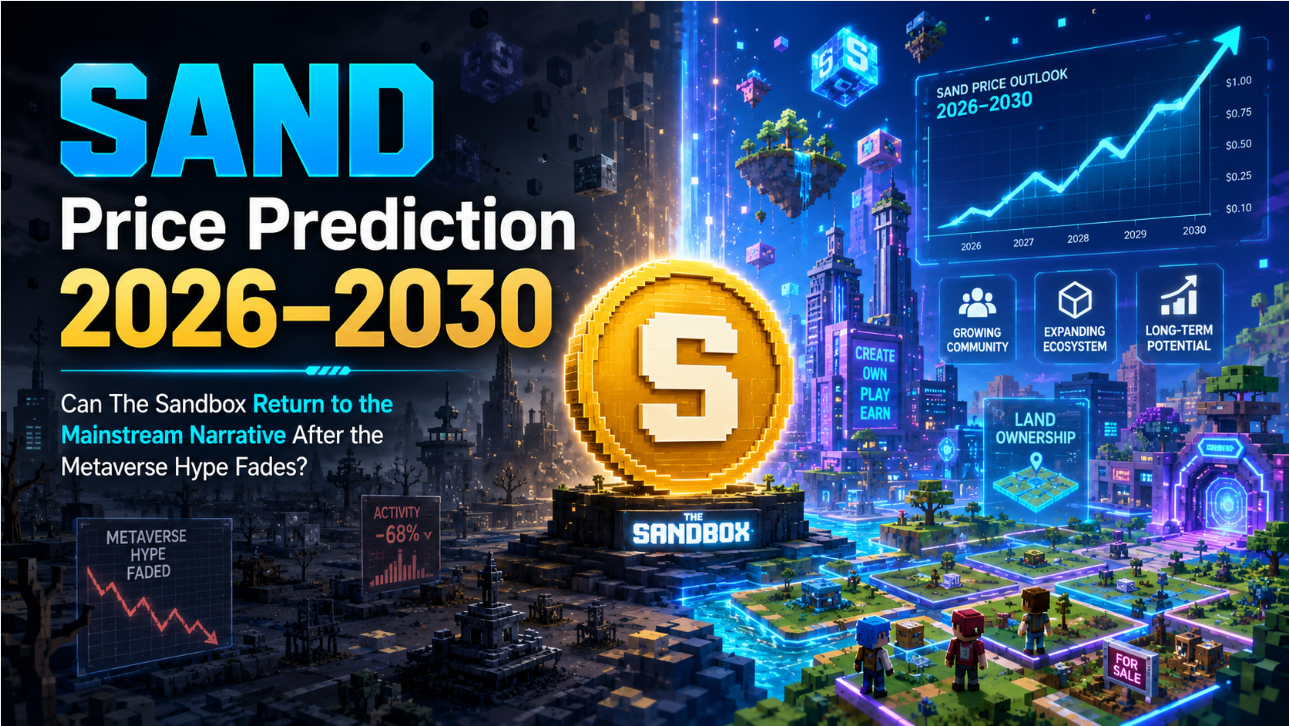
But the problem is: the story of 2021 is over. SAND once surged due to the metaverse narrative, but also fell sharply during the 2022–2025 bear market as the narrative faded. By 2026, when discussing SAND price predictions, the truly important question is no longer "will it rise again?" but rather:
Under what conditions can SAND realistically rise again? Does The Sandbox still have enough real users, content, brands, and economic activity to escape the fate of being a purely narrative-driven token?
This article will not simply give a number like "how many dollars by 2030." Instead, it will analyze the possible price paths of SAND from 2026 to 2030 from several angles: fundamentals, token supply and demand, metaverse narrative, macro cycles, regulatory environment, and investment strategies.
2. Understanding SAND's Price Drivers: What Really Makes It Go Up?
2.1 Where Does Demand for SAND Come From?
To judge whether SAND has long-term value, you can't just look at the candlesticks; you must first look at its sources of demand.
The main demand for SAND falls into four categories:
First, in-platform consumption demand. Users can use SAND to buy virtual land, game assets, NFT items, and related services. The Sandbox is essentially a creator platform. If there are enough players, creators, brand activities, and asset transactions on the platform, SAND will generate real usage demand.
Second, creator economy demand. The Sandbox emphasizes a model of "Play, Create, Own, Govern, Earn." Creators can earn income by making game experiences, selling NFT assets, and participating in ecosystem activities. SAND acts as a medium of exchange and incentive token.
Third, staking and governance demand. SAND holders can participate in staking and influence the direction of ecosystem development through governance mechanisms. Third-party summaries of SAND's uses also show its functions cover access, governance, staking rewards, and as a medium of exchange within the platform.
Fourth, investment and narrative demand. This has actually been the strongest price driver for SAND historically. The surge of SAND in 2021 was not because the ecosystem's cash flow was mature, but because the market believed "the metaverse will become the next-generation internet portal." When the narrative is stronger than fundamentals, prices price in the future prematurely.
But by 2026, the market is much more rational than in 2021. Relying solely on the word "metaverse" will hardly bring SAND back to its former highs. Whether SAND can rise in the future depends crucially on whether the platform can shift from a "conceptual metaverse" to a "virtual economy with real users, real content, and real consumption."
2.2 How Much Supply Pressure Does SAND Have?
The maximum supply of SAND is 3 billion tokens, and the current circulating supply is already close to the cap. Multiple data sources show that the total supply of SAND is 3,000,000,000, with a circulating supply of approximately 2.667 billion.
This has two implications for price prediction.
First, the early maximum unlocking pressure has gradually passed. Compared to 2021–2024, the marginal pressure from large unlocks in the future will be weaker. Historically, SAND did face pressure due to large unlocks; for example, in August 2024, there was an expectation that over 200 million SAND would be unlocked, which significantly affected market sentiment.
Second, high circulation does not automatically mean price increases. Easing supply pressure only reduces downward factors; it does not create upward momentum. Without new users and new capital inflows, a larger circulating supply actually means more capital is needed to push the price up.
Therefore, the core of SAND's future rise is no longer "end of unlocking" but "whether demand can grow again."
2.3 Is the Metaverse Narrative Still Alive?
Many people think the metaverse is dead. This judgment is not entirely correct.
To be precise, the metaverse narrative driven by PowerPoint presentations, virtual land, avatar NFTs, and grand visions has faded. But the deeper layers—virtual content, digital identity, game assets, AI characters, UGC creation, and AR/VR interaction—have not disappeared.
The Sandbox's challenge is to prove that it is not just a "metaverse concept coin left over from the last bull market," but an infrastructure capable of carrying the next wave of "AI + gaming + virtual assets + creator economy."
From public information, The Sandbox still emphasizes brand partnerships, user-generated content, and the virtual land ecosystem. Its official website still positions itself as a metaverse platform that can be explored, where users can own LAND, and participate in brand and community experiences.
However, the market will no longer pay unconditionally for "concepts." From 2026 to 2030, for SAND to regain valuation, it must answer three questions:
- Are users willing to continuously enter The Sandbox, rather than just participating briefly during events?
- Can creators actually make money on the platform, rather than relying solely on project subsidies?
- Can brand partnerships generate real consumption, rather than just news release hype?
2.4 Will Competitors Steal SAND's Share?
SAND is not the only metaverse asset. It has long faced competition from Decentraland, Otherside, the Yuga Labs ecosystem, Roblox-like Web2 platforms, and future AI-native virtual worlds.
Decentraland and The Sandbox are the two most typical representatives of on-chain metaverses. Both exploded in 2021 due to the metaverse narrative, and both subsequently experienced declining user engagement, falling asset prices, and difficulties in validating business models. Some industry commentators have also pointed out that The Sandbox underwent a relatively large restructuring and layoffs in 2025, indicating that even top metaverse projects face pressure to move from vision to execution.
This does not mean SAND has no opportunity. On the contrary, after a shakeout, projects that survive are more likely to attract attention from capital in the next cycle. But the prerequisite is that The Sandbox must prove it still has the capacity for continuous development.
If the MOVR price prediction 2026–2030 more reflects how infrastructure projects find new positioning amid ecosystem competition, then the problem SAND faces is more biased toward "content platform assets": technology is not the only key; user time, content supply, and community activity are the core determinants of valuation ceilings.
3. Four Major Macro Variables Affecting SAND's Trend in 2026–2030
3.1 How Does the Bitcoin Halving Cycle Transmit to SAND?
The altcoin market in crypto is usually inseparable from the Bitcoin cycle. After Bitcoin completed its halving in 2024, if the market enters a more mature bull market phase in 2025–2026, capital typically follows this path:
BTC rises → ETH and major L1s rise → large-cap altcoins rotate → narrative-driven assets catch up.
SAND is a typical narrative-driven altcoin. It is not a core asset like BTC or ETH, nor is it an exchange platform token, stablecoin, or RWA with stronger cash flow or compliance attributes. Therefore, SAND often does not start moving in the earliest stage of a bull market but is more likely to be revisited by capital as a "high-beta metaverse asset" after market risk appetite warms up.
This also means that SAND's upside elasticity can be strong, but its sustainability may not be stable. It is more suitable to be analyzed within a "cyclical trading asset" framework rather than simply treated as a long-term value coin.
3.2 Regulatory Environment: GameFi and Metaverse Assets Will Become More Standardized
After 2026, the impact of crypto regulation on assets like SAND will become more complex.
The EU's MiCA has established a unified regulatory framework for crypto assets, covering transparency, disclosure, authorization, and transaction supervision. In the US, by 2026 the SEC has also further clarified the boundaries regarding crypto assets, staking, airdrops, wrapped assets, and non-security crypto assets.
For SAND, regulation has two sides.
The downside: If the game platform involves return commitments, financialized NFTs, staking rewards, or secondary market speculation, regulatory requirements may become stricter, increasing project operating costs.
The upside: If regulatory boundaries become clearer, brands, institutions, payment service providers, and compliant trading platforms may become more willing to enter. For a platform like The Sandbox that emphasizes brand partnerships and virtual asset trading, regulatory clarity could be a long-term positive.
3.3 AI + Metaverse: Real Opportunity or Another Round of Packaging?
From 2026 to 2030, the biggest new variable for SAND may not be the "metaverse" but "AI."
AI can bring three changes to the metaverse:
First, AI can lower content production costs. Previously, creating a virtual scene, character, mission, or interactive experience required a lot of human labor. In the future, AI can help creators quickly generate maps, NPCs, storylines, assets, and mission systems.
Second, AI can improve the interactivity of virtual worlds. In the past, the biggest problem with many metaverse spaces was "not knowing what to do after entering." If AI agents, AI NPCs, and automated storylines mature, virtual spaces will feel more like real game worlds rather than empty exhibition halls.
Third, AI can help automate brand campaign operations. Brands can create activities, distribute missions, and analyze user behavior within The Sandbox, rather than just doing one-off marketing.
But investors must be wary: AI + metaverse could also be old wine in a new bottle. If The Sandbox only adds "AI" to its roadmap without actually improving user retention and spending, the help to SAND's price will be very limited.
3.4 Will Institutional Money Enter SAND?
After 2026, the ways institutions enter the crypto market will be more mature. But institutional capital will first favor BTC, ETH, stablecoin infrastructure, RWA, exchanges, custody, payments, and compliant DeFi. SAND, being a metaverse gaming asset, will typically not be the first choice for institutional asset allocation.
This means that for SAND to gain institutional attention, it must have at least one clear label:
- Leader in the metaverse sector;
- AI virtual world infrastructure;
- Web3 game creator economy platform;
- Brand virtual marketing portal;
- Virtual land and digital asset trading network.
If these labels cannot be translated into data growth, it will be hard for SAND to attract large capital in the long term. In contrast, assets like UMA, which are related to oracles and optimistic verification mechanisms, have investment logic more biased toward "financial infrastructure," and their analysis focuses more on protocol usage scenarios and on-chain demand. You can refer to the analytical framework for infrastructure-type tokens in the UMA price prediction 2026–2030.
4. SAND Price Prediction for 2026: The Post-Halving Window — Can It Catch Up?
2026 is a key observation year for SAND.
If the overall crypto market is still in a risk-expansion phase after the halving, SAND has a chance for a valuation recovery. But if market capital is more biased toward BTC, ETH, RWA, AI, and stablecoin infrastructure, the metaverse sector may remain sluggish.
Three Scenarios for SAND in 2026

The core judgment for 2026 is: SAND has a chance to rebound, but it is not advisable to assume it will return to its 2021 highs too early.
If driven only by the overall market, SAND is more likely to see a staged catch-up. If The Sandbox can demonstrate real user growth, a high-quality content ecosystem, and AI-native experiences, then SAND may move from a "rebound" to a "trend reversal."
5. SAND Price Prediction for 2027: End of the Bull Run or Second Growth?
2027 could be the year with the most divergent trends for SAND.
If a significant rise has already occurred in 2026, then investors need to be wary of the risk of the bull market ending in 2027. Historically, many altcoins see impressive gains in the mid-to-late stages of a bull market, but very few projects can truly survive the cycle.
Three Signals to Watch in 2027
First, whether The Sandbox's active users are growing. Not registered users, not event participants, but consistently active users, number of creators, content publishing frequency, and transaction activity.
Second, whether LAND asset prices are recovering. Virtual land was an important foundation of The Sandbox's valuation. If LAND lacks trading and usage value for a long time, the ecological value of SAND will also be questioned.
Third, whether brand partnerships move from marketing to consumption. Many metaverse partnerships in the past were more like PR events. What will truly matter in the future is whether users are willing to pay for experiences, assets, memberships, missions, games, and virtual goods.
SAND Prediction Range for 2027

If SAND rises to a higher range in 2027 but ecosystem data does not improve simultaneously, investors should prefer "partial profit-taking" rather than blindly believing in a long-term story.
6. SAND Price Prediction for 2028: Can It Survive the Deep Bear Market?
2028 could be the toughest year for SAND.
If we follow the traditional crypto cycle, around 2028 may enter a new bear market or cyclical adjustment. For a high-volatility narrative asset like SAND, its performance in a bear market is typically weaker than BTC and ETH.
6.1 The Biggest Risks for GameFi Tokens in a Bear Market
GameFi and metaverse tokens usually face three problems in a bear market:
First, rapid user loss. When token incentives decline, many users stop participating.
Second, liquidity dries up for NFT assets. When there aren't enough buyers for virtual land, equipment, avatars, and items, floor prices keep falling.
Third, project cash flow pressures. If revenue is insufficient, teams have to reduce operations, lay off staff, delay roadmaps, further eroding market confidence.
The Sandbox was reported to have undergone relatively large-scale layoffs and restructuring in 2025, indicating that the project has indeed experienced operational pressures. Such information is important for long-term investors because it reminds us: metaverse projects are not just about vision; they also depend on organizational efficiency, financial reserves, and execution capability.
6.2 Can LAND Act as a Floor for SAND?
In theory, The Sandbox's virtual land can provide ecological support for SAND. As long as LAND still has usage value for brands, creators, communities, and activities, SAND will not completely lose its application scenarios.
But in reality, LAND prices cannot simply be equated to a floor for SAND. The reasons are:
- LAND is an NFT asset with even worse liquidity than the token;
- Land prices are heavily influenced by market sentiment;
- If land has no sustained use value, price support will be very fragile;
- SAND is a circulating token, selling pressure and trading sentiment will be more direct.
So LAND can provide a narrative, but cannot support SAND's price on its own.
SAND Prediction Range for 2028

The focus for 2028 is not on how much SAND can rise, but on whether it can prove it is "still alive." If The Sandbox can still maintain content updates, partnerships, and an active community during the bear market, then it will be qualified to participate in the next cycle.
7. SAND Price Prediction for 2029–2030: Can Metaverse 2.0 Open the Ceiling Again?
By 2029–2030, SAND's long-term value will depend on a bigger question:
Will the metaverse return in a new form?
This time, it may no longer be called the "metaverse." It may manifest as:
- AI-driven virtual characters and worlds;
- Immersive social interaction after the popularization of AR/VR devices;
- Cross-platform circulation of in-game assets;
- Brand digital memberships and virtual goods;
- Creators using AI to generate interactive content at scale;
- Users owning digital identities and virtual assets.
If these trends occur, The Sandbox could still have the opportunity to be one of the representative projects in the Web3 virtual content space.
But if the future virtual world is controlled by large Web2 gaming platforms, AI-native platforms, or hardware ecosystems, and The Sandbox cannot keep up with interactive experiences and user demands, then SAND may only become a historical asset from the last metaverse bubble.
Long-term SAND Prediction Range for 2029–2030

It must be emphasized here: SAND above $2 is not impossible, but it would require very strong conditions.
At a minimum, all of the following must be met simultaneously:
- The crypto market enters a new major bull market;
- The metaverse or AI virtual world narrative becomes a main theme again;
- The Sandbox's user and creator data grow significantly;
- LAND and NFT asset trading revives;
- SAND has genuine consumption within the ecosystem, not just speculative trading;
- The regulatory environment does not impose major constraints on GameFi and NFT assets.
If these conditions are not met, a more realistic range for SAND in 2030 may still be between $0.20 and $0.60.
8. Practical Investment Strategies: What Should Different Risk Tastes Do?
8.1 The Three Most Common Mistakes Beginners Make
First mistake: Using the 2021 highs as a target price. Many people think: "SAND has reached that high before, so it can go back, right?" This logic is very dangerous. The past highs were the result of extreme liquidity, metaverse frenzy, and market froth, and do not mean they will necessarily repeat.
Second mistake: Equating The Sandbox with the entire metaverse sector. The metaverse may still develop in the future, but that does not mean SAND will be the biggest beneficiary. The existence of a sector does not equal the success of a particular token.
Third mistake: Only looking at the narrative, not the data. What really matters is active users, number of creators, LAND transactions, ecosystem revenue, quality of brand partnerships, on-chain transactions, and community heat — not the vision unilaterally announced by the project team.
8.2 Dollar-Cost Averaging (DCA) Strategy: Suitable for Those Who Believe in the Sector but Don't Want to Gamble on Short-Term
If you believe that AI + metaverse still has a future, but cannot determine SAND's short-term bottom, consider small-amount DCA.
A reasonable approach is:
- Only use a high-risk portion of your portfolio;
- Buy over 6–12 months;
- Fixed amount each time;
- Pause DCA during sharp rises;
- Stop adding when fundamentals break down.
For example, if your total crypto portfolio is 100%, for a high-volatility narrative asset like SAND, it is recommended not to exceed 3%–8%. For beginners, 1%–3% is already sufficient.
8.3 Position Management: SAND Is Not Suitable for Heavy Betting
SAND's advantage is its high elasticity, but its disadvantage is also its high elasticity.
It is suitable as a "high-risk thematic position" within a portfolio, not as a core position. A more robust portfolio should typically focus on BTC, ETH, stablecoin yields, mainstream platform assets, or projects with stronger cash flow logic, and then allocate a small portion to narrative assets like SAND.
Reference structure:
- Conservative: SAND 0%–2% of portfolio
- Balanced: SAND 2%–5% of portfolio
- Aggressive: SAND 5%–10% of portfolio
- Above 10%: only for those who know the metaverse sector very well and can withstand significant drawdowns
8.4 Take-Profit and Stop-Loss: Don't Rely Only on Feelings
Based on the prediction ranges above, you can set several observation anchors:
- If SAND falls below $0.05 and ecosystem data continues to worsen, reassess whether it is still worth holding.
- If SAND rebounds to 0.25–0.40 but there is no clear user growth, consider taking partial profits.
- If SAND breaks above $0.60, accompanied by genuine improvement in The Sandbox's data, continue to observe the trend.
- If SAND enters the $1+ range, driven mainly by market sentiment, prioritize taking profits in batches.
For an asset like SAND, taking profits is harder than buying. Because when it rises, it is often accompanied by a strong narrative, making it easy to believe "this time is different." But historical experience tells us that narrative-driven altcoins require the most discipline.
9. Conclusion: Is SAND Worth Holding Until 2030?
SAND is not a project that has been completely eliminated, but it is no longer the metaverse star coin that stood at the center of the风口 in 2021.
By 2026 and beyond, the investment logic for SAND has changed:
It is no longer appropriate to explain SAND's value by saying "the metaverse will definitely explode." Instead, it should be judged by whether a "virtual content platform can generate real economic activity."
Future upside for SAND requires three necessary conditions:
First, overall crypto market liquidity recovery. Without a bull market environment, SAND will have difficulty strengthening on its own. Second, The Sandbox completes product and user growth validation. It must generate real usage demand from brand partnerships, virtual land, and creator activities. Third, AI + metaverse reopens the narrative space. If AI lowers the barrier to content creation, The Sandbox may regain market attention.
The biggest risks are also clear: If The Sandbox lacks real users for a long time, LAND assets remain depressed, and brand partnerships stay at the marketing level, then SAND may continue to be regarded by the market as a concept coin from the previous cycle.
One-sentence conclusion: SAND is suitable for small-position, cyclical, narrative-driven allocation, but not as a core long-term heavy asset. Only when The Sandbox proves it can upgrade from a "metaverse concept platform" to a "virtual content economy platform for the AI era" will SAND truly have the value to hold until 2030.
The above content is only research analysis and scenario simulation and does not constitute any investment advice. Cryptocurrency assets are extremely volatile. Please make independent judgments based on your own risk tolerance before investing.